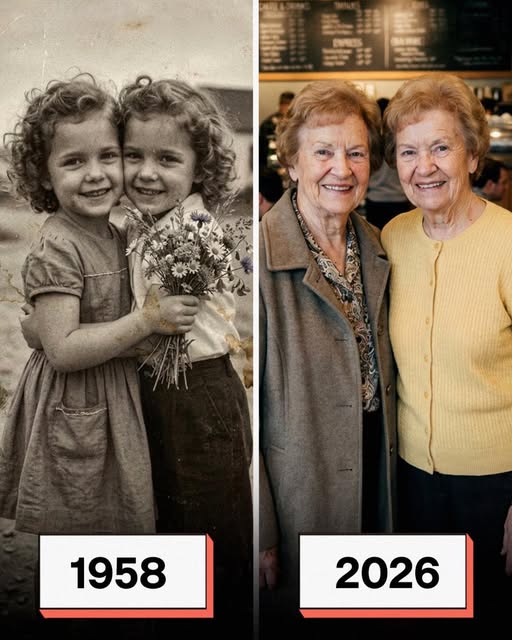
For nearly seventy years, Dorothy carried a hollow space in her chest, a void shaped like a little girl named Ella. At seventy-three, she had lived a full life—education, marriage, motherhood, the joy of grandchildren—but the “buzzing hole” of her childhood remained. It all began in the rain-slicked woods of a small Midwestern town when she was just five. Ella wasn’t simply Dorothy’s sister; she was her identical twin, a “share-a-brain” companion whose laughter and tears were indistinguishable from Dorothy’s own. One afternoon, while Dorothy lay shivering with a fever, Ella wandered into the trees behind their grandmother’s house with a red rubber ball—and never came back.
The search that followed was frantic. Flashlights bobbed through the downpour, men shouted into the dark, but all that was recovered was the ball. Then came silence—a heavy, suffocating quiet that settled over their home like a shroud. Weeks later, Dorothy’s parents told her that the police had found Ella’s body. She was dead. That was all Dorothy was allowed to know. No funeral, no small casket, no grave for a grieving sister to visit. Ella’s toys disappeared overnight, her name vanished from family conversations, and whenever Dorothy asked for details, her mother’s face shuttered, a warning of pain too volatile to confront.
Dorothy grew up under that shadow. At sixteen, she tried to storm the local police station for the case file, only to be turned away by a sympathetic officer who said some truths were “too painful to dig up.” By the time her parents passed away, the secret seemed buried with them, leaving Dorothy as the sole keeper of a mystery she couldn’t solve. She resigned herself to dying without ever knowing the truth about the twin who had been half her soul.
The universe, however, had a different plan, waiting until Dorothy was seventy-three to reveal itself. It began with a simple trip to visit her granddaughter at college. Seeking a quiet moment, Dorothy stepped into a local café, warm with the scent of roasted beans and the low hum of conversation. As she waited in line, a raspy, familiar rhythm caught her ear. A woman at the counter was ordering a latte. When she turned, Dorothy didn’t see a stranger—she saw herself.
The woman was the same height, the same posture, the same weary-but-kind expression. It was like looking into a mirror reflecting a life slightly different from her own. The woman, Margaret, introduced herself, equally stunned. They sat at a mismatched wooden table, hands trembling as they held their coffee cups. Margaret had been adopted from the same Midwestern region Dorothy had grown up in. Her birth family had been hidden behind a “locked door,” she said.
As they compared stories, a staggering realization struck. They weren’t twins—they were born five years apart—but the resemblance was uncanny. Nose, eyes, and brow crease matched perfectly. Dorothy realized her mother hadn’t just lost one daughter in the woods; she had been keeping secrets about another daughter she never even knew existed.
Back home, Dorothy dug through a dusty box of her parents’ papers. At the bottom, she found a manila folder: an adoption document for a female infant born five years before Dorothy and Ella. Tucked behind it was a note in her mother’s faded handwriting—a confession written in the ink of deep, generational shame.
The note revealed a heartbreaking truth: Dorothy’s mother had been young and unmarried when she had her first child. Her parents, terrified of social stigma, forced her to give the baby away. She married, had Dorothy and Ella, and lived in perpetual fear that the past would resurface.
DNA tests later confirmed the truth: Dorothy and Margaret were full biological sisters. The “death” of Ella in the woods, the lack of a body, and absence of a grave suggested a darker possibility—that the story had been fabricated to conceal the earlier secret. Or perhaps, in grief and fear, the loss of Ella was perceived as punishment for the first child’s surrender.
The reunion between Dorothy and Margaret wasn’t cinematic joy. It was an acknowledgment of three lives broken by silence and forced forgetting. They realized their mother had lived with unimaginable fractures: one daughter given away, one lost to the woods, and one kept but shrouded in silence.
Today, Dorothy and Margaret are reclaiming lost years. They speak every day, send photos, and point out shared traits and small similarities that prove their bond. The buzzing hole in Dorothy’s chest has finally stopped. She understands now that her mother’s silence wasn’t lack of love, but a broken attempt to survive tragedies too heavy for one person to bear.
The mystery of Ella’s fate may never be fully solved, but Dorothy is no longer alone in the dark. She has found a sister she didn’t know she had, and in doing so, opened the locked room of her life. The face in the mirror is no longer a reminder of what was lost; it is proof that the truth, however deeply buried, always finds its way to the light.