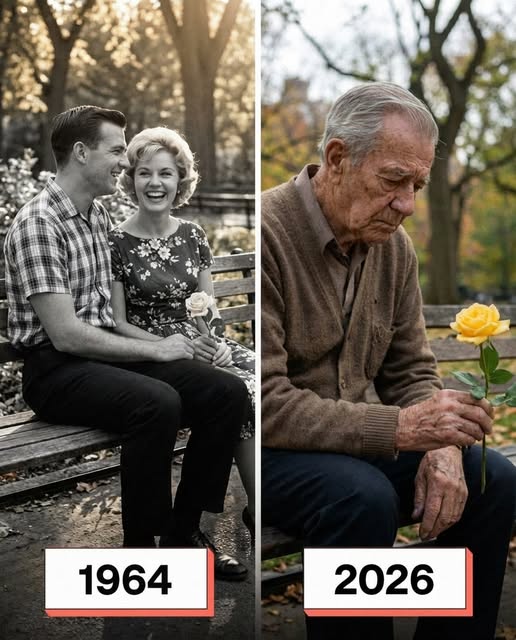
For more than sixty years, my wife and I shared a quiet, unchanging tradition. Every Sunday, at the same hour, we would sit together on a worn wooden bench beneath a willow tree. It wasn’t anything extraordinary to an outsider, just a simple routine in a quiet corner of the park—but to us, it was everything. That bench witnessed the rhythm of our lives. It was where we talked through life’s biggest decisions, celebrated small victories, and found comfort during difficult times. It held decades of memories, layered one over another, until it felt almost sacred.
After she passed away, I made a promise to myself that I would never return there alone. The thought of sitting on that bench without her felt unbearable, like reopening something I wasn’t ready to face. So I stayed away, holding onto the memory of it as it had always been—shared, warm, complete.
But on what would have been her birthday, something shifted inside me. It wasn’t a loud realization or a sudden decision, but a quiet pull I couldn’t ignore. Before I knew it, I found myself walking the familiar path toward the park, each step carrying both hesitation and something else I couldn’t quite name. I expected silence when I arrived—perhaps a wave of memories, maybe even regret.
Instead, I found someone sitting on that bench.
And in that instant, my heart stopped.
My name is James. I’m 84 years old, and until that day, I truly believed I understood the life my wife Eleanor and I had built together. We had shared so much, endured so much, and loved each other through every season. I thought there were no secrets left between us, nothing hidden in the spaces of our long years together.
The park itself looked unchanged, almost frozen in time. The same trees, the same pathways, the same gentle stillness. But the moment I saw the young woman sitting there, I knew something was different. There was something about her—something strikingly familiar, though I couldn’t immediately place it. It wasn’t just her face, but the way she carried herself, the quiet calm in her presence.
She looked up at me, as if she had been expecting me.
When she introduced herself, her voice was steady, almost gentle, and then she handed me an old envelope. My breath caught the moment I recognized the handwriting. It was Eleanor’s—unmistakable, delicate, and carefully formed, just as it had always been.
My hands began to tremble as I held it.
The date written on the envelope stopped me even more. It wasn’t recent. It had been written decades ago—long before I could have imagined there was anything left unsaid between us.
I opened it slowly, almost afraid of what I might find.
As I read, I felt the ground beneath me shift. The letter revealed a chapter of my wife’s life I had never known existed. It spoke of a decision she had made when she was very young, a choice that had shaped her in ways she had never fully shared with me. It wasn’t written with regret, but with a quiet honesty—like something she had carried for years, waiting for the right moment to be understood.
The young woman beside me gently began to explain the rest. Her words filled in the spaces between the lines, connecting pieces of a story that had been unfolding long before I ever entered Eleanor’s life. Their lives had been linked in a quiet, distant way—woven together by choices made in another time, under circumstances I could only begin to imagine.
It wasn’t easy to take in.
For a moment, I didn’t know what to feel. Surprise, confusion, disbelief—they all moved through me at once. But as I looked at her more closely, something shifted. I began to see it clearly—small pieces of Eleanor reflected in her expressions, in the softness of her eyes, in the way she spoke. It was both unfamiliar and deeply meaningful at the same time, like recognizing something you didn’t know you had been missing.
In the days that followed, I found myself revisiting memories I had long taken for granted. Small details began to stand out—moments, pauses, things Eleanor had said or left unsaid. It was as though I was seeing our life together from a new perspective, one that added depth rather than taking anything away.
And slowly, I began to understand something important.
Love doesn’t always mean knowing everything about someone. It doesn’t mean having every answer or uncovering every hidden piece of their past. Sometimes, love means accepting what you learn—even when it comes late, even when it changes the story you thought you knew.
When I returned to that bench again, it no longer felt like a place tied only to the past. It felt different—expanded, somehow. I wasn’t sitting there alone, and I wasn’t just holding onto memories. Something new had begun to take shape, something that connected the past with the present in a way I hadn’t expected.
And in that quiet space, beneath the same willow tree, I realized something that brought me an unexpected sense of peace.
Somehow, without ever saying it directly, my wife had guided me back there one more time—not to say goodbye, but to help me understand a part of her she had carried all along.