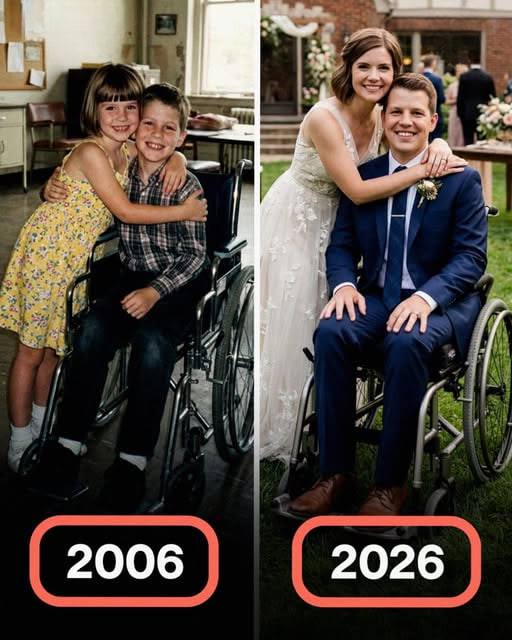
I married the boy I grew up with in an orphanage, and the morning after our wedding, a stranger appeared at our door with news I never expected about my husband.
I’m Claire, 28, and I grew up in the foster system.
By the time I was eight, I’d been through more foster homes than birthdays. Each move was like losing a little piece of myself—another room, another bed, another set of rules, another goodbye. I had one rule: never get attached.
People like to say kids in care are “resilient,” but the truth is we just learn to pack quickly, move on, and stop asking questions. We learn to survive, but surviving doesn’t always leave room for hope.
By the time I landed in the last orphanage, I had perfected that rule. I watched, I observed, I adapted—and then I met Noah.
He was nine, thin, a little too serious for his age, with dark hair that stubbornly stuck up in the back and a wheelchair that made everyone else unsure how to act. He carried himself with quiet dignity, but the other kids didn’t know what to do with that.
One day, I caught him sitting alone by the window, watching the street. The other kids had run off to play, and the staff treated him like a chore chart instead of a person. I lowered myself to sit near him, book in hand, and said, “If you’re going to guard the window, you have to share the view.”
He glanced at me, raising an eyebrow. “You’re new.”
“More like returned,” I said softly. “Claire.”
He nodded once. “Noah.”
From that moment, we were inseparable.
Growing up together, we witnessed every version of each other. Every heartbreak, every victory, every scraped knee and stolen cookie.
“I get your hoodie,” I’d say when someone was leaving for adoption.
“If you get adopted, I get your headphones,” he’d reply, eyes twinkling with mischief.
We clung to each other because nobody else did. We joked about it, but deep down, we knew the truth: we were all each other had.
At 18, they handed us papers, a bus pass, and a quiet, “Good luck out there.” There were no celebrations, no cheering, just the crushing weight of adulthood landing squarely on our shoulders.
Noah spun his wheel lazily on the sidewalk. “Well, at least nobody can tell us where to go anymore.”
“Unless it’s jail,” I said, laughing despite the knot in my stomach.
We enrolled in community college and found a tiny apartment above a laundromat. It smelled like soap and burnt lint. The stairs were steep and creaky, the floorboards groaned, but the rent was cheap, and the landlord didn’t ask questions. That was all that mattered.
We furnished it with whatever we could scavenge—three plates, one decent pan, a couch that tried to stab you with its springs—but it was ours. Every piece carried a story: scraped together, imperfect, but undeniably ours.
Somewhere in that everyday grind, our friendship shifted. There was no dramatic first kiss. No confessions under starlight. Just small things: I felt calmer when I heard his wheels in the hallway, he started texting, “Message me when you get there,” when I walked home after dark. Movies became excuses to fall asleep on each other’s shoulders.
One night, exhausted from studying, I whispered, “We’re kind of already together, aren’t we?”
He didn’t look up. “Oh, good. Thought that was just me.”
We said boyfriend and girlfriend, but what mattered had already been there for years.
We finished our degrees one grueling semester at a time. When our diplomas arrived, we propped them on the kitchen counter like fragile trophies.
“Two orphans with paperwork,” Noah said, smiling.
A year later, he proposed quietly in our tiny kitchen while I was cooking pasta. I laughed, cried, and said yes before he could take it back.
Our wedding was small, cheap, and perfect. Friends from college, two caring staff members from the orphanage, fold-out chairs, a Bluetooth speaker, and too many cupcakes. We didn’t need extravagance—we already had everything that mattered: each other.
Then, the morning after, a knock came at the door.
I opened it to a man in a dark coat, maybe in his 40s or 50s, calm eyes, neat hair. He looked like he belonged behind a desk, not at our chipped doorway.
“I’ve been trying to find your husband for a long time,” he said.
Something in me tensed. “Why?”
“There’s something you don’t know about your husband. You need to read this letter,” he said, handing me a thick envelope.
Noah, still groggy, peeked from his bed. “Claire?”
The man introduced himself as Thomas, an attorney. He explained he represented a man named Harold Peters. Years ago, Noah had helped Harold outside a store. Most people ignored him; Noah stopped, helped him up, waited until he was steady, and walked away without fanfare.
Harold never married, never had children, and had no close family. Before he died, he wanted to leave his house, savings, and belongings to someone who knew what it was like to be overlooked—and he chose Noah.
Noah was listed as the sole beneficiary.
For weeks, we sat quietly. Our lives had always been about what we didn’t have. Now, there was this: a house, a safety net, a gift born of someone noticing him when no one else did.
We visited the house a few weeks later. It smelled like dust and coffee, with a ramp at the entrance, photos on the walls, books on the shelves—a real home. Noah turned slowly in the living room, taking in every corner, every detail.
“I don’t know how to live in a place that can’t just… disappear on me,” he admitted, voice soft.
I put my hand on his shoulder. “We’ll learn. We’ve survived worse.”
For the first time, someone had truly seen him—and rewarded it.
That house wasn’t just a building. It was validation. It was recognition. It was the proof that good deeds, even those done quietly, could ripple forward decades later.
And in that moment, I realized something profound: the life we had fought for, clawed for, and carried each other through—was only beginning to bloom.
Noah’s past had finally met our present, and it was beautiful.
If this happened to you, what would you do? How would you honor someone who saw your worth when no one else did? Share your thoughts in the comments.