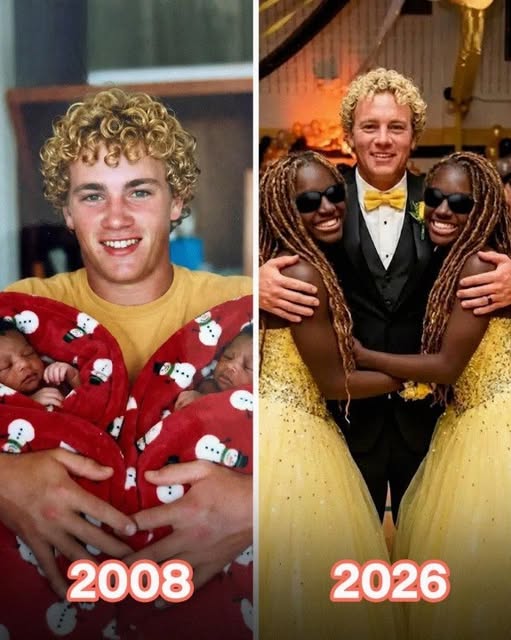
Eighteen years ago, my life split in two because of a single note left on the kitchen counter.
That morning, I woke up to a silence so loud it hurt my ears. The bed beside me was cold. The apartment, once filled with whispered hopes and newborn cries, felt empty. My wife, Lauren, was gone. In her place were our twin daughters, Emma and Clara, and a piece of paper with words I would never forget:
“I can’t do this. I have dreams. I’m sorry.”
The girls had been born blind just days earlier. The doctors delivered the news gently, as if soft words could soften the truth. I accepted it immediately. Lauren did not. To her, their blindness was not a challenge—it was a prison she refused to serve.
At twenty-four, I became a single father to two babies who would never see my face.
The early years were brutal. Sleep came in fragments. Fear crept in during quiet hours. I wasn’t just learning to be a parent—I was learning to translate the world for them. I narrated sunsets they would never see, described my smile so they could imagine it, memorized Braille late into the night, and organized our small apartment so that every step, every sound, became familiar and safe.
I worked multiple jobs. I set aside my own dreams. Survival was necessary, but my goal was bigger: I wanted my daughters to thrive.
When they were five, something unexpected changed everything.
I introduced them to sewing—not as a career, but as a way to strengthen their hands and build confidence. Yet fabric became their language. Emma could identify materials by touch alone, instantly distinguishing silk from satin, linen from wool. Clara could sense structure—mapping dresses in her mind, calculating symmetry and balance with astonishing precision.
Our living room became a workshop. Thread covered the tables. Sewing machines hummed late into the night. We built a life from scraps and determination. Blindness didn’t define them—it sharpened them.
They grew into confident, fiercely independent young women. They never asked about their mother. I never poisoned them with bitterness. I let her absence speak for itself. We were happy. Tired, yes—but whole.
Then, last Thursday, the doorbell rang.
Emma and Clara were debating a hemline when I opened the door—and came face-to-face with the past.
Lauren stood there in a designer suit that probably cost more than our rent. Perfect hair. Expensive perfume. Sunglasses shielding her eyes despite the overcast sky. She didn’t ask to come in; she pushed past me as if she still owned the place.
She looked around our home with open contempt.
“You’re still the same,” she sneered. “Living like this? You were supposed to be somebody.”
Before I could respond, Clara asked, “Dad? Who is it?”
I swallowed hard. “It’s your mother.”
The silence that followed was suffocating.
Lauren’s tone suddenly turned sweet and rehearsed: “Girls! You’re all grown up now.”
Emma didn’t turn. “We can’t see you,” she said calmly. “We’re blind. Isn’t that why you left?”
Lauren faltered, but only briefly. She placed two designer garment bags on the couch and dropped a thick envelope of cash onto the table.
“I’m here to give you the life you deserve,” she said. “Money. Connections. A real future.”
“Why now?” I asked.
Her smile was sharp and calculated.
“Because I want my daughters back. And I have one condition.”
She set a legal document next to the money.
“You choose me,” she said. “Publicly admit your father failed you. That he kept you poor while I built success. Sign this—and everything changes.”
My heart nearly stopped.
Emma reached out and touched the envelope. I could barely breathe.
Then she spoke.
“This is a lot of money,” she said thoughtfully, “but we never needed it. We had a father who stayed. Who believed in us. Who taught us we weren’t broken.”
Clara stood beside her.
“We don’t want your money. Or your gowns. Or you.”
Emma tore open the envelope and tossed the cash into the air. Bills rained onto Lauren’s shoes like meaningless confetti.
“We are not for sale,” Emma said. “And we are not your redemption story.”
Lauren exploded, accusing me of brainwashing them, of trapping them in a small life.
I met her eyes calmly.
“You’re only here because your career is failing,” I said. “You wanted a comeback story. Blind daughters make good headlines.”
She had no response.
She gathered her money and stormed out in silence.
What she didn’t know was that Emma’s friend had been recording everything via a video call. The clip went viral within hours under one caption:
“This Is What Real Love Looks Like.”
Lauren’s image collapsed overnight. Sponsors vanished. Projects disappeared.
But for my daughters, something beautiful happened.
A prestigious costume design house saw the video—not for the drama, but for the craftsmanship. They wanted talent, not pity.
Yesterday, I stood on a professional film set watching my daughters work. Emma adjusted an actress’s costume. Clara pinned a complex hemline. They were respected. Valued.
The director turned to me and said, “Your daughters are extraordinary.”
I smiled through tears.
“No,” I said. “I’m the lucky one.”
Lauren chased fame and found emptiness.
We chose each other—and found everything.