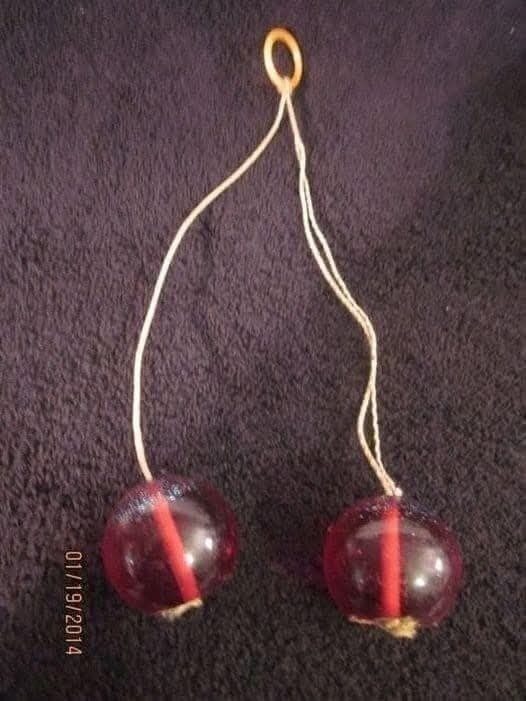
At first glance, the object looks unusual—almost a little unsettling. Two smooth, glossy spheres in a deep red color hang from a thin string, connected by a small loop at the top. There’s no packaging, no label, no instructions—nothing that immediately explains what it is or how it’s meant to be used. When images of it began circulating online, confusion spread quickly. People offered all kinds of guesses, some creative, some completely off track—everything from medical equipment to fishing tools to something far more questionable.
But the truth was never really hidden.
It had simply been forgotten over time.
For many adults—especially those who grew up in the late 1960s and early 1970s—the reaction wasn’t confusion at all. It was instant recognition. Not because they remembered the name right away, but because they remembered the experience. Before the word came back to them, there was a sound echoing in their minds:
Clack. Clack. Clack.
They were Clackers.
The reason so many people today struggled to identify them isn’t because they were rare or obscure. In fact, they were once incredibly popular. But they belonged to a very specific moment in time—a short but intense craze that took over playgrounds, sidewalks, and living rooms before disappearing almost entirely from everyday life.
Clackers weren’t subtle toys. They demanded attention. They were loud, physical, and a little unpredictable. And for a brief period, they were everywhere.
To really understand why they caused so much confusion decades later, you have to understand the world they came from.
The late 1960s and early 1970s were defined by a different kind of play. Toys were simple, hands-on, and often came with a certain level of risk that wouldn’t be acceptable today. There were no screens to guide you, no apps to explain the rules, no tutorials to show you how to get started. You learned by doing. You experimented. And sometimes, you got it wrong before you got it right.
Clackers fit perfectly into that environment.
Their design was almost unbelievably simple: two hard plastic balls attached to each end of a string, with a small loop in the middle that fit around your finger. That was the entire toy. No batteries. No assembly. No instructions needed—at least not officially.
But using them successfully was another matter entirely.
To make them work, you had to swing your hand up and down in a controlled rhythm so the balls would strike each other above and below your hand in a continuous motion. When you got it just right, the balls would collide rapidly, producing that unmistakable clacking sound—faster and louder the more skilled you became.
For beginners, it was anything but easy. The balls would miss each other, tangle, or slam into your knuckles. Many kids gave up quickly, but others kept trying. And that challenge became part of the appeal. It wasn’t just a toy—it was something you had to master. Kids competed with each other, trying to go longer without stopping, make the loudest rhythm, or perform tricks that required precision and control.
The toy first appeared around 1969, during a wave of novelty toys built around movement and simplicity. Companies like Wham-O, already famous for products like the Hula Hoop and Frisbee, helped fuel the popularity of toys that relied more on physical interaction than imagination alone. Clackers quickly joined that trend and became a full-blown phenomenon.
They were affordable, easy to carry, and could be used almost anywhere. Schoolyards filled with the sharp clacking noise as kids practiced and competed. Sidewalks echoed with the sound. Even inside homes, despite the complaints of parents, the noise carried from room to room.
But their simplicity came with hidden problems.
Early versions were made from acrylic plastic, which wasn’t always strong enough to handle the repeated high-speed impacts. Over time, the material could weaken. Small cracks would form, often unnoticed. And in some cases, the balls would shatter while being used, sending sharp fragments outward.
Injuries began to happen—cuts, bruises, and more serious accidents in rare cases. Concerns grew. Schools started banning them. Some stores removed them from shelves. News reports and parent complaints added pressure.
Manufacturers responded by redesigning them with stronger, safer materials. But by that point, the damage to their reputation had already been done.
Like many trends, Clackers burned brightly—and then faded quickly.
Part of their decline came from simple overexposure. They had become so common, so constant, that the excitement wore off. Kids moved on to the next new thing. Attention shifted, as it always does. And gradually, the sound that once filled playgrounds disappeared.
What remained wasn’t the object itself, but the memory of it.
That’s why, decades later, the internet struggled to identify something that had once been so widespread. Younger generations had never seen them before. Without context, the object looks incomplete—like a tool missing its purpose or a toy without instructions.
But for those who remember, there’s no confusion at all.
Clackers represent more than just a toy. They reflect a time when play was physical, shared, and sometimes a little risky. A time when learning came from repetition, patience, and persistence. When toys didn’t guide you—you figured them out yourself.
The confusion online wasn’t really about the object. It was about the distance between generations.
Clackers belong to a different kind of childhood—one that still exists in pieces, but no longer defines how most people grow up.
And for those who once held that small loop between their fingers, trying to find the perfect rhythm, the image isn’t strange or mysterious.
It’s familiar.
It’s a sound.
It’s a feeling.
And it’s a memory that still echoes—faint, but impossible to forget.