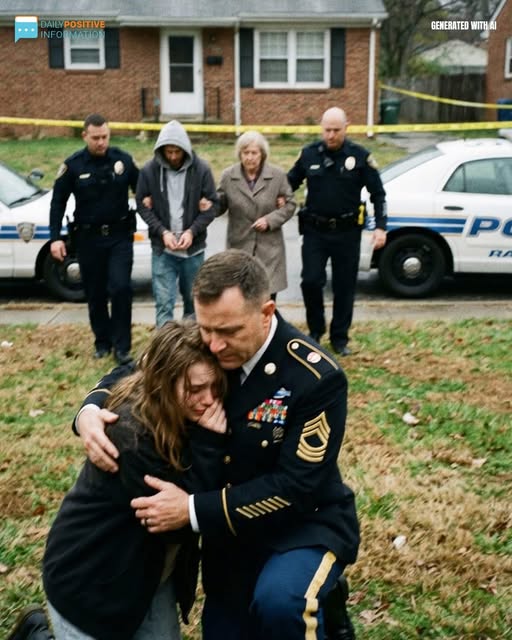
The early morning sun spread across the small town of Briar Glen like warm honey, pouring over rooftops, stretching across narrow streets, and settling gently on weathered wooden fences and dented mailboxes. Everything seemed softer in that light, almost peaceful in a way that made the world feel slower, kinder. At the very edge of town, where the gravel road thinned out and most cars rarely bothered to turn, stood a modest white house—simple, quiet, easy to overlook. Behind it, in a carefully tended garden, a man in his late sixties knelt among rows of lavender and roses, his calloused hands working slowly through the dark, rich soil.
Harold Bennett moved with a deliberate rhythm, the kind that comes from years of discipline and patience. His fingers gently loosened the roots of lavender bushes that had been growing there for nearly a decade, as if he were handling something fragile, something worth protecting. The scent around him was layered and comforting—fresh herbs, damp earth, and the faint sweetness of climbing roses. It wrapped around him like a familiar memory, something steady and grounding. This garden wasn’t just a hobby. It was something he had built piece by piece, something that had helped him rebuild himself.
To anyone passing by, Harold looked like exactly what he appeared to be: a quiet widower, living alone, spending his days tending to plants. He wore faded flannel shirts no matter the season, always long-sleeved even when the summer heat pressed down heavily. A thermos of black coffee sat faithfully beside a worn stone bench near his roses, always within reach, always refilled. When neighbors drove past or walked their dogs, they waved politely. Harold would glance up, nod once, and offer a small smile—polite, distant, never quite reaching his eyes.
People assumed things about him. That he was harmless. That he was lonely. That he had lived a simple life and found comfort in quiet routines. In many ways, that’s what they saw—and what they chose to believe.
But what they didn’t see, what they couldn’t possibly know, was the weight hidden beneath that stillness.
The slight stiffness in Harold’s left leg wasn’t just age catching up to him. It came from an IED explosion in a desert far from Briar Glen—an explosion that had changed everything in a matter of seconds. Two young soldiers under his command had died that day. Harold had survived, but not unchanged. Shrapnel had lodged dangerously close to his spine, something doctors told him would remain there for the rest of his life. A constant reminder of a world he had tried very hard to leave behind.
Those quiet, observant eyes—so calm now as they scanned rows of herbs—had once been trained to detect movement in complete darkness, to read danger before it revealed itself. His hands, steady as they trimmed thorns from rose stems with near-surgical precision, had once guided frightened young soldiers through chaos—through firefights, ambushes, and moments where hesitation meant death. He had treated wounds under impossible conditions, made decisions no one should ever have to make, and carried the consequences of those decisions long after the missions were over.
For nearly thirty years, Harold Bennett had served as an instructor for elite military units—the kind that didn’t exist in public conversations, whose missions were buried under layers of classification. He trained people to survive the worst conditions imaginable, to function where most would break. Yet when he retired, he didn’t bring that life with him. No medals hung on his walls. No stories were shared over coffee. That chapter of his life remained locked away, known only to him.
When his wife, Margaret, passed away after a long and painful battle with cancer, something in him shifted. Losing her didn’t just leave a space in his life—it changed the direction of it entirely. After watching her fade, piece by piece over eighteen months, Harold made a decision that was both simple and profound.
He chose peace.
He chose silence.
He chose to leave everything behind that reminded him of violence, loss, and the weight he had carried for so long.
That choice brought him to Briar Glen, to this small white house where no one knew his past and no one asked questions he didn’t want to answer. He built his garden the way he once planned missions—with precision, patience, and intention. Raised beds, irrigation systems, carefully selected plants—every detail mattered. But here, the outcome wasn’t survival. It was growth.
For four years, that life held together.
For four years, Harold became the man people believed him to be—a quiet, peaceful figure who spent his days among flowers and soil, asking nothing from the world and giving little reason to be noticed.
And then, on a cool morning in late September, everything changed.
It started with something small.
A single vibration in his pocket.
Harold paused, his hands still buried in the soil. The sound was subtle, but it cut through the quiet like something sharp. Slowly, he pulled off his gloves, brushing dirt from his fingers before reaching for his phone. The sunlight made the screen hard to read at first, but then he saw the name.
Emily.
His daughter. His only child. The one person who mattered above everything else.
He answered on the second ring.
“Hello.”
What came through the phone wasn’t a conversation.
It was a voice—faint, breathless, shaking.
“Dad… please…”
And then—nothing.
No goodbye. No explanation. Just silence. The kind of silence that doesn’t feel natural. The kind that feels like something has been taken.
Harold didn’t move.
For a few seconds, maybe five or six, he stood completely still in the middle of his garden. The breeze continued to pass through the lavender, releasing its calming scent into the air. Somewhere above him, a bird called out from the branches of the oak tree. The world continued exactly as it had moments before.
But for Harold, everything had changed.
The calm, quiet man in the garden was gone.
In his place, something older—something sharper—began to surface.
Emily lived about thirty minutes away, in a place that couldn’t have been more different from Briar Glen. Lakeview Crest was a gated community built on wealth and exclusivity. Every lawn was perfect, maintained by professionals. Security cameras watched every corner. Guards made regular rounds. It was the kind of place designed to feel safe—untouchable.
Six months earlier, Emily had married Curtis Hale in a wedding so elaborate it felt like something out of another world. The cost alone was more than Harold’s house had been worth. Curtis came from old money—generations of wealth that had shaped not just his lifestyle, but his beliefs. His family owned property across the state, had influence in places most people never saw, and carried themselves with the quiet certainty that rules didn’t apply to them the way they applied to everyone else.
Harold had attended the wedding. He had smiled when expected, shaken hands, said the right things. But deep down, he had felt something he couldn’t quite ignore. Not fear exactly—but unease. A quiet instinct, the kind that had kept him alive for years, telling him that something wasn’t right.
He had pushed that feeling aside for Emily’s sake.
But now, standing in his garden with her voice echoing in his mind, that instinct returned stronger than ever.
This time, he didn’t ignore it.