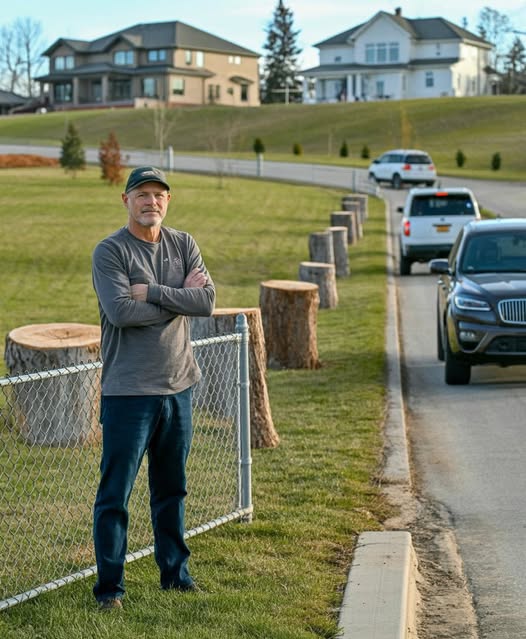
The first tree fell before he even knew what was happening. There was no warning, no call, no knock on the door—just the distant echo of machinery and the quiet, irreversible change that had already begun. By the time he made it home that evening, the damage was done. Forty years of his family’s history—trees planted by his father, shaded afternoons from his childhood, the living boundary of memory and land—had been reduced to six clean-cut stumps. Where there had once been a wall of green, now stood a row of polished, million-dollar houses, their wide glass windows staring directly into his yard as if they had always belonged there.
The homeowners association called it a “view corridor,” a term that sounded neat and harmless, like something decided over coffee and paperwork. To them, it was an improvement—an upgrade that increased property value and aesthetic appeal. To him, it felt like something taken, something erased without permission. He didn’t argue with them that night. He didn’t knock on their doors or raise his voice. Instead, he called his lawyer. And by the next morning, before most of the new homeowners had even finished their breakfast, he had already taken action.
A heavy chain stretched across Pine Hollow Road—the only road leading to their front doors. It wasn’t symbolic or temporary. The chain was solid, anchored into place with intent, and secured with a thick padlock that made it clear this was no bluff. The road, as it turned out, ran across land his grandfather had owned, and decades earlier, a carefully negotiated easement had been put in place. It was a small detail, long forgotten by most, but now it mattered more than anything. That document, yellowed with age, proved sharper and more effective than any chainsaw they had used the day before.
At first, the residents of Cedar Ridge didn’t believe him. People rarely do when someone finally decides to use the leverage they’ve been quietly holding. They assumed it was a misunderstanding, or a temporary protest that would be resolved with a quick conversation. But the chain remained. The padlock didn’t come off. And as hours turned into days, the inconvenience became real. Deliveries had to take the long, uneven gravel route around the back. Commuters found their daily drives extended by forty extra minutes, each one filled with growing frustration. Group chats lit up with complaints, emails were sent, conference calls were held—but none of it moved the chain.
Meanwhile, he waited. Not out of spite, but with a steady patience that came from knowing he was right. The land had always been his family’s. The trees had never been theirs to remove. What had been done couldn’t be undone, but it could be answered.
In the end, it wasn’t anger or confrontation that settled things—it was paper. Old agreements, county records, and a professional survey laid everything out with quiet precision. The boundary lines were clear. The trees had stood firmly on his property. There was no ambiguity left to argue. Trespass. Timber theft. Damages. Replacement. The words carried weight, and this time, everyone understood.
So in late November, under a sky the color of steel, the trucks arrived. One by one, twelve young sycamores were delivered on flatbeds, their bare branches reaching upward like promises. A crane lifted each tree carefully into place, lowering them into the same earth that had once held the originals. Workers packed the soil around their roots, firm and deliberate, restoring what had been taken—not exactly as it was, but as close as it could be.
He stood there as it happened, watching each tree settle into the ground. And only when the first one was planted, when it touched the soil and stood on its own, did he walk back to the road. Without ceremony, he unlocked the chain and pulled it aside.
Life at Cedar Ridge returned to normal, at least on the surface. The road was open again, the commutes shortened, and the complaints faded into memory. The houses still had their view of the sunset stretching across the ridge. But now, that view came with something new. The young sycamores, planted in a careful line, would grow year by year, their branches thickening, their leaves spreading wider with each season.
In time, they would rise tall enough to reshape the horizon once more. Not to block it entirely, but to frame it—to remind everyone who looked out from those windows that the land below was not empty space waiting to be claimed. It had a history, a boundary, and a cost. And from now on, every sunset they admired would be seen through branches that stood as a quiet, living testament to what happens when people assume that everything in their line of sight exists for their pleasure.