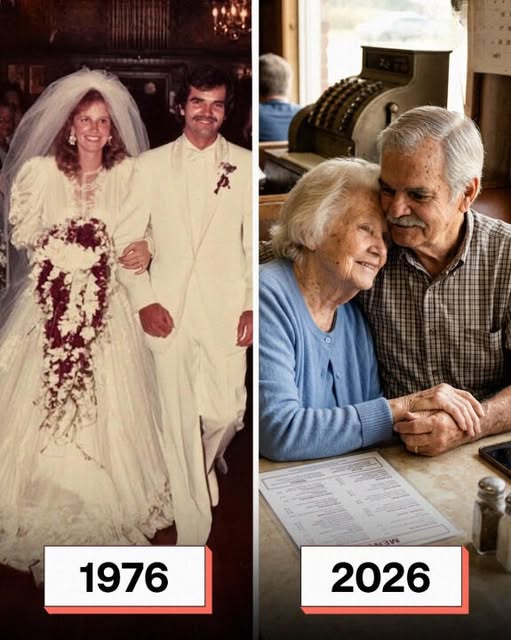
Every year on her birthday, Helen returns to the same diner booth where her story truly began. It’s a quiet ritual she has honored for nearly fifty years—a promise made not with words, but with love and memory. But this year, something changes. When a stranger sits in her husband’s place, holding an envelope with her name on it, everything she thought had ended begins again—softly, unexpectedly, and in the most intimate way.
When I was younger, I used to laugh at people who said birthdays made them sad.
It always sounded exaggerated to me, like one of those dramatic things people say just to fill silence. Back then, birthdays meant celebration—laughter, candles, and chocolate cake. And to me, chocolate cake meant everything was still right with the world.
But time has a way of changing what things mean.
Now, I understand.
These days, birthdays feel heavier. It’s not just about getting older or counting candles. It’s about everything that comes with the years—the memories, the absences, the quiet spaces left behind by people who once filled your life so completely you couldn’t imagine a day without them.
Today is my 85th birthday.
And just like every year since my husband Peter passed away, I wake up early and prepare myself carefully, almost ceremoniously.
I brush my thinning hair into a soft twist, taking my time as if the act itself matters. I apply my wine-colored lipstick—the same shade I’ve worn for years—and button my coat all the way to my chin. It’s always the same coat. Always the same routine.
I’m not someone who lives in the past.
But this… this is different.
This is ritual. This is remembrance. This is the thread that still connects me to him.
The walk to Marigold’s Diner takes me about fifteen minutes now. It used to take seven. My steps are slower, my knees less forgiving, but I never miss it.
The path is familiar—three turns, past the pharmacy, then the small bookstore that smells faintly of old paper and cleaning solution. I’ve walked it so many times I could do it with my eyes closed.
And I always go at noon.
Because that’s when we met.
I still whisper to myself before stepping outside, “You can do this, Helen. You’re stronger than you think.”
I met Peter at Marigold’s when I was 35.
It was a Thursday, cold and inconvenient. I had missed my bus and needed somewhere warm to wait. He was already there, sitting in the corner booth, fumbling awkwardly with a newspaper and a cup of coffee he had clearly spilled once already.
“I’m Peter,” he told me with a crooked smile. “Clumsy, awkward, and a little embarrassing.”
I remember thinking how strange and disarming that introduction was.
He looked at me like I was the final piece of a story he hadn’t quite finished telling.
I was cautious. He was charming in a way that almost felt rehearsed—but genuine enough to make me stay.
He told me I had the kind of face people wrote letters about.
I told him it was the worst line I had ever heard.
He laughed, then said something I never forgot:
“Even if you leave here with no intention of seeing me again, I’ll find you, Helen. Somehow.”
And for reasons I still can’t explain, I believed him.
We were married the following year.
And from that point on, the diner became ours. Every birthday, no matter what life brought—work, stress, illness—we came back to that same booth.
Even when cancer came into our lives.
Even when he could barely eat more than a few bites.
And after he was gone…
I kept going.
Because it was the only place that still felt like he might walk through the door and sit across from me again.
Today, like always, I push open the door to Marigold’s. The bell rings softly above me, and the familiar scent of burnt coffee and cinnamon wraps around me like a memory I can step into.
For a brief moment, I’m 35 again.
But then something feels… different.
I stop just inside the doorway.
My eyes go straight to our booth.
And sitting in Peter’s seat… is a stranger.
He looks young—mid-twenties, maybe. Nervous. Tense. He’s holding a small envelope, glancing at the clock like he’s waiting for something uncertain.
When he sees me, he stands immediately.
“Ma’am… are you Helen?” he asks carefully.
Something in his voice unsettles me.
“I am,” I reply. “Do I know you?”
Instead of answering directly, he steps forward and holds out the envelope with both hands.
“He told me you’d come,” he says. “You need to read this.”
I hesitate.
Then I look down at the envelope.
The edges are worn.
And the handwriting—
I know it instantly.
My breath catches.
“Who told you to bring this?” I ask.
“My grandfather,” he replies softly. “His name was Peter.”
The world seems to pause.
I don’t sit. I don’t ask more questions.
I take the envelope and walk out.
Outside, the air feels sharper, heavier. I walk slowly, trying to steady myself—not because I’m ashamed of crying, but because grief has a way of making the world feel too exposed.
Back home, I make tea I never intend to drink.
The envelope sits on the table in front of me as the light shifts across the room. It feels like something alive, something waiting.
I don’t open it until evening.
When I finally do, inside I find a letter, a photograph, and something wrapped carefully in tissue.
The handwriting is unmistakable.
“My Helen…”
My hands tremble as I begin to read.
Peter writes as if no time has passed, as if he’s still sitting across from me in that booth.
He wishes me a happy 85th birthday.
He explains why this moment matters—how we would have reached fifty years together, how his mother once said that reaching 85 meant living long enough to forgive everything.
Then he tells me something I never knew.
Before me… there was a son.
Thomas.
A life he left behind, then quietly found again.
A truth he chose not to share—not out of betrayal, but out of fear, timing, and the complicated nature of love.
Through Thomas came a grandson.
Michael.
The young man in the diner.
The one who brought me this letter.
Peter writes that he told Michael everything—about us, about our story, about how deeply he loved me.
The ring inside the tissue is my birthday gift.
Simple. Gold. Perfect.
When I slide it onto my finger, it fits as if it has always belonged there.
I sit in silence for a long time after finishing the letter.
Not angry.
Not even surprised.
Just… full.
“I wish you had told me,” I whisper softly.
“But I understand.”
That night, I place the letter under my pillow.
And for the first time in years, I sleep peacefully.
The next day, I return to the diner.
Michael is there, waiting.
He stands when he sees me—just like Peter used to.
“I didn’t know if you’d come,” he says.
“I didn’t know either,” I reply. “But here I am.”
And in that moment, something shifts.
Not a replacement.
Not an ending.
But a continuation.
We talk. We laugh. We share small pieces of the man we both knew in different ways.
And before I leave, I ask him:
“Will you meet me here next year?”
He smiles.
“Yes. Same time.”
I pause, then add gently:
“Or maybe… every week.”
His eyes light up.
And for the first time in a long while, the emptiness I carried feels a little less heavy.
Because sometimes, love doesn’t disappear.
Sometimes, it waits.
Quietly.
Patiently.
In the places you return to again and again—
Until one day, it finds you there.