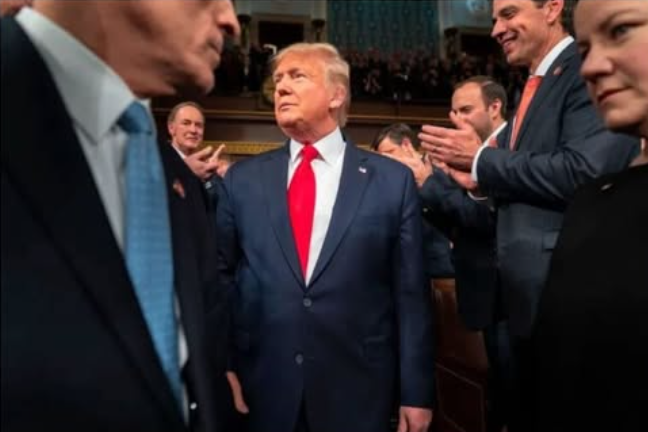
Viewers didn’t just watch Donald Trump’s State of the Union address—they felt it, as if the words and gestures extended beyond the television screen and touched something personal, visceral, and immediate. The energy in the chamber, the applause, the occasional gasp—all of it translated through the airwaves into living rooms, bars, and offices across the country. According to CNN’s instant poll conducted with SSRS, the impact was far larger than anticipated. Confidence among viewers spiked sharply, skeptics softened just enough to reconsider, and two of America’s most contentious issues—immigration and the economy—suddenly appeared in a new light to millions of Americans. Yet beneath the immediate applause, the smiling faces, and the rising approval numbers, a more pressing and uneasy question emerged: could a televised address still shift the deeply entrenched political divisions that have fractured Washington and the nation?
The CNN–SSRS instant poll revealed something striking. Trump’s address did not merely resonate with his base; it reinforced it while simultaneously nudging the edges of the electorate. Nearly two-thirds of viewers reported a positive reaction, with a larger proportion leaving the speech convinced that his policies were moving the country in the right direction than had believed it beforehand. This change, modest in absolute numbers but significant in its psychological impact, underscores the enduring influence of a nationally televised speech. Even in an era dominated by social media snippets, soundbites, and algorithm-driven content, the State of the Union remains a rare moment when millions simultaneously focus on the same words, gestures, and imagery, creating a shared national experience that can subtly shape perception.
Yet the poll numbers also reveal the limitations and fissures inherent in such a broadcast. The audience that tuned in was far from representative of the broader population; it skewed toward the politically engaged, generally informed, and often already sympathetic to Trump. In other words, the speech functioned more as a reinforcement of preexisting beliefs than a tool for conversion. For those predisposed to approval, his confident delivery, the framing of policy successes, and the appeals to patriotism created validation and a sense of momentum. Immigration and the economy, the issues that strike at some of the rawest nerves in American politics, were cast in terms of clarity, strength, and direction. Yet for viewers more critical or skeptical, the same speech highlighted gaps: details left unresolved, tensions left unaddressed, and promises that may have sounded aspirational rather than actionable.
The State of the Union also served as a mirror, reflecting back the country’s deep divisions rather than bridging them. For many, the address confirmed what they already believed about the nation’s trajectory. For others, it reinforced doubts, anxieties, and frustration. Even the rhetoric intended to unify—references to shared values, anecdotes of individual triumph, and appeals to collective responsibility—was interpreted differently depending on one’s ideological lens. What appeared as decisive leadership to one segment of the audience felt incomplete or selective to another. In a polarized nation, this duality is both inevitable and revealing: a single speech can illuminate consensus where it exists, but it also exposes fractures and unresolved tensions that no amount of applause can erase.
Beyond the numbers and the immediate reactions, the address also highlights the evolving role of televised political communication. In the age of 24-hour news cycles, social media, and partisan commentary, the State of the Union retains symbolic power even if it no longer commands the undivided attention of an entire country. For supporters, it is a moment of rallying, reassurance, and affirmation; for critics, it becomes fodder for analysis, critique, and counter-narratives. The interplay between these perspectives—between reinforcement and challenge, validation and skepticism—is precisely what makes the address both compelling and contentious.
Finally, the broader significance of the speech lies not in instant polling alone, but in its ability to shape narrative. Even a modest shift in perception among politically engaged viewers can ripple outward, influencing discussions in workplaces, family gatherings, and social media networks. It sets the tone for subsequent debates in Congress, frames the media’s coverage for the following days, and influences how policies are received by the public. The State of the Union, in this sense, is both performance and policy, spectacle and substance. It reminds Americans that leadership is not solely about legislation or executive action; it is also about perception, framing, and the ability to command attention at moments that matter.
In sum, while the immediate reaction to Trump’s State of the Union—applause, poll spikes, and positive viewer responses—was striking, the deeper story is more complex. The speech functioned as both an anchor and a mirror: reinforcing beliefs, shifting perceptions slightly at the edges, and revealing the enduring fault lines in a polarized nation. Even as millions of viewers walked away feeling inspired or validated, the broader question lingers: can any televised address, however confident or well-crafted, truly bridge the divisions that define contemporary American politics? The answer, at least for now, remains as unresolved as the nation itself.