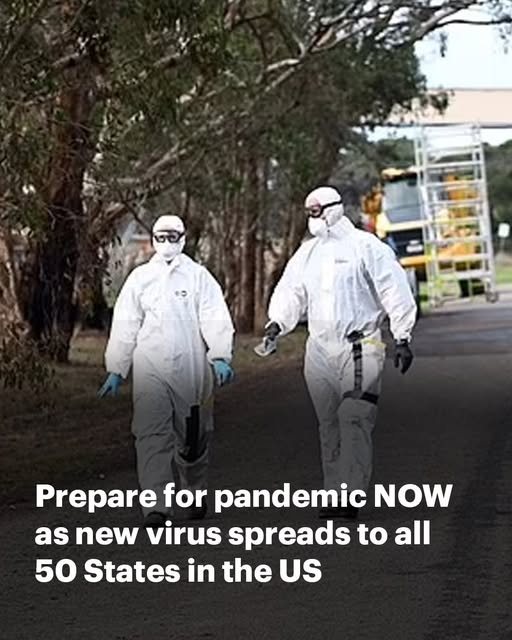
The United States is facing a pivotal moment in public health as scientists and infectious-disease specialists raise urgent concerns about the spread of the H5N1 avian influenza virus. What originally appeared to be a problem confined mostly to poultry farms has gradually transformed into a nationwide issue, with confirmed detections now reported across all 50 states. The numbers continue to grow more concerning. Nearly a thousand dairy cattle herds have been affected, and more than seventy human infections have been confirmed in laboratories, including the first fatal case reported in the country. Researchers associated with the Global Virus Network, along with other leading virologists, warn that the country may be witnessing the early stages of a potential pandemic developing slowly over time. They emphasize the need for immediate planning and coordinated response so the nation does not experience the same institutional and societal disruptions seen during the beginning of COVID-19.
The effects on agriculture have already reached an extraordinary scale. Since the outbreak began accelerating in 2022, more than 168 million chickens and other poultry birds have either died from the disease or been culled in efforts to contain its spread. This enormous loss has placed serious pressure on the U.S. poultry industry and has also affected consumers directly, pushing the cost of eggs and other everyday food items dramatically higher. A particularly troubling development occurred in 2024 when the virus was detected in mammals, especially dairy cattle. This shift significantly increased scientific concern because viruses circulating widely in mammals have far greater opportunities to mutate. Experts such as Marc Johnson of the University of Missouri explain that although the virus has not yet gained the ability to spread efficiently from person to person, it is effectively experimenting through every infected host, increasing the chances of genetic change.
The first confirmed death in the United States linked to this strain occurred in early 2026 in the state of Louisiana. The patient had been hospitalized with severe breathing complications and was over the age of sixty-five with underlying medical conditions. Genetic sequencing of the virus from that case revealed that mutations had developed during the infection itself, which may have contributed to the seriousness of the illness. Health officials are also concerned about a small number of infections appearing in people who had no direct contact with animals. Such cases suggest that the boundary between animal transmission and human infection is becoming less clear. Because of this, scientists from the Global Virus Network are urging federal authorities to expand surveillance programs and introduce stronger biosecurity measures throughout the food production chain.
Despite repeated warnings from the scientific community, critics argue that the national response has been inconsistent and insufficiently coordinated. For much of the outbreak, testing livestock and agricultural workers was voluntary and largely left up to farm operators. Many public-health professionals believe this policy allowed the virus to circulate undetected for extended periods. At present, mandatory testing applies mainly to animals transported across state borders, leaving significant gaps in the data needed to understand how the virus is moving across the country. Concerns have also been raised about administrative changes in Washington. Reports indicate that the White House Office of Pandemic Preparedness and Response has faced staffing shortages and funding reductions. Additionally, transferring pandemic planning responsibilities to the National Security Council has sparked debate about transparency and the speed at which information can be shared with scientists and public-health agencies.
One of the most serious scientific concerns involves the possibility of infection in pigs. Swine are uniquely vulnerable because they can host both human influenza viruses and avian strains simultaneously. For this reason, they are often described by virologists as “mixing vessels,” where genetic material from different viruses can combine. If a pig were infected at the same time with a common human flu virus and the highly pathogenic H5N1 avian influenza virus, the resulting hybrid virus could potentially spread easily between people while still retaining high lethality. Researchers such as Ab Osterhaus emphasize that monitoring infections in cattle, pigs, and wildlife—including animals like foxes, skunks, and seals—is therefore not just an agricultural issue but also a matter of national security.
In response to the growing threat, both the pharmaceutical industry and the federal government have begun preparing defensive measures. A contract worth about $590 million was previously awarded to Moderna to develop an mRNA vaccine specifically targeting the H5N1 avian influenza virus. Although questions remain about whether funding will continue at the same level, the United States already holds an emergency reserve of roughly twenty million doses of an existing vaccine that appears compatible with current virus strains. Production capacity could also allow the rapid manufacturing of up to one hundred million additional doses if necessary. Antiviral treatments such as Oseltamivir—widely known by the brand name Tamiflu—are also being stockpiled and used to treat current patients. Nevertheless, public-health officials acknowledge that distributing vaccines and medications quickly during a major outbreak would present enormous logistical challenges.
Environmental monitoring programs have offered additional insight into how widespread the virus may already be. Wastewater testing conducted throughout the country has detected traces of the virus in roughly one quarter of monitored sampling locations. In certain states, including California and Iowa, the proportion of positive wastewater samples has exceeded eighty percent. These findings suggest that the virus may be circulating more broadly in the environment than clinical testing alone reveals. A higher environmental presence also increases the possibility that individuals with no direct contact with livestock could be exposed accidentally.
Regulatory agencies have also begun tightening oversight within the food industry. The United States Department of Agriculture has introduced requirements for companies handling raw or unpasteurized milk to provide samples for testing after viral fragments were detected in certain retail milk products. Meanwhile, the Food and Drug Administration maintains that pasteurization effectively neutralizes the virus, meaning properly processed milk remains safe for consumers. Even so, the discovery of viral material within the food supply illustrates how deeply the outbreak has affected modern agricultural systems. In regions where farming operations are densely concentrated, strict biosecurity practices are becoming essential for preventing further spread and avoiding severe economic damage.
Experts stress that educating the public is just as important as conducting laboratory research. Influenza specialist Peter Palese emphasizes that basic precautions—such as properly cooking poultry products and avoiding contact with sick or dead wildlife—can significantly reduce risk. As the virus continues to evolve, scientists warn that the opportunity for proactive preparation may be narrowing. Their message is increasingly direct: the emergence of a major H5N1 outbreak is no longer merely hypothetical but a realistic possibility that could occur if conditions align.
Recent global health crises have demonstrated that infectious diseases do not respect political boundaries, economic differences, or geographic borders. The current bird flu situation represents an important test of how effectively the nation can apply lessons learned over the past decade. Strengthening surveillance where human and animal populations intersect, ensuring transparency in pandemic planning, and continuing to fund scientific research are all essential steps. Remaining informed and vigilant will be crucial as health authorities attempt to contain a virus that appears determined to become the next major global health threat.