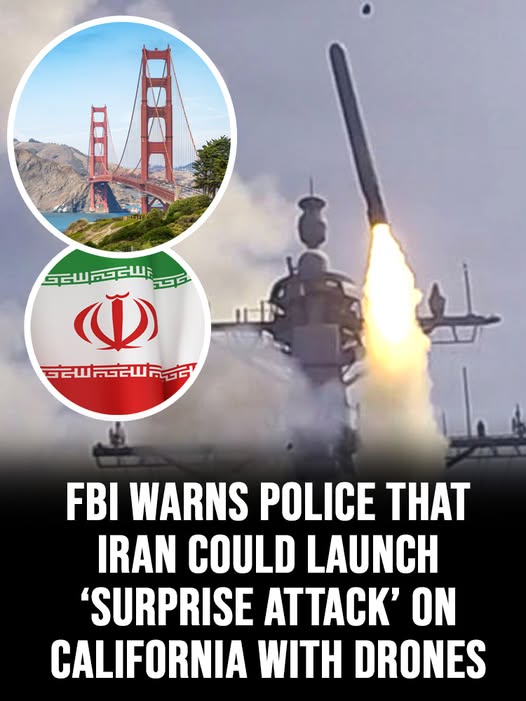
The warning sent a chill through every corridor of power it touched. A top-secret FBI memo, classified and discreet, quietly found its way onto the desks of California law enforcement officials, carrying a message that was equal parts vague and terrifying. It suggested that Iran could be planning a drone “surprise attack” somewhere off the West Coast. The document was deliberately sparse—no precise date, no identifiable targets, no definitive coordinates. Yet that was exactly what made it so menacing. The mere possibility of a strike hovering somewhere along the Pacific coastline cast a shadow over the lives of millions, from sleepy coastal towns to sprawling urban centers. Every routine commute, every late-night stroll, every ocean-bound vessel suddenly existed under the specter of unseen danger.
As U.S. forces continued to escalate their operations in the Middle East, targeting mine-laying ships and tightening pressure around the Strait of Hormuz, the conflict was no longer a distant geopolitical issue confined to faraway waters. The battlefield seemed to creep closer to home, inch by inch, like an invisible tide. The leaked FBI alert suggested that Iran might be positioning itself to launch drones from an as-yet-unidentified vessel somewhere off American shores if provoked further—a scenario so ambiguous it seemed almost surreal, yet the implications were clear and immediate. No concrete plot had been confirmed, no precise timeline existed, but the mere suggestion was enough to trigger late-night strategy calls in dimly lit offices, emergency drills at key ports, and covert adjustments to civilian surveillance and air defenses. Even the quiet hum of everyday life took on a new urgency, a heightened awareness that danger could arrive without warning.
California officials responded with a careful blend of calm reassurance and urgent mobilization. Public statements emphasized that there was no immediate threat, yet behind closed doors, preparations were accelerating. Governor Gavin Newsom’s team coordinated closely with federal intelligence and military agencies, running simulations, updating response protocols, and ensuring communication lines between local law enforcement, emergency services, and the National Guard were robust. The Los Angeles County Sheriff’s Department significantly increased patrols around high-profile and sensitive locations: synagogues, mosques, churches, cultural centers, government buildings, and even popular tourist sites. Security cameras were reviewed and upgraded, emergency evacuation plans were re-examined, and rapid-response teams were placed on heightened alert. In the background, analysts scrutinized shipping traffic, offshore radar data, and unusual maritime activity, searching for any clue that might confirm or rule out the warning.
For now, it was a war waged in warnings, intelligence leaks, and careful deterrence—a dangerous and delicate dance where a single misstep could turn civilians into collateral. While Washington’s statements emphasized “resolute action” and President Trump’s threats of “violent retaliation” reverberated through both U.S. and international media, Tehran’s own rhetoric promised swift revenge for any perceived aggression. Each side was calculating, measuring, and posturing, while ordinary Americans, many unaware of the behind-the-scenes tension, were left to wonder how real the threat might be. Every airplane taking off from Los Angeles International Airport, every cruise liner departing the Bay Area, every fisherman heading out to sea became part of an unspoken anxiety: could any of these innocuous routines become the stage for a surprise attack?
The memo’s lack of specificity did not make the threat any less potent. In fact, its ambiguity amplified the fear. Security analysts emphasized that the very uncertainty forced officials to prepare for every conceivable scenario: drones launched from cargo ships, from converted private vessels, or even from commercial freighters operating in international waters close to U.S. territory. Counter-drone measures were reviewed, and coordination between the Coast Guard, Navy, and local police became a priority. Even emergency broadcast systems were quietly tested to ensure that any public warning could be delivered swiftly and effectively. Meanwhile, community leaders in cities along the coast engaged in discreet outreach, reinforcing safety protocols without triggering panic.
At the same time, the psychological toll was evident. For ordinary citizens, news of the memo sparked uneasy conversations over dinner tables, in offices, and online forums. Some Californians, long accustomed to the state’s natural disasters—earthquakes, wildfires, and tsunamis—found themselves now preparing for a type of threat that could not be predicted by seismic readings or weather forecasts. Parents discussed contingency plans with their children, mariners checked navigation systems more carefully, and local law enforcement worked to balance vigilance with reassurance. The very real sense of living under a shadow—the knowledge that conflict, once considered distant, might intrude upon daily life—was a heavy burden to bear.
Amid these uncertainties, the critical question for many was no longer theoretical: how close are we to the moment when diplomacy fails, deterrence falters, and the threat becomes reality? Each passing day, each naval movement in the Persian Gulf, each statement from Washington or Tehran added to the tense calculus. What began as a cryptic warning on a classified memo had transformed into a persistent presence in the public consciousness, a reminder that global conflicts, no matter how far away geographically, can ripple suddenly and dangerously into the lives of those who thought themselves safe.