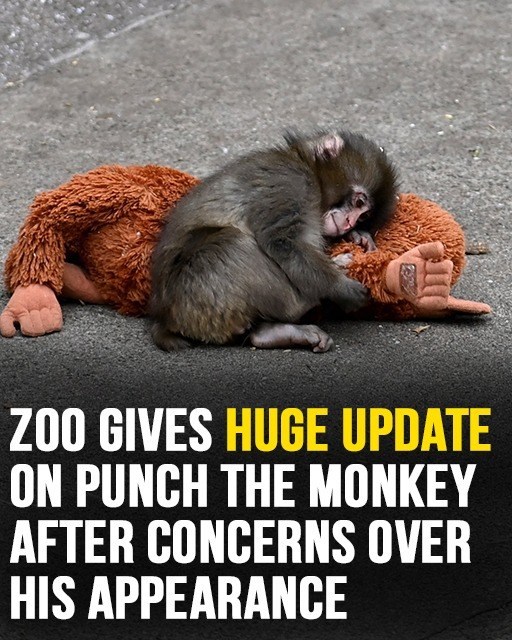
The digital era has a remarkable ability to transform private suffering into something the entire world observes. Yet few stories have gripped global attention the way the story of Punch has. Punch is a young macaque whose life began not with the comfort of a mother’s embrace, but with rejection and an unexpected rise to viral fame. In early March 2026, a video began spreading rapidly across social media platforms. Unlike the polished and uplifting rescue clips people are used to seeing, this footage was painfully raw. It showed a fragile newborn primate tightly clinging to a stuffed orangutan toy as if it were his only connection to safety. The image struck millions of viewers deeply, igniting intense conversations about wildlife care, the vulnerability of social animals, and the difficult reality of rebuilding a life after such a traumatic beginning.
Punch’s earliest days were marked by a profound absence. For primates, the first hours of life are meant to be filled with constant contact, warmth, and the instinctive bond between mother and infant. Without a mother to cling to, Punch faced a void that could have easily defined his future. Human caregivers stepped in, providing specialized incubators, carefully prepared formula, and the plush orangutan that would soon become a symbol recognized around the world. Although the toy was simply meant to offer physical comfort, people everywhere saw it as a heartbreaking reminder of what Punch had lost. The reaction online was immediate and emotional. Viewers expressed anger, sadness, and protectiveness all at once. Many demanded answers or solutions before fully understanding the complex biological and psychological challenges involved in rehabilitating a primate.
Introducing a rejected infant back into a social group is not the smooth, emotional process often shown in documentaries. Instead, it is slow, tense, and sometimes uncomfortable to witness. When Punch began carefully supervised introductions with other macaques, every interaction was watched closely by thousands of people online. If another young macaque tugged his fur or if Punch reacted by pulling away nervously, viewers quickly filled comment sections with accusations of cruelty. What many did not realize was that within those awkward and sometimes harsh interactions, Punch was learning something essential. He was beginning to understand the language of his own species—how to respond to dominance, how to participate in grooming rituals, and how persistence helps animals find their place in a social group.
Real resilience rarely appears graceful while it is happening. For Punch, progress did not arrive in dramatic or viral moments. Instead, it showed itself in small but meaningful steps. It was there the first time he walked a short distance without checking for his caregivers behind him. It appeared on a quiet afternoon when he sat alone in a patch of sunlight, carefully peeling fruit without assistance. Perhaps the most meaningful milestone came the day he left his stuffed orangutan behind and reached out toward another macaque instead. In that moment, something within him shifted—from complete dependence to the early stages of independence.
Punch’s story also illustrates how modern conservation efforts are shaped by public attention. The millions of people watching his journey online were not simply observers. Their collective interest influenced how openly caregivers communicated about the rehabilitation process. This global attention created both advantages and challenges. Public support helped generate resources and awareness that allowed specialists to provide advanced medical care and enrichment. At the same time, the expectation for heartwarming updates sometimes conflicted with the reality of animal rehabilitation, which is often slow, unpredictable, and messy. Healing rarely follows a straight path.
As Punch’s physical condition improved, his caregivers began focusing more on his emotional and behavioral development. A macaque raised too closely by humans can struggle to function in a troop, becoming isolated or unable to understand social rules. To prevent this, the caregivers had to make a difficult decision. They needed to step back. By gradually reducing human interaction, they allowed Punch to experience the natural social learning that comes from interacting with other macaques—even when that meant brief moments of rejection or confusion. In doing so, they gave him the chance to reclaim what he truly was: a member of his own species. By 2026, his fur had grown thicker, his movements more confident, and the earliest signs of trauma were slowly being replaced with the marks of experience.