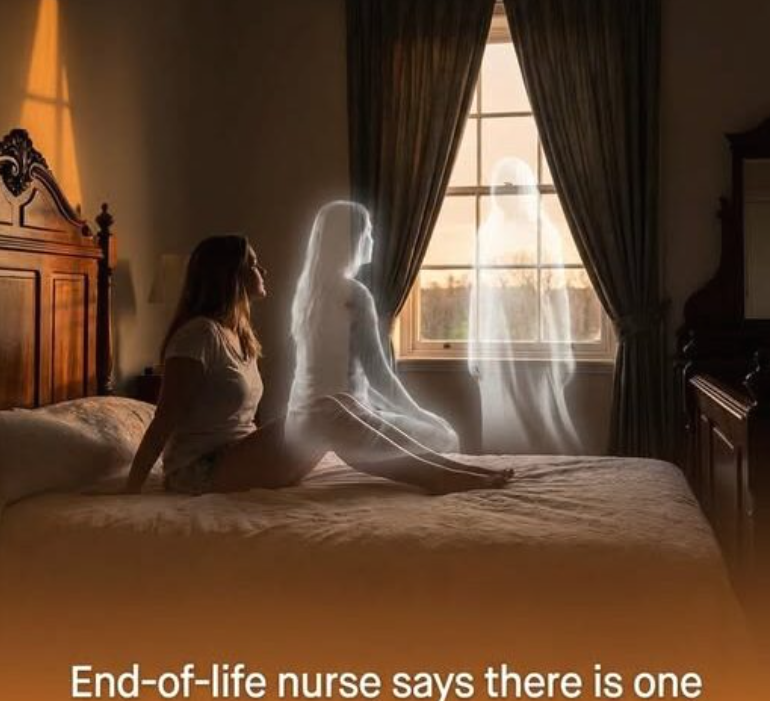
Facing the boundary between life and death is an experience that most people encounter only a few times in their lives. However, for palliative care professionals such as nurse practitioner Katie Duncan, it is a daily reality. In the quiet environments of palliative care units or in the private rooms of patients, a particular phenomenon has often been observed in the final moments of life. Patients frequently extend their hands slowly into the air or look upward with a calm expression. To an outside observer, this may appear to be a sign of confusion, but for professionals who work with people at the end of life, it is a familiar and often very peaceful occurrence.
This gesture of “reaching out” is usually not accompanied by panic or fear. On the contrary, it often appears gentle and full of recognition, as if the person is greeting someone or something beyond what others in the room can see. For many hospice nurses, these moments seem to be a sign that the body and mind are preparing for the final departure.
From a medical perspective, these behaviors are often explained by the physical changes that occur in the body during the final stage of life. When the body enters the active phase of dying, major changes occur in brain function and metabolism. A decrease in oxygen levels in the blood, an increase in carbon dioxide, or the release of certain natural chemicals in the brain can affect a patient’s awareness. These processes may cause altered states of consciousness, delirium, or hallucinations.
In some cases, patients may mention the names of people who died long ago or smile toward an empty part of the room. Some medical theories suggest that as certain brain functions begin to shut down, old memories or powerful emotional experiences may rise to the surface and appear as visions or sensations that feel very real to the patient.
However, for family members who sit beside the bed of their loved one, clinical explanations are often not enough to capture the emotional weight of the moment. When someone who has been unresponsive for days suddenly raises a hand or looks upward with a peaceful expression, that moment becomes much more than a “neurological event.” For family members, it may seem like a final message without words.
Many people who experience this moment interpret it as a sign that the transition from life to whatever comes next is not as frightening or lonely as they once imagined. It can appear as though the person is being welcomed by something familiar and loving, rather than being pushed away by pain. In those moments, the patient’s room often becomes a special space where medical and spiritual elements blend together. The role of the hospice nurse in these moments is not only to administer medication, but also to stand as a quiet witness to a deeply human process.
Katie Duncan and her colleagues do not claim to have definitive answers about the nature of these experiences. They do not attempt to prove or disprove the existence of a world beyond life. Their role is to help families understand that these experiences are common and a documented part of the dying process.
By explaining this to families, they help remove the fear of the unknown. Instead of worrying about why something like this is happening, families can focus on simply being present with the patient—holding their hand and accompanying them peacefully through their final moments.
These behaviors take on even stronger emotional meaning when patients who were previously distressed or agitated suddenly become calm. They are often accompanied by a focused upward gaze, as if the person is looking beyond the walls of the room. Some say nothing at all, while others appear to carry on quiet conversations with someone that others cannot see.
Regardless of personal beliefs about life after death, the impact of these moments on the quality of the final stage of life is undeniable. For many people, they transform the final moments from a purely physical process into a deep emotional and psychological experience.
In modern palliative care, there is an increasing emphasis on a holistic approach, where importance is given not only to managing the patient’s pain but also to supporting the emotional needs of the family. Professionals in this field understand that the memories formed during these final hours will remain with loved ones for the rest of their lives.
If the last memory of a loved one is a peaceful smile and a gentle gesture reaching into the air, that memory can become a source of comfort during the grieving process.
Ultimately, the experiences shared by hospice workers remind us of the dignity that still exists in the final moments of life. They show that the process of leaving this world is complex and involves not only the body, but also emotions and human connections.
Gestures like “reaching out” symbolize the enduring human need for connection with others, even in the final moments. They remind us that as our connection to the physical world weakens, our awareness may open to something else.
Whether these experiences are the result of neurological processes or a deeper spiritual experience, the outcome is often the same: a moment of peace during a time filled with intense emotions.
By witnessing these moments, hospice nurses provide a valuable service to families. They remind us that death is not simply a medical failure, but a natural part of human life that can be experienced with dignity and calm.
And for those who remain behind, these moments often become a special memory—a final story filled with peace, the presence of loved ones, and a gentle reaching toward the light.