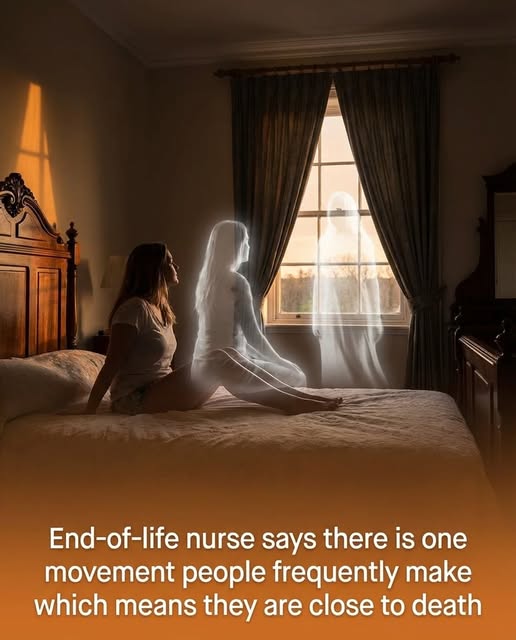
Some families never forget it. A frail hand, delicate and trembling with age or illness, slowly rises, fingers reaching toward something no one else in the room can see. Nurses pause mid-step, unsure whether to intervene or simply watch. Loved ones hold their breath, leaning in as if a secret is unfolding just beyond human perception. In quiet rooms across hospices, hospitals, and private homes, this same mysterious upward gesture appears again and again, often just hours or days before death. Is it pain? A memory? A vision? Or simply the brain and body letting go in its own strange, final rhythm? No single answer satisfies every observer, yet the gesture is profoundly moving in its persistence and subtlety.
Hospice nurse practitioner Katie Duncan has watched this movement unfold countless times at the bedsides of the dying. She notes that it is rarely frantic, never panicked; more often it is slow, deliberate, almost tender—as if the patient is greeting someone or something just beyond the limits of sight. Some whisper the names of long-departed relatives, conjuring voices from memory that bring comfort in their final hours. Others smile faintly, a quiet acknowledgment that transcends words, and some say nothing at all, their gaze fixed on a point above the ceiling, distant yet intimate. Clinically, these gestures may be linked to complex changes in brain function, oxygen levels, or shifts in the body’s chemistry as life ebbs away. Yet emotionally, for those present, the scene becomes something far larger: a window into the mystery of passing, a moment that feels almost sacred.
For families, the gentle upward reach can take on a deeply personal significance. It may feel like a final message: reassurance that their loved one is not alone, that the journey into death is softer and more peaceful than they feared. Witnessing it can be both heartbreaking and comforting—a paradox that holds the simultaneous weight of grief and a sense of release. Hospice workers, trained in both medicine and empathy, do not claim to have definitive answers. Instead, they stand vigil, offering presence, quiet words, and the reassurance that what families are seeing is not an isolated event but a common, natural, and often peaceful part of the dying process.
These moments linger in memory long after the room falls silent. Relatives describe them as encounters with something beyond understanding, instances that defy conventional explanation yet bring a profound sense of connection. The rising hand, the distant gaze, the whispered names—each act becomes a bridge between life and death, between the visible world and whatever lies beyond. Nurses like Katie Duncan learn to honor the mystery without needing to decode it, finding beauty in the stillness, the small gestures, and the unspoken communication that fills the space with meaning. In these intimate, final hours, the ordinary act of letting go transforms into something transcendent, reminding us all of the fragility, wonder, and dignity inherent in the closing chapter of life.