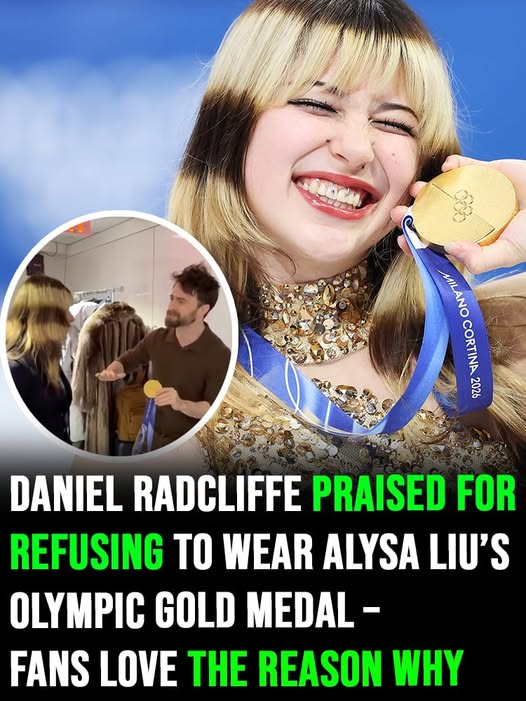
In a world obsessed with optics, virality, and staged moments, Daniel Radcliffe did something so subtle it almost went unnoticed at first—but resonated far deeper than any headline could capture. When Olympic figure skating sensation Alysa Liu offered him her gold medal, the expectation was almost obvious: slip it over his neck, flash a grin, let the cameras roll, and share another viral moment. But Radcliffe did the opposite. He paused, looked at her with quiet recognition, and refused. No stunt, no borrowed glory, no attention-seeking display—just a gentle, deliberate refusal that silenced the room for a heartbeat and then sent social media into an unexpected roar of admiration.
Instead of transforming the medal into a prop for celebrity content, Daniel held it with care, cradling the gold in his hands like it was something fragile, priceless, and wholly hers. Every gesture, every glance, reinforced a simple truth: this medal did not belong to him. It belonged to Alysa Liu, to her years of relentless practice, her early mornings on ice, the bruises she ignored, and the countless hours she spent perfecting jumps that made the audience gasp. As photographers snapped away, he spoke directly to her, his words carrying the weight of genuine admiration. “Watching you skate,” he said, “has been one of the most joyful things I’ve ever seen.” Not a line for the press. Not a scripted compliment for cameras. Just honesty, unadorned, from one person who had witnessed greatness to another.
Alysa Liu, fresh from her historic double gold victory in Milan, has always balanced talent with humility. Even at the pinnacle of her career, she speaks not of perfection, but of learning from mistakes, embracing challenges, and finding joy in every glide across the ice. Meeting Radcliffe became more than a celebrity encounter—it was a rare, unspoken acknowledgment of her journey. The worlds they inhabit are vastly different: one built on scripts, sets, and public expectation; the other on blades, ice, and split-second precision—but in that moment, they collided beautifully, each recognizing the other’s dedication and integrity.
Online, the reaction was immediate, widespread, and reflective of a deeper hunger for authenticity. People praised Radcliffe’s restraint, calling it the kind of respect that doesn’t announce itself with fireworks or hashtags, but lingers in memory and inspires quietly. In a digital era where attention is currency, his refusal to appropriate the medal became an unspoken lesson in humility and admiration. It reminded viewers that true acknowledgment doesn’t need amplification, and that sometimes the most meaningful gestures are those that remain understated yet profoundly sincere.
As they posed for photos, Radcliffe continued to emphasize Liu’s achievements, not as a fleeting talking point, but as the core of the moment. Each smile, each compliment, each careful handling of the medal underscored an unspoken truth: the spotlight on someone else does not diminish your own light—it only proves your character. By the end of the encounter, the images circulating online were not just of a Hollywood actor and an Olympic champion standing together; they were a snapshot of respect, of recognition, of the quiet power of giving space to someone else’s moment.
This brief, unassuming exchange between Alysa Liu and Daniel Radcliffe became a reminder that greatness can be celebrated without overshadowing, and admiration can be expressed without spectacle. It was a lesson in humility for the world, broadcast not through fanfare or viral gimmicks, but through the simple act of honoring someone else’s achievement fully, visibly, and sincerely. In the end, Radcliffe didn’t need to wear the medal—because in refusing to, he showed far more about character, respect, and authenticity than any viral moment ever could.