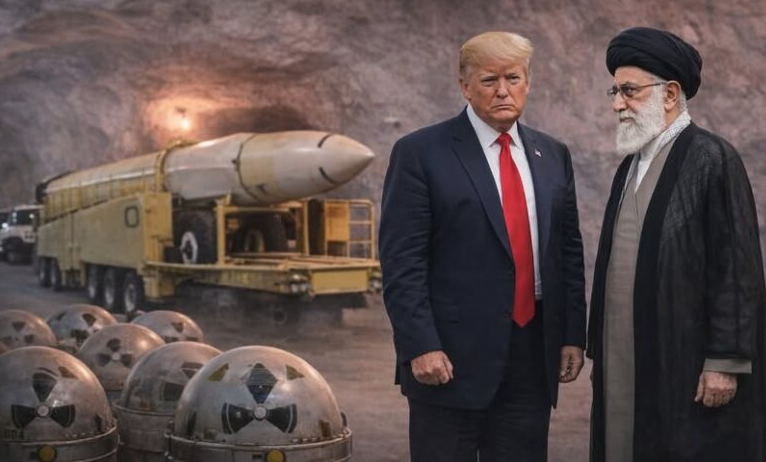
The geopolitical landscape of the Middle East has long been defined by a complex balance of power. However, in recent years Iran’s military development has begun to play an increasingly significant role in this balance. Deep beneath the harsh and arid terrain of the Iranian plateau, a major secret has been carefully constructed—one that is now fueling serious strategic debates in Western capitals. Reports speak of massive facilities built about 500 meters underground, which Iranian officials refer to as “missile cities.” These are not merely weapons depots, but fully integrated underground military complexes designed to store, maintain, and launch an advanced missile arsenal that has made Iran the most powerful missile force in the region.
According to data from the United States Central Command, Iran’s ballistic missile capacity is extremely large. It is estimated that the country possesses more than 3,000 missiles of various types. This arsenal is the result of decades of domestic technological development and the adaptation of foreign technologies, creating a multi-layered deterrence strategy capable of striking targets throughout the Levant and deep into Europe. The sheer number of missiles, combined with their fortified storage systems, reflects a military doctrine focused on survivability and the ability to retaliate even after suffering heavy aerial bombardment.
At the core of this strategy are short-range ballistic missiles, particularly the Fateh and Zolfaghar families. These systems are designed for precise strikes against military targets near Iran’s borders. Their tactical value lies in what are known as “saturation strikes,” where multiple missiles are launched simultaneously to overwhelm enemy radar and air-defense systems. This tactic was clearly demonstrated in 2020 following the assassination of General Qassem Soleimani, when a series of missiles struck U.S. military bases in Iraq. The operation showed that Tehran had the capability to conduct rapid and coordinated military actions.
However, the main strategic pillar of Iran’s deterrence consists of its medium-range ballistic missiles. Models such as the Shahab-3, Khorramshahr, and Sejjil represent the peak of Iranian military engineering and have an operational range of around 2,000 kilometers. Although Iran officially claims that this is the current limit of its ambitions, Western analysts remain skeptical. According to them, the propulsion systems and structural technologies of these missiles could relatively easily be adapted for longer ranges, which would theoretically place a large portion of Europe within reach.
Beyond traditional missiles, the development of hypersonic technology has added a new dimension to the regional security equation. The Fattah-2 project is among the most discussed within Iran’s defense industry. According to official statements, this missile can maneuver at extremely high speeds, making it very difficult for current missile defense systems to intercept it. If these claims are accurate, the Fattah-2 represents a major step forward in modern weapons technology and forces a reassessment of how defense systems such as Patriot must be organized to protect strategic assets.
Iran’s deterrence strategy is further complicated by the use of cruise missiles and suicide drones. Cruise missiles such as the Soumar—believed to be influenced by the Russian Kh-55 model—fly at low altitudes following the terrain, which makes them difficult for radar systems to detect. At the same time, the Shahed-136 drone has transformed the nature of low-cost warfare. These drones are relatively cheap to produce and can be deployed in large numbers. A swarm of drones costing only a few thousand dollars can force an air defense system to use interceptor missiles that cost millions.
The physical manifestation of this military capability is found in the “missile cities” carved into deep rock formations. Satellite images and state-released materials reveal kilometers of reinforced tunnels, vast underground depots, and specialized launch platforms capable of bringing a missile from deep underground to the surface within minutes. These facilities are designed to be extremely protected, even from the most powerful bunker-busting munitions. By placing strategic assets 500 meters underground, Iran has made any attempt to destroy them from the air extremely difficult.
Although some Israeli reports suggested that Iran’s missile stockpiles were weakened during intense military clashes last year, current assessments indicate that the country has recovered very quickly. Thanks to a distributed manufacturing network and a strong supply chain for dual-use components, Tehran has managed to replace much of its arsenal in a timeframe that surprised many analysts. This industrial resilience is a key element of its long-term strategy.
In Washington, assessments of Iran’s intercontinental capabilities remain cautious. U.S. intelligence suggests that although Iran’s regional missile reach is significant, the country still does not possess a reliable intercontinental ballistic missile capable of striking the United States mainland. Most analysts believe such a capability will not be fully realized before 2035. However, the connection between Iran’s space program and its military missile development continues to attract close attention, since the technology used to launch satellites is closely related to that required for long-range missiles.
As 2026 continues, the world watches the Iranian plateau with a mixture of concern and strategic curiosity. The secret hidden 500 meters underground is no longer completely unknown, but its existence has created a new reality in international diplomacy. Warnings about this arsenal are not intended to provoke panic but to encourage a more realistic understanding of the balance of power in the region. Amid the historic tensions of the Middle East, Iran’s underground missile cities remain a powerful reminder of a nation that has placed its security—and its future—deep within the earth.
The debate over Iran’s missile program is not only about the number of weapons, but about how modern warfare itself is evolving. From hypersonic missiles to kamikaze drones and deep underground bases, these developments show that the concept of military deterrence is changing fundamentally. In an era where digital commentary and analysis spread rapidly, the activities taking place beneath Iranian soil remain an important and constant factor in discussions about global stability.