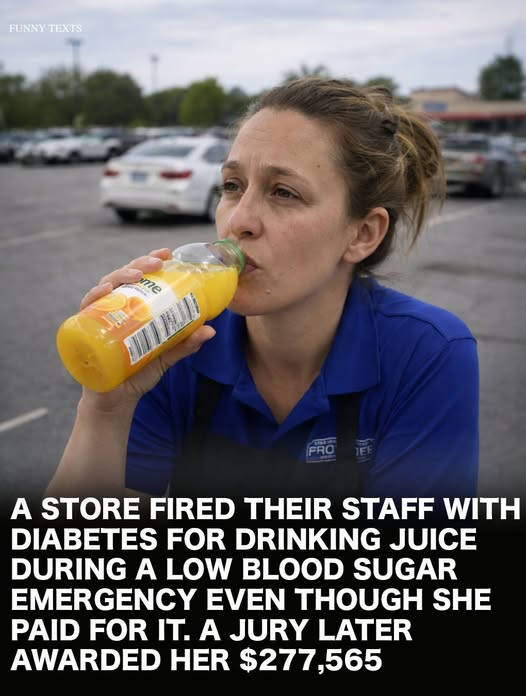
Linda Atkins, a dedicated cashier at Dollar General in Maryville, Tennessee, faced a life-threatening situation at work that ultimately cost her employer hundreds of thousands of dollars. Atkins, who lives with Type 1 diabetes, relies on careful monitoring of her blood sugar levels to prevent serious medical emergencies. One day, during a routine shift, her blood sugar dropped to a dangerously low level, creating an urgent need for immediate treatment.
Aware that her condition could quickly become life-threatening, Atkins responsibly sought permission from a supervisor to grab a drink from the register area to stabilize herself. Her request, however, was denied. Faced with the imminent risk of losing consciousness, she made a quick decision: she took a $1.69 bottle of orange juice from the register area, drank it immediately to raise her blood sugar, and then promptly paid for it right afterward. Her actions were guided purely by medical necessity.
Despite her responsible and urgent response to a medical emergency, Dollar General terminated Atkins’ employment, citing a company policy known as “grazing,” which prohibits employees from consuming store merchandise before payment. What the company viewed as a minor policy violation was, in reality, an emergency response to a serious health condition.
Recognizing the injustice, the Equal Employment Opportunity Commission (EEOC) filed a lawsuit against Dollar General on Atkins’ behalf under the Americans with Disabilities Act (ADA). The lawsuit argued that firing Atkins failed to accommodate a medical emergency directly related to her disability, effectively punishing her for acting to protect her health in a life-threatening moment.
The case went to a federal jury, which thoroughly examined the circumstances. The jury concluded that Dollar General had indeed violated federal law by dismissing Atkins for responding to her diabetes-related medical emergency. In a landmark decision, they awarded Atkins a total of $277,565. This included $27,565 in back pay, accounting for the income she lost due to the wrongful termination, and $250,000 in compensatory damages, reflecting the emotional distress, humiliation, and hardship caused by the employer’s actions.
What started as a simple $1.69 bottle of orange juice became one of Dollar General’s most expensive and high-profile termination cases, highlighting the importance of accommodating employees’ medical needs. The case also served as a cautionary tale for employers nationwide: rigidly enforcing company policies without considering medical emergencies can have serious legal and financial consequences.
Legal experts noted that the decision reinforced the protections offered under the Americans with Disabilities Act, emphasizing that employees should never be penalized for taking immediate action to preserve their health during a crisis. For Linda Atkins, the ruling was not just about compensation—it was a validation that her life and safety mattered more than a strict adherence to policy.
The case also drew public attention, sparking conversations about workplace safety, diabetes awareness, and the need for greater understanding and flexibility when employees face medical emergencies. What might have seemed like a minor workplace incident became a defining example of how legal protections can safeguard vulnerable individuals and hold corporations accountable for their actions.