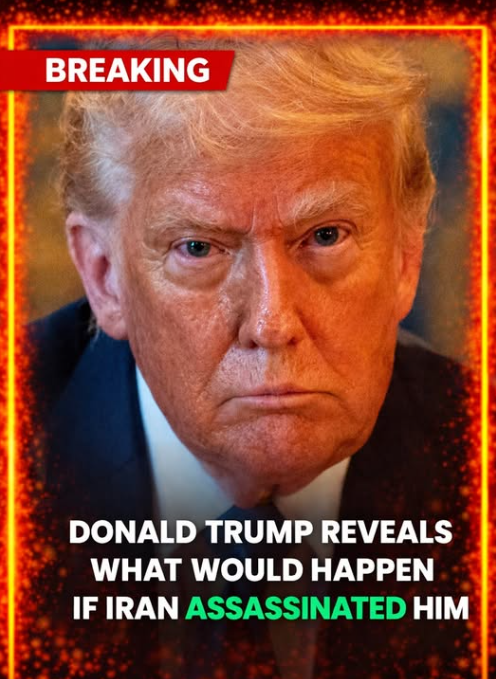
The warning was long dismissed as nothing more than bluster, an offhand remark meant to shock and entertain rather than serve as a serious policy statement. Yet, in the volatile days of March 2026, as bombs rain down over the Middle East and news headlines report the deaths of key leaders, that private threat from Donald Trump has taken on a frighteningly prophetic weight. What was once a snippet buried in the endless churn of cable news clips now resonates as an ominous testament to the very real human consequences of political rhetoric unbound by restraint. This threat wasn’t about policy strategy or diplomatic maneuvering; it was deeply personal, a declaration rooted in ego, vengeance, and the desire to assert dominance over a global adversary should he ever feel directly targeted. Trump has long insisted that he left detailed instructions for retaliation, and those words, once waved away by analysts as hyperbolic, now loom over the region with the gravity of a blueprint for destruction.
The starkness of Trump’s vow cannot be overstated. He stated unequivocally that if Iran were ever involved in an attempt on his life, the response would be total and devastating: the country, in his own words, would be “obliterated” — “there won’t be anything left.” At the time, commentators treated the statement as another in a long line of shocking soundbites, part of a spectacle that blended reality TV bravado with presidential authority. But today, in the aftermath of Khamenei’s assassination, rapid retaliatory strikes, and a regional conflict that shows no sign of slowing, that clip is no longer just rhetoric. It reads now as a forewarning, a dangerous outline of how a personal vendetta can translate into catastrophic military decisions with consequences reaching far beyond any single nation’s borders.
This moment sheds light on the core of Trump’s strategic worldview. It reveals an approach to Iran—and by extension, to global conflict—that is intensely personal, unflinchingly maximalist, and predicated on deterrence through sheer terror. Where other leaders might prioritize negotiation, proportionality, or coalition-building, Trump’s statements suggest a philosophy in which personal affronts equate to existential threats. For his supporters, this is strength incarnate: a president unafraid to confront enemies with uncompromising force, willing to project absolute power to safeguard national honor. For his critics, however, it is reckless brinkmanship of the highest order, a worldview that reduces the lives of millions—innocent civilians, military personnel, and regional allies alike—to bargaining chips in a high-stakes game dictated by ego and vengeance. The tension between these interpretations has never felt so immediate, so real, as analysts warn that the cycle of retaliation could unfold in unpredictable and devastating ways.
What makes the threat particularly unnerving is how it transforms over time from abstract words to tangible risk. In moments like these, when intelligence reports, satellite imagery, and casualty counts dominate the news cycle, what was once dismissed as a quip becomes a lens through which every diplomatic move and military strike is now filtered. Americans, watching from home, are forced to confront the dissonance between personal threats issued by one man and the global consequences that could follow. Policy debates become moral and existential debates. Military planners, diplomats, and regional observers must weigh not only conventional strategy but also the psychological shadow of a leader whose pronouncements may escalate conflicts far beyond rational limits. The “obliteration” threat no longer sits neatly in the archives of viral media; it hangs over the Middle East like a storm cloud, ready to drench a region already soaked in uncertainty and fear.
For Iranians and other Middle Eastern populations, the implications are immediate and deeply personal. They are caught in a web woven from both real military capabilities and the threat perception created by an unpredictable actor. Streets that were once merely contested by political factions are now understood to be potential grounds for destruction dictated by the whims of a distant leader. Communities brace for retaliatory cycles that could last weeks, months, or even years, and the psychological toll of knowing that one person’s private vendetta could translate into national catastrophe weighs heavily. For global allies and adversaries alike, the threat is a cautionary tale about the dangers of conflating personal grievances with state policy, of allowing a single individual’s ego to dictate the fates of millions.
At home, Americans grapple with a different but equally sobering reality. The political theater of Trump’s past statements is now inseparable from real-world outcomes. Citizens are reminded that leadership is not simply about posturing or making headlines; it carries the weight of human lives, of families, economies, and the fragile balance of international order. The earlier clip, once relegated to social media humor or late-night monologues, now reads like a warning etched into the public consciousness: that the consequences of unchecked threats are not theoretical, that the casual diction of a private vendetta can become the operational orders for a nation’s military machinery.
In the shadow of these developments, the moral and strategic questions multiply. How should democratic societies respond when a leader’s personal impulses threaten global stability? What responsibilities do allies and intelligence agencies bear when rhetoric teeters dangerously close to action? And how do citizens reconcile the dissonance between private threats and public safety, between political bravado and the lives at stake? Every analysis, every commentary, and every conversation is now suffused with the recognition that what was once dismissed as bluster has the potential to shape history in profoundly tragic ways.
The chilling clarity of Trump’s earlier statements underscores the thin line separating words from deeds. In a world where mass destruction can be unleashed in hours, where a single directive can cascade into a regional conflict, the line between a private threat and a public calamity vanishes. His pronouncements are no longer merely part of his personal mythology—they are a lens through which military action, geopolitical tension, and human suffering must now be interpreted. The clip that once provoked laughter or derision now provokes fear, a stark reminder that in the high-stakes realm of international politics, words are never just words.
Ultimately, this situation crystallizes a broader truth: the personalization of foreign policy carries immense risk. When national strategy becomes entwined with personal vendettas, the consequences are never abstract; they are immediate, tangible, and often tragic. Trump’s warnings about Iran, once filed alongside countless other rhetorical flourishes, have now become a test of the world’s ability to respond to ego-driven threats without tipping into uncontrollable violence. The memory of that stark promise—the obliteration of an entire nation—remains, haunting policymakers, citizens, and analysts alike, a grim illustration of the power one individual holds to shape, and potentially destroy, the fates of millions.