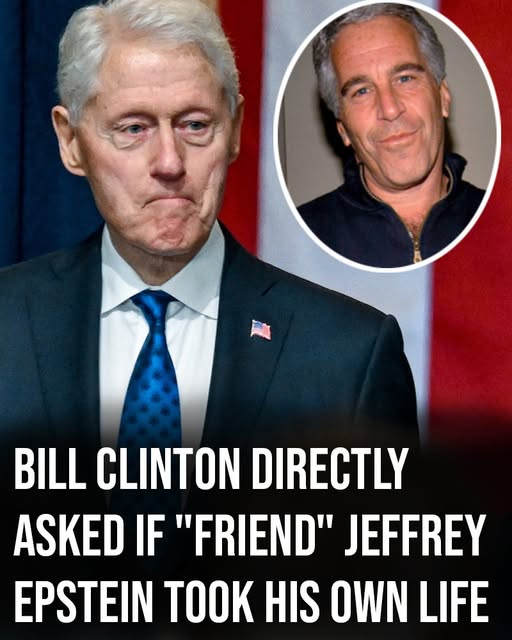
The question landed like a thunderclap in the hushed, tension-filled room. Bill Clinton, once the embodiment of political poise and public confidence, was now seated under oath, confronting a figure whose shadow has loomed over him for decades: Jeffrey Epstein. The atmosphere was dense with expectation and unease. Lawmakers leaned forward, pens poised above pads of paper; legal advisers murmured objections and reminders under their breath; and the cameras outside, though barred from the room, seemed to have seeped into every corner through the collective consciousness of the nation, waiting for a single slip, a single revelation. The former president, whose decades in public life had trained him to handle scrutiny with practiced calm, faced a question that cut deeper than any political query ever could: What, exactly, was the nature of his connection to Epstein, and what did he truly know?
The deposition, conducted behind closed doors in the solemn chambers of the House Oversight Committee, unfolded not just as a legal formality but as a profound psychodrama, a national reckoning of perception versus reality. With over three million pages of Justice Department documents newly released to the public, every statement, every pause, every carefully chosen word bore the weight of years of speculation, rumor, and partisan pressure. The air in the room seemed electric, as if the walls themselves were charged with the anticipation of history being recorded. Clinton was questioned directly about Epstein’s death—a topic that had long been cloaked in rumor and conjecture, and one that has fueled innumerable online debates, op-eds, and late-night news monologues.
Clinton’s response was carefully measured yet unmistakably human. He did not offer wild conspiracy theories, nor did he attempt to soothe public curiosity with facile explanations. Instead, he leaned into the uncertainty that has defined this saga, stating, in a manner both cautious and candid, that he had “accepted in [his] own mind” that he simply did not know the circumstances surrounding Epstein’s death. There was no attempt to deflect blame or obfuscate, only a quiet acknowledgment of the limits of his knowledge. For those observing through transcripts, leaks, or later reporting, the statement was at once frustrating, unsatisfying, and profoundly revealing: even someone of immense power and experience could be left without certainty when confronting such a tangled web of influence, secrecy, and tragedy.
The human dimension of this admission resonated deeply. Every pause in Clinton’s testimony, every subtle inflection in his voice, underscored the vulnerability that accompanies the recognition of one’s limitations. His advisers’ insistence that his relationship with Epstein had been “friendly, not friends” further highlighted the delicate balancing act of reputation management in the aftermath of scandal. In a climate where every word is scrutinized, where historical associations can be weaponized for political gain, even an ordinary admission of ignorance requires careful navigation. The tension between transparency and self-preservation, between honesty and the instinct for damage control, played out in real time, revealing the complex interplay between public accountability and personal vulnerability.
Outside the committee room, the deposition rippled through public discourse. Analysts, journalists, and everyday citizens alike grappled with the implications. For some, the acknowledgment of uncertainty reinforced doubts about how much information is ever fully accessible to those at the top of power structures. For others, it humanized a former president, reminding the nation that even the most experienced figures are subject to the limits of knowledge and the constraints of circumstance. Social media debates flared, opinion columns multiplied, and the dialogue around Epstein, his networks, and the broader question of accountability intensified. In the space between official findings and private doubt, the public was left navigating the uneasy terrain of partial truths and unresolved mysteries.
As Congress continues to deliberate the potential release of additional documents, and as investigative journalists comb through the sprawling archives of the DOJ, the tension remains unresolved. The deposition serves as a reminder that transparency is rarely absolute; it exists in gradients, punctuated by gaps, silences, and ambiguities. Citizens are compelled to engage critically, to weigh evidence and testimony, and to confront the uncomfortable possibility that some dimensions of the truth may remain forever obscured. Clinton’s candid acknowledgment of uncertainty, far from providing closure, underscores the enduring challenge of accountability in a world where secrecy, influence, and human fallibility intersect.
Ultimately, the moment captured in that closed-door session exemplifies the complex interplay between power, knowledge, and responsibility. It reminds the nation that even those who have occupied the highest offices are not immune to the unknown, and that confronting such unknowns publicly is an act fraught with both risk and moral significance. The deposition, in all its painstaking detail, reflects a nation’s ongoing struggle to reconcile transparency with human limitation, to navigate the intricate web of public scrutiny, and to seek understanding in a landscape where certainty is often elusive.