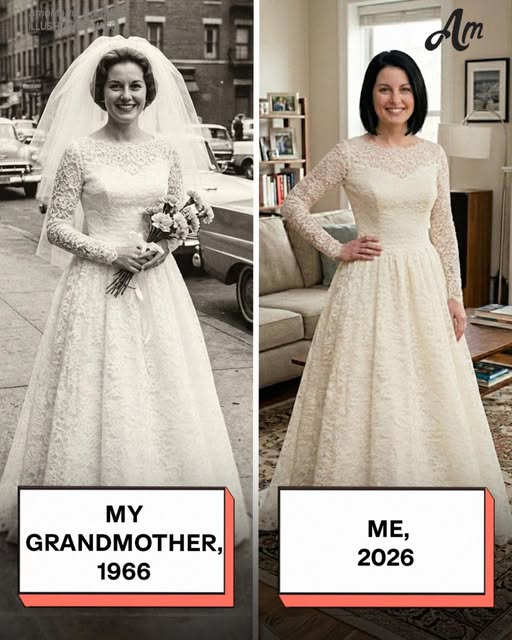
My grandmother raised me, loved me, and kept a secret from me for thirty years, all at the same time. She carried it quietly, folded into the routines of our lives, into the smell of the baked bread on Sunday mornings, the warmth of her knitted blankets, the way she always hummed in the kitchen when she thought I wasn’t paying attention. I didn’t realize that love could hold both protection and concealment until I found the truth sewn inside her wedding dress, tucked away in a pocket she must have stitched with intention. Inside, there was a letter. Her handwriting, the delicate, looping script that I’d traced countless times as a child, sprawled across the page. She had left it knowing I’d be the one to find it, that I’d be the one ready. And the words she wrote changed everything I thought I knew about who I was, about where I came from, and the story I’d been telling myself for decades.
Grandma Rose used to say that some truths fit better when you’re grown enough to carry them. She said it one warm summer night, the night I turned eighteen, when we were sitting on her old wooden porch after dinner, the cicadas loud in the dark, their hum vibrating through the air like some eternal background music. We were silent for a while, listening to the night and the chirping, the kind of quiet that only comes when the world feels entirely yours for a moment.
She had just brought out her wedding dress from the closet in its yellowed, slightly brittle garment bag. I remember the sound it made as she unzipped it, a soft ripping noise, like the faintest sigh. She held the dress up in the porch light, letting the warm yellow glow settle across the lace and satin as if she were offering it to the night itself. There was something sacred about the way she moved, the way she cradled the decades-old fabric as though it were a living memory, breathing again in my presence.
“Grandma, it’s sixty years old!” I said, laughing nervously, feeling the weight of its age but also its fragility.
“It’s timeless,” she corrected, with that quiet certainty that made arguing feel absurd, pointless. That was Grandma: full of stubborn truths she didn’t need to explain. “Promise me, Catherine. You’ll alter it with your own hands, and you’ll wear it. Not for me, but for you. So you’ll know I was there.”
I promised her, because of course I did. I believed her, even without understanding the full depth of what she meant. I didn’t understand what she meant by “some truths fit better when you’re grown.” I just thought she was being poetic. She always spoke in half-riddles and half-wisdom, as if life itself were a puzzle meant to be unfolded slowly.
I grew up in her house because my mother died when I was five, a loss I still feel in sharp, echoing moments. My father, according to Grandma, had walked out before I was born, never to return, never to call. That was the sum total of what I knew about him—no anecdotes, no stories, no photographs except the kind I imagined. Grandma never elaborated, and I learned young not to press. I learned that whenever I asked questions, her hands would still mid-motion, her eyes would drift somewhere else, and the air would fill with a quiet tension that told me everything and nothing.
She was my whole world. She was my home, my constant, the measure by which I gauged love and security. And so, I let it be.
I grew up, eventually moved to the city, chasing a life that felt bigger than our small hometown. But I drove back every weekend without fail. Home was wherever Grandma was. She kept me tethered to the world I had left behind, reminding me that no matter how far I went, someone was always there waiting, someone who had made space for me in her heart long before I even knew I belonged anywhere.
Then Tyler proposed. And suddenly, everything became the brightest it had ever been. The city lights faded into insignificance compared to the glow of a ring, the warmth of a hand holding mine, the laughter that came without caution.
Grandma cried when Tyler slid the ring onto my finger. Full, happy tears, the kind that streaked her cheeks and made the corners of her eyes crinkle. She didn’t bother wiping them away; there was too much laughter mixed in, the kind of laughter that breaks open something inside you you didn’t know needed breaking. She grabbed both my hands, squeezed them, and whispered, “I’ve been waiting for this since the day I held you.” And I believed her, because I always had.
Tyler and I began planning the wedding. It was a small, delicate process at first, a dance of color swatches and catering samples, flower arrangements and dress fittings. But Grandma had opinions, strong, unyielding opinions. She called me every other day, a new idea or a gentle correction always in tow. And I didn’t mind a single call. Each conversation, each suggestion, felt like her presence weaving itself into this new chapter, a continuation of a story that had begun long before I existed.
We laughed, debated, and sometimes argued over the smallest details. I could hear her chuckling through the phone as she insisted on one shade of ribbon over another or questioned the design of the place cards. Every call was a reminder that she was still there, still guiding me, still loving me in her particular, unstoppable way.
Four months into our plans, she was gone.
The news didn’t feel immediate; it felt impossible, as though the world had shifted slightly off its axis. The house was quiet. The hum of life that she carried with her, in the kitchen, in the garden, in the corners of every room, had vanished. I kept expecting her to appear at the door, waving some tiny detail about the wedding she thought I had overlooked. But she never did.
And then I found it.
It was in her wedding dress, folded carefully into the closet, the same dress I had promised to wear one day. There, tucked into the delicate lace, was the letter. Her handwriting, that graceful script, felt alive in my hands. As I read it, every word she had chosen resonated, each phrase a careful instruction, a confession, and a final gift.
She told me things I hadn’t known—about my mother, about my father, about choices she’d made to protect me, to shield me from heartbreak and confusion until I was ready. She explained that the family I thought I had was only part of the story, that the love I had known was never absent, just layered in ways I couldn’t have understood at five, at ten, at eighteen. And in those moments, sitting on her floor with the dress in my lap, I understood exactly what she had meant: some truths only fit when you are grown enough to carry them.
I wept for her, for the life she had lived quietly and fully, for the love she had given and the burdens she had carried alone. I wept for myself, for the years of questions I hadn’t asked, for the years I hadn’t understood the depth of her courage. And I wept for the wedding yet to come, knowing that she would be there, in spirit, when I wore her dress, altered by my own hands, carrying her legacy forward.
Her letter closed with words that would stay with me forever: “I have always loved you, and I always will. Wear this dress not to honor me, but to honor yourself. You are everything I hoped you would be, and I am finally free to watch from where I belong.”
In that moment, I realized something profound: love is not just what you give or receive in life—it’s what you carry forward, in memory, in actions, in the quiet moments where a hand isn’t there to hold you, but a heart is always with you.