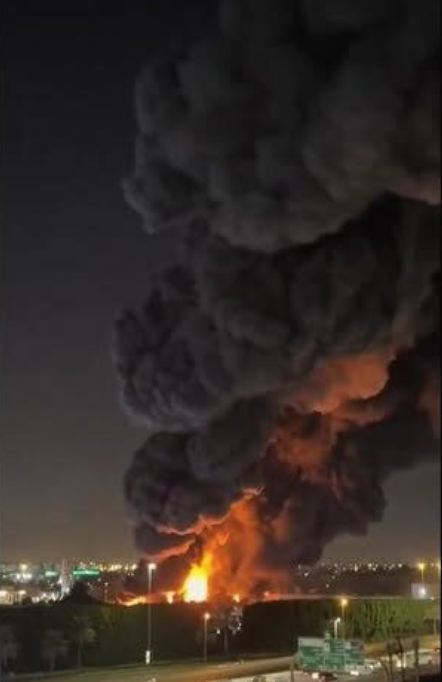
As the sun sets over the Eastern Mediterranean on March 2, 2026, the skyline of Tel Aviv and surrounding areas has become a theater of high-speed kinetic warfare. Following the morning reports of a joint U.S.-Israeli strike that reportedly killed Iran’s Supreme Leader, the anticipated “Second Wave” of retaliation has arrived with terrifying precision. Israeli defense officials, operating under a state of total national emergency, have confirmed that a massive barrage of ballistic missiles—launched from multiple points in Iran and potentially from proxy positions in Lebanon and Iraq—has breached national airspace, causing multiple impacts in densely populated civilian areas.
The events unfolded at a speed that tested even the world’s most advanced air defense systems. Around 4:10 PM local time, red alert sirens—an eerie, oscillating wail that has become the grim soundtrack of the decade—sounded across central Israel. Residents from the coastal plains of Tel Aviv to the Judean Hills had less than 90 seconds to reach fortified shelters. While “Iron Dome” and “David’s Sling” interceptors streaked across the sky attempting to neutralize the incoming threats, the sheer volume of the attack allowed several projectiles to slip through.
The Tragedy in Beit Shemesh
The most devastating impact occurred in Beit Shemesh, a rapidly growing city west of Jerusalem. Emergency services, including Magen David Adom and Home Front Command search-and-rescue teams, were dispatched to a residential neighborhood where a heavy ballistic missile—preliminarily identified as a Fattah-class medium-range projectile—struck a religious complex.
The structural damage was catastrophic. Authorities confirmed nine fatalities and at least 28 injuries. On-site triage revealed a spectrum of trauma, with two individuals in critical condition, two in moderate condition, and the remaining 24 with minor injuries caused mainly by flying glass and concussive force. Jerusalem district hospitals declared a “Mass Casualty Event,” clearing operating rooms and calling in off-duty surgical teams to handle the influx.
A Sanctuary Collapsed: The Synagogue Strike
Jerusalem District Police Chief Avshalom Peled reported from the wreckage that the missile directly hit a local synagogue. The explosion’s force caused the upper structure to collapse onto a reinforced public shelter beneath the building. Tragically, most, if not all, of the deceased were inside the shelter at the time. The reinforced concrete above crushed the ceiling, severely complicating rescue efforts. Specialized engineering units with heavy lifting equipment and thermal sensors were required to stabilize debris before survivors could be safely extracted. The psychological toll on first responders, many local volunteers, has been immense.
The Regional Powder Keg: A Fluid Security Context
The strikes on Tel Aviv and Beit Shemesh are part of a broader month-long escalation that began with attacks on Iranian nuclear facilities and culminated in the decapitation of Iran’s leadership. Israel’s defense establishment warns that the situation is “fluid and evolving,” signaling the likelihood of further attacks.
Security forces have been deployed in record numbers along the Green Line and throughout major cities to prevent civil unrest and manage the chaos of a nation under fire. Residents are instructed to remain in shelters indefinitely. The Home Front Command has suspended all non-essential activities, closed schools, and limited indoor gatherings to ten people.
Coordination with strategic allies, particularly the United States, has intensified. Reports indicate the USS Abraham Lincoln carrier strike group is providing real-time satellite data to help the Israel Defense Forces predict missile launch sites. Analysts speculate that a “Third Phase”—a large, multinational counter-offensive—is being planned in the Kirya’s underground war rooms in Tel Aviv.
The Fog of War and the Path Ahead
As the dust settles over Beit Shemesh, the broader strategic implications are becoming clear. This is no longer a shadow war but a direct state-on-state confrontation with the potential to draw in every major regional power. The precision of the synagogue strike—whether deliberate or due to GPS jamming—may justify a “disproportionate” Israeli response.
Authorities urge extreme caution and advise the public to ignore unverified social media reports, which are already spreading misinformation about the number of impact sites. “Clarity will come in the coming hours, but for now, the priority is saving lives,” a government spokesperson said. The world watches the skies over Israel, waiting to see if diplomacy still has a role or if the region has entered a full-scale, era-defining conflict.
For residents of Tel Aviv and Jerusalem, the immediate future is measured in the minutes between sirens. As hospitals strive to save survivors of the Beit Shemesh strike, the nation remains on edge, bracing for the next radar alert and the devastating impact that could redefine the Middle East in the 21st century.