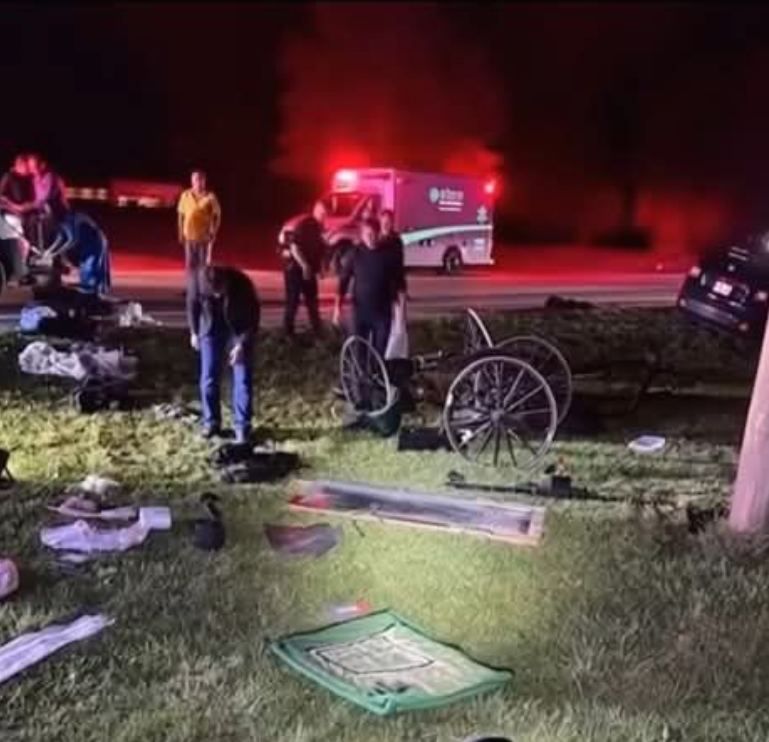
On a quiet stretch of State Road 218 near Berne, Indiana, a tragic collision unfolded, symbolizing the clash between tradition and modernity. Late one evening, beneath a sky far removed from the bright lights of the city, a way of life that had persisted for centuries collided with the fast-paced realities of the 21st century. A Jeep, traveling at highway speeds, crashed into the rear of an Amish buggy carrying nine people. What began as a peaceful journey home for a family turned into chaos in an instant, as the gentle rhythm of horse hooves was drowned out by the roar of helicopter blades and the harsh glare of emergency floodlights cutting through the darkness.
The aftermath of the crash painted a heartbreaking picture. Seven of the nine occupants of the buggy were injured, the majority being children whose lives are now divided into a “before” and “after” marked by this tragic event. The father, the cornerstone of the family, was airlifted from the scene, his condition becoming a focal point of concern for a community that measures its strength through close-knit family ties. As paramedics worked tirelessly to stabilize the injured, the wreckage of the buggy, a jumble of timber and metal, served as a stark reminder of the forces at play when a two-ton SUV collides with a horse-drawn carriage.
The Forensic Search for Answers
As local authorities began their investigation, the spotlight shifted to the driver of the Jeep. In 2026, even in the most rural areas, legal protocols following such an incident are stringent. Blood tests were conducted to determine if impairment was a factor in the driver’s failure to notice the slow-moving vehicle. While the results are still pending, the broader question of why lingers over the community: Was this a case of distracted driving, a momentary lapse due to a smartphone screen, or simply the inherent danger of sharing a road built for modern vehicles with horse-drawn carriages?
The investigation is expected to look into the visibility of the buggy. State laws often require Amish carriages to have lanterns, battery-operated lights, and reflective tape. But at highway speeds, even with these measures in place, the gap in recognition is perilous. The closing speed between a car and a buggy is so fast that a driver has only seconds to react once the buggy enters their headlights. This “recognition gap” is a deadly consequence of infrastructure where the 19th and 21st centuries must coexist.
A Community Under Pressure
For the Amish community in Berne, this tragedy is not just a news story; it’s a painful reminder of the daily risks they take to preserve their way of life. The Amish do not reject technology out of belief in its evil but to uphold Ordnung—a set of rules that ensures their community stays intact and resists outside influences. Rejecting automobiles is central to this way of life, a way to keep their existence slow, local, and connected to church and farm.
However, as the “English” (the Amish term for non-Amish people) continue to settle in rural areas, roads once thought to be quiet country lanes have become high-speed corridors for commuters and freight. Every trip to the market, visit to a neighbor, or journey home from church now carries the shadow of this crash. The Amish must now balance their desire for separation with the unavoidable reality of a faster world. This tragic collision has sparked a much-needed conversation about road safety, visibility, and the right to the road.
The Logistics of Survival: Modern Medicine and Traditional Faith
There’s an undeniable irony in such accidents: while the Amish live disconnected from modern technology, they are often saved by its most advanced forms. The image of a father being airlifted by a medical helicopter underscores the complex relationship the Amish have with the modern world. They are self-sufficient, yet in times of crisis, they rely on the expertise of trauma surgeons and flight nurses to save their lives.
The recovery process for the seven injured will be long and challenging, but they will be supported by a community well-equipped to face such trials. In Berne, the principle of “bearing one another’s burdens” is not just a saying—it’s a way of life. As the children heal, the community will come together to manage farms, provide meals, and cover the costs of modern medical care. This collective resilience is the Amish response to life’s unpredictable challenges, a social safety net that’s as strong as any in the modern world.
Re-evaluating the Shared Roadway
Looking ahead to the rest of 2026, the crash near Berne serves as a reminder to reassess rural road safety. In states with significant Amish populations like Indiana, Ohio, and Pennsylvania, there is an ongoing effort to modernize infrastructure while respecting the traditional values of Amish communities. Some counties have begun to widen shoulders for buggy traffic or implement additional signage to warn drivers of horse-drawn vehicles.
But infrastructure can only go so far. The critical factor is the awareness and empathy of the driver behind the wheel of the modern vehicle. The crash is a tragedy of perception—modern life moving so quickly, distractedly, that it fails to recognize the slower, more deliberate pace of another world. It serves as a sobering reminder that the privilege of speed carries with it a deep responsibility for vigilance.
A Legacy of Resilience
In time, the wreckage on State Road 218 will be cleared, and the debris will be swept from the road. But the emotional impact on the Berne community will linger for generations. The children who survived will carry the memory of that fateful night, forever marked by the trauma of the sirens.
The story of the Berne crash is a story of a collision between two incompatible paces of life. It is a somber reflection on the cost of maintaining a traditional identity in a world that values speed above all else. As the father fights for his life and his children begin to heal, the Amish community continues, moving forward, one clip-clop at a time, undeterred by the violence of the modern world. They remain steadfast in their commitment to a life defined by faith, family, and an extraordinary, rooted love.