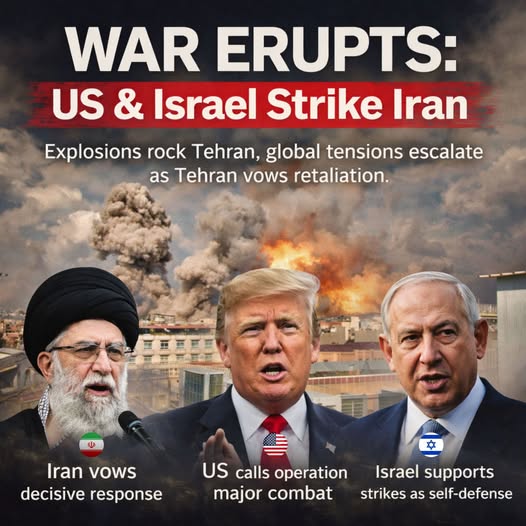
According to early reports, at least 40 people have been killed in a series of coordinated strikes, with dozens more suffering injuries of varying severity. Among the victims were individuals at a girls’ school in southern Iran, where local sources reported particularly high casualties, including students and staff. Eyewitnesses described scenes of chaos as emergency personnel rushed to evacuate survivors from collapsed buildings and areas heavily damaged by the attacks. At this stage, the full extent of the destruction, the number of missing persons, and the confirmed death toll remain unclear, as authorities continue to gather information from affected areas. The lack of comprehensive data reflects both the scale of the operation and the difficulty of accessing some of the hardest-hit regions.
Smoke and flames were visible rising over multiple cities in the aftermath of the strikes, with explosions reported near several key infrastructure sites, including bridges, energy facilities, and military installations. Emergency services, including ambulances, firefighting units, and medical teams, were quickly deployed to respond to the crisis. Hospitals in the region reported being overwhelmed with wounded civilians, many of whom sustained severe injuries, and medical staff struggled to treat the influx while supplies ran short. In some regions, communications have been disrupted due to damage to cellular networks and internet infrastructure, making independent verification of the situation challenging for journalists and international observers. Satellite imagery later revealed damage consistent with high-explosive strikes, highlighting the intensity and coordination of the operation.
Officials in Washington and Jerusalem have not yet released detailed statements regarding the operational specifics of the attacks. However, intelligence sources suggest that the strikes were targeted at strategic military assets, including missile production facilities, command centers, and storage depots. Analysts note that such actions may have been intended to weaken Iran’s regional influence and reduce its military capabilities amid mounting tensions and hostilities in the Middle East. Some experts argue that the strikes also serve as a warning, signaling to Tehran the limits of its regional maneuvers and reinforcing the commitment of the United States and Israel to maintaining a strategic balance in the area.
Iranian authorities have condemned the attacks in the strongest possible terms, labeling them an act of aggression and promising a swift response. State media broadcast dramatic images of damaged buildings, smoke rising from urban areas, and crowds gathering in protest. Senior Iranian leaders warned that retaliation could follow rapidly, emphasizing that the country reserves the right to respond to any violation of its sovereignty. Public demonstrations were reported in several cities, with citizens expressing anger and demanding action, while security forces were deployed to maintain order amid growing tensions.
Governments across the region are closely monitoring developments, concerned that the situation could escalate and draw in additional actors. Neighboring states have heightened security alerts, and intelligence agencies are reportedly coordinating to assess potential spillover effects. Diplomatic channels are active behind the scenes, as global powers—including European nations and the United Nations—urge restraint and caution to prevent the outbreak of a wider conflict. Analysts highlight that even a limited escalation could have far-reaching consequences for regional stability, energy markets, and international trade, particularly in the Persian Gulf, where key shipping routes are vulnerable to disruption.
As rhetoric intensifies from both sides, the international community watches anxiously. Political leaders, think tanks, and security analysts are closely following the situation, assessing both immediate threats and long-term implications. With casualties already reported, the humanitarian impact is a growing concern, as local authorities attempt to provide shelter, medical care, and support for affected families. Humanitarian organizations have begun preparing to deploy emergency aid, anticipating that more civilians could be impacted if the conflict escalates further. The threat of retaliation looms large, creating an atmosphere of uncertainty and fear that could persist for days or even weeks.
The tensions mark a dramatic escalation in the Middle East after reports that the United States and Israel carried out major, coordinated strikes against targets inside Iran. Observers note that this represents one of the most serious direct confrontations between these long-time adversaries in recent years, raising questions about how the conflict might unfold in the near future. Past encounters between these nations and Iran have involved covert operations, cyberattacks, and proxy conflicts, but the scale and coordination of these strikes suggest a more direct approach aimed at achieving strategic objectives.
Local eyewitnesses described harrowing scenes immediately following the strikes. Smoke plumes could be seen across multiple urban centers, and the sound of explosions rattled nearby neighborhoods. Many families fled their homes in panic, while others sought shelter in schools, mosques, or community centers. Reports indicate that power outages and disruptions to water and gas supplies compounded the difficulties for first responders. Emergency coordination centers worked around the clock to triage casualties, organize transportation to hospitals, and provide temporary shelters for those displaced.
Media organizations are reporting from within the country and via international correspondents, piecing together information from social media, government announcements, and satellite imagery. Analysts have noted that repeated attacks of this nature can have a significant psychological impact on the population, potentially fueling anti-Western sentiment, regional instability, and a heightened risk of further retaliatory attacks.
In the broader geopolitical context, the strikes underscore the fragile balance in the Middle East, where longstanding rivalries, sectarian divides, and proxy conflicts continue to influence the actions of major powers. The international community, while closely monitoring the immediate situation, is also considering long-term strategies to prevent escalation and ensure humanitarian needs are addressed. Political observers emphasize that the coming days will be critical in determining whether tensions spiral into a wider regional conflict or remain contained.
For now, the situation remains volatile. With casualties mounting, infrastructure damaged, and the possibility of retaliatory strikes, analysts warn that any misstep could quickly escalate into broader confrontation. Diplomatic efforts are ongoing, but the risks of rapid escalation remain high. Civilians, governments, and international institutions alike are watching closely as events unfold, fully aware that the next hours and days could determine the trajectory of regional security and stability.