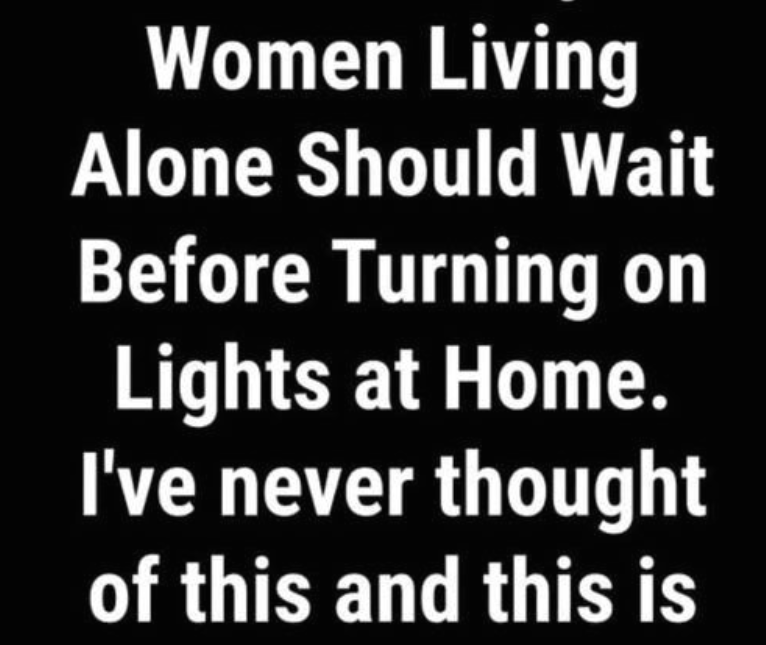
In a time dominated by smart alarms, doorbell cameras, motion sensors, and digital locks, it is striking that one of the most powerful safety reminders to circulate in early 2026 required no technology at all. A viral video shared by a woman named Mary Alice offered advice so simple it almost felt counterintuitive: when arriving home alone at night, don’t immediately turn on the lights. In an online environment often saturated with exaggerated threats and sensational warnings, her message stood out for its calm practicality and its emphasis on personal awareness rather than panic. Instead of promoting gadgets or fear, she focused on reclaiming control through small, intentional behavior.
Her suggestion resonated deeply, especially among people who live alone in apartments, small houses, or compact urban spaces where privacy can feel fragile. We are conditioned to associate light with safety. Flipping the switch the moment we step inside feels natural—light symbolizes comfort, control, and relief from uncertainty. But Mary Alice highlighted a subtle risk: when lights blaze on instantly in a dark neighborhood, they signal arrival. They announce presence. To anyone watching from outside, that glow confirms not only that someone is home, but often exactly which room they’ve entered.
This automatic reaction—what could be called the “instant light reflex”—is predictable. And predictability can reduce personal advantage. A sudden illumination provides information: the occupant is inside, likely distracted with routine tasks, perhaps placing down keys or checking their phone. By contrast, stepping inside and remaining in darkness for a short moment keeps that information private. The exterior remains unchanged—quiet, still, unreadable. The arrival has happened, but it has not been broadcast. That small pause shifts control back to the person inside.
Mary Alice explained that her perspective came from lived experience rather than professional security training. One evening, she sensed she might be watched—not because of a clear threat, but because of that subtle internal alert many people recognize. Instead of reacting automatically, she stepped into her home and stayed still. In the dark, she allowed her senses to adjust. Without interior lights creating a “fishbowl” effect—where she would be visible from outside while unable to see outward—her eyes gradually adapted. She could listen to the ordinary sounds of her home, confirm nothing felt disturbed, and assess her surroundings before revealing her presence.
That quiet pause created space between instinct and action. It allowed her to reclaim a sense of agency. Rather than rushing to eliminate darkness, she used it to her advantage. The darkness was not an enemy; it was a buffer. It gave her time to orient herself, to breathe, and to confirm that her space was secure before lighting it up.
As the video spread, it sparked a broader discussion about vulnerability and routine. Many viewers shared similar experiences—the unease of walking home at night, the discomfort of unlocking a door in a dim hallway, or the awareness of how visible they felt through uncovered windows. What emerged was not widespread fear, but a collective reflection on how much of our daily behavior is automatic and how those habits can unintentionally reveal patterns. People began to reconsider how predictable their movements might appear from the outside.
For those living in tiny houses or compact dwellings with large windows, the advice carried particular weight. Smaller homes can feel exposed, especially at ground level. Managing light becomes not only an aesthetic choice but a practical one. Entering in darkness, even briefly, allows for a moment of assessment—checking surroundings, ensuring no unexpected movement nearby—before becoming the focal point of the environment.
The deeper appeal of Mary Alice’s message lies in empowerment. Modern security culture often suggests that safety depends entirely on external devices—cameras, apps, monitoring systems. While those tools can help, her reminder emphasizes that awareness is equally important. Choosing when to be seen is a form of autonomy. It’s not about living in fear or constant suspicion; it’s about cultivating presence and mindfulness. It’s about understanding that safety also comes from how we move through space.
In a culture that prizes visibility and constant connectivity, the idea of “staying dark” even for a few minutes feels almost rebellious. We are used to broadcasting our locations through check-ins, posts, and predictable routines. Her advice suggests there is strength in selective invisibility. Sometimes security lies not in announcing ourselves, but in choosing when and how to appear.