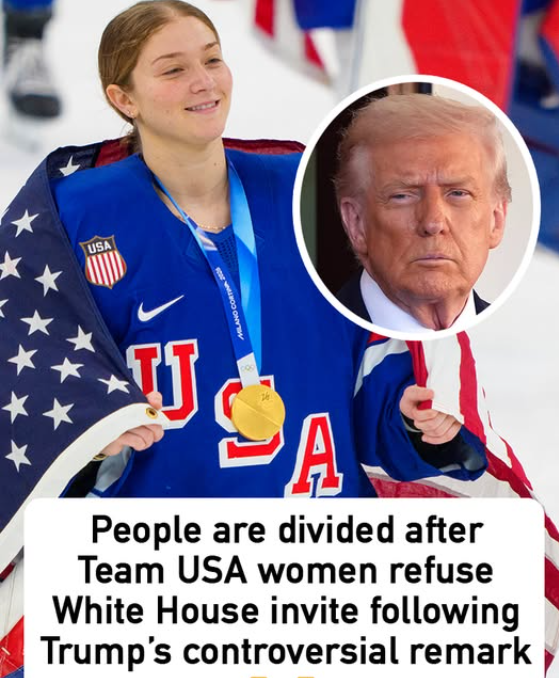
President Trump’s voice resonated with pride and congratulation, filling the room with its familiar boom. Yet in an instant, a single joking remark about the women’s hockey team shifted the moment. Within hours, what had begun as a gold‑medal celebration became a flashpoint for a national conversation about respect, authority, and the question of who truly represents America. When the women’s team responded with a polite but firm “no,” the country divided almost immediately, and the story was just beginning.
Both the men’s and women’s teams left Milan as champions, their victories indisputable. But the aftermath exposed a very different kind of contest—one measured not in points on the scoreboard, but in public perception. Trump’s congratulatory phone call to the men, coupled with his quip about needing to include the women or risk political consequences, landed in a nation already primed to dissect and debate every syllable. To some, it was a harmless joke; to others, it served as a stark reminder that women’s achievements are often still footnoted or diminished.
The women’s formal yet gracious refusal—explaining that academic and professional obligations prevented their participation—became a canvas for projection and debate. Supporters interpreted their stance as quiet defiance, a demonstration of dignity and independence; critics argued it unnecessarily politicized a rare national honor. Yet, in reality, their choice reflected a recurring dynamic faced by female athletes: the pressure to embody both excellence and decorum, to serve simultaneously as symbols and as citizens with their own priorities.
The medals will shine for decades, testament to the skill, endurance, and dedication of these athletes. But alongside the physical trophies remains the more subtle legacy: a team that asserted its agency, choosing to define its own presence on the national stage rather than allow it to be framed for others’ convenience. Their decision, quiet but resolute, became as much a part of the story as the gold itself.