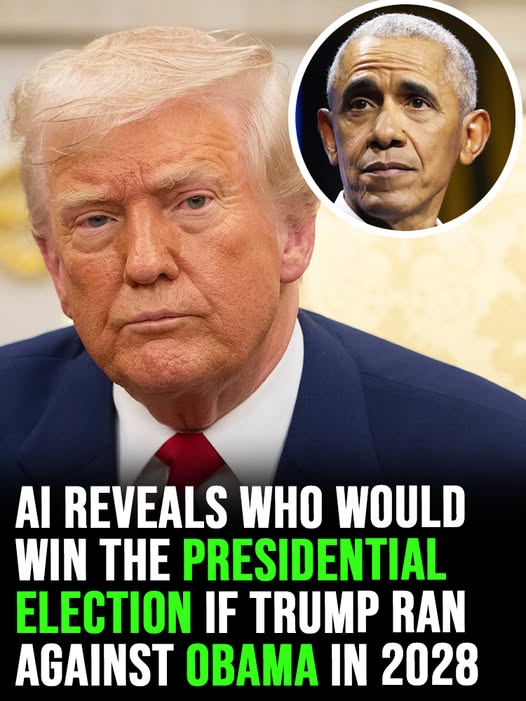
The question isn’t meant to be real, at least not in any legally or constitutionally feasible sense. Yet somehow, the idea rattles Washington as though it could manifest tomorrow. Imagine an AI tasked with pondering the unthinkable: a 2028 presidential election featuring both Donald Trump and Barack Obama on the ballot. No 22nd Amendment. No term limits. No conventional boundaries. Just two titans of modern American politics, clashing once more under the unforgiving gaze of a nation simultaneously fatigued and fascinated, a citizenry teetering between hope, cynicism, and outright dread. The scenario, though impossible under current law, forces every observer to confront not only the personalities involved but the broader dynamics of power, trust, and institutional strain in the United States.
In this hypothetical showdown, the AI doesn’t produce a neat, decisive outcome or a narrow photo finish. Instead, it maps a country that feels perpetually exhausted by crises, a nation where the ordinary rhythms of governance have been disrupted so thoroughly that voters are less interested in charisma or ideology than in the faint promise of calm. The scenario paints streets and suburbs alike populated by citizens weary of endless political spectacle, where daily life has been punctuated by an unbroken chain of economic shocks, international tensions, and domestic upheavals. Against this backdrop, the AI suggests Barack Obama would emerge as the steadier, more reassuring figure—less because of policy specifics than because he represents a return to predictability and procedural competence. In this frame, the election transforms from a simple contest between left and right into a referendum on stability versus disruption, continuity versus chaos, measured governance versus performative spectacle.
Meanwhile, Donald Trump’s enduring appeal remains undeniable. His brand of combative, grievance-driven politics still electrifies a loyal base, especially voters who see in him a champion willing to defy conventions, institutions, and elites alike. Rally crowds would cheer as he casts himself as the antidote to bureaucratic inertia, a disruptor who refuses to apologize for asserting power and speaking directly to the frustrations of millions. Yet, according to the AI, this loyal base, however passionate, is outnumbered by a broader electorate increasingly wary of unending chaos, scandal, and hyper-partisan conflict. In this imagined 2028, the electorate is less swayed by bravado and more concerned with the emotional and social costs of perpetual political turmoil. The question becomes: who can be trusted to provide at least the illusion of respite from the relentless cycle of confrontation and media frenzy?
Still, the scenario is grounded in impossibility. The 22nd Amendment explicitly bars both men from seeking a third term. Undoing such a constitutional safeguard would require a near-impossible political and legal effort: congressional supermajorities, state ratifications, and a public willingness to rewrite one of the few unambiguous guardrails in American governance. The legal barriers themselves underline why this exercise is purely speculative. And yet, the thought experiment serves a deeper purpose than mere prediction. It functions as a mirror reflecting America’s ongoing anxieties about power, loyalty, and institutional oversight. It asks uncomfortable questions: do citizens value the existence of hard limits on executive authority, or would they prefer the freedom to repeatedly elect the same leader, regardless of the consequences? How much risk is the public willing to tolerate in exchange for familiarity or perceived competence?
Beyond the legal framework, the AI’s scenario touches on psychological and cultural realities that define the modern electorate. In imagining this race, it considers the exhaustion embedded in daily life: the relentless news cycle, the erosion of civic norms, the polarization that has fractured neighborhoods, workplaces, and families. Voter decisions, in this context, are not solely about policy proposals or ideological purity. They are shaped by collective memory of past crises, the desire for emotional relief, and the instinct to prioritize stability over excitement. The AI’s projection shows that even in a purely fantastical matchup, the nation’s appetite for drama is tempered by a yearning for predictability.
Ultimately, this imagined 2028 election functions less as a forecast than as a philosophical exercise. It forces reflection on the tension between freedom and restraint, between the thrill of rebellion and the comfort of routine. It asks citizens to consider: what is more dangerous—the absolute consolidation of authority in a familiar figure or the uncertainty of continuous turnover? In doing so, the thought experiment transcends personalities entirely, touching on fundamental questions about democracy itself, the social contract, and the delicate balance between individual choice and collective stability.
Even if Donald Trump and Barack Obama will never meet on the 2028 ballot, the exercise is valuable. It sharpens awareness of the stakes inherent in every election, highlights the subtle dynamics of voter fatigue and institutional trust, and illuminates the latent desire for both renewal and reassurance in American politics. In the end, the scenario reminds us that democracy is not only about who is eligible to run but about the broader psychological, social, and cultural forces that shape every vote cast, every debate held, and every headline read. And in that sense, the unthinkable matchup becomes a lens through which the nation can examine its past, present, and the fragile future of its political norms.