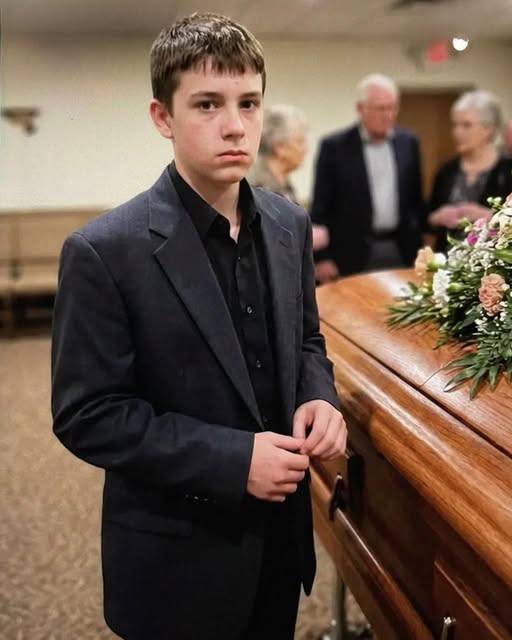
I was burying my husband when a strange boy stepped forward and calmly detonated my entire marriage. It wasn’t dramatic. He didn’t shout. He didn’t cry. He simply waited until the last handful of dirt hit the coffin, until the murmurs softened and the crowd thinned, and then he spoke.
One sentence. Seven words.
And just like that, twenty-eight years of trust trembled beneath my feet.
He mentioned a photograph. A woman’s name I had never heard. Something about papers. Responsibility. A promise.
In that instant, grief stopped feeling like a weight pressing down on me and started feeling like the ground itself giving way. My husband—Daniel—had been my certainty. Nearly three decades of shared mornings, shared arguments, shared plans for a retirement we would now never see. And suddenly, standing in a cemetery with wilting flowers at my feet, I was staring at a stranger who spoke as if he knew my husband in a way I did not.
A secret photo. A woman named Donna. A hidden guardianship.
Or something worse.
That night, the house was unbearable. Silence has a different texture after a funeral—it hums. Every room felt staged, as though Daniel might step back into it and explain everything. His shoes still by the door. His coffee mug still faintly stained. I stood in our bedroom, staring at the safe in the closet I had never once opened without him.
My hands trembled as I entered the code.
Inside were documents I didn’t recognize. A sealed envelope with Donna’s name written in Daniel’s careful handwriting. And the photograph.
It wasn’t romantic. That’s what startled me most. No embrace. No kiss. Just Daniel standing beside a woman whose eyes looked exhausted, and between them, a thin boy with wary shoulders and an expression too old for his face.
Adam.
I held that photograph like it was evidence in a trial, my grief calcifying into anger. Every unexplained Saturday. Every time Daniel had come home later than expected, smelling faintly of hospital disinfectant or city air instead of the hardware store he claimed to visit. Every tired smile. Every distracted nod when I asked about his day. The word “volunteering,” which he had used so often and so gently, now echoed like a rehearsed alibi.
Had my entire marriage been a performance?
I replayed years in my mind, searching for cracks I had ignored. Anniversaries he seemed distant. Phone calls he took outside. The modest withdrawals from our savings that I’d never questioned because we had always trusted each other implicitly. Trust had been the oxygen of our marriage. And now it felt poisoned.
The next morning, I found Adam at the cemetery again. He stood near Daniel’s grave, hands in his pockets, as if unsure whether he belonged there. I approached him not as a widow seeking comfort, but as a woman bracing for betrayal.
“Tell me the truth,” I demanded, my voice sharper than I intended. “All of it.”
I was prepared to confirm the ugliest version of my husband—that he had lived a second life, fathered a child, built another family in the shadows of ours.
Instead, Adam told me about a car accident twenty-eight years ago. About Donna’s husband dying instantly. About hospital bills and eviction notices. About a newborn baby and a mother unraveling under the weight of shame and poverty. Daniel had been there that night, Adam said. A volunteer firefighter who pulled them from the wreckage.