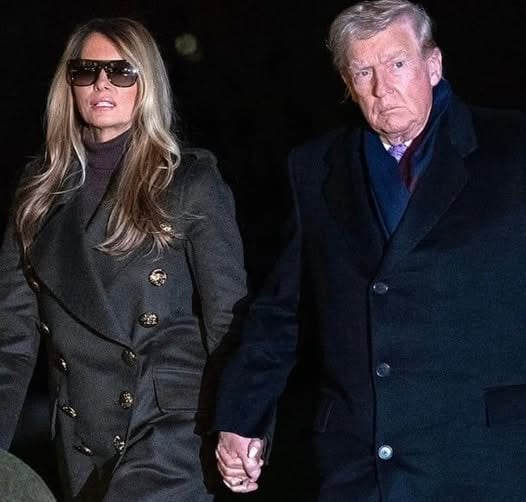
Public panic exploded almost overnight. What began as a single blurry ringside photograph quickly spiraled into a digital firestorm. One aging president, one ambiguous image, and suddenly the internet was convinced it had uncovered something hidden in plain sight. Claims spread at lightning speed. Speculation hardened into certainty. Comment threads filled with amateur diagnoses, slowed-down video clips, and red circles drawn around shadows and wrinkles. Strangers dissected every fold in his suit, every angle of his posture, every perceived expression on his face as if they were decoding a classified file.
In the age of viral outrage, it doesn’t take much—just one frame frozen at the right (or wrong) moment—to ignite suspicion. Within hours, narratives formed. By the next morning, those narratives were being repeated as if they were verified truths. The louder the reaction became, the more difficult it was to separate observation from assumption. The photograph stopped being a simple image and became a canvas for projection, reflecting political anxieties, partisan divides, and long-standing debates about leadership and age.
Yet behind the noise, behind the viral posts and trending hashtags, the official medical record told a very different story.
The uproar surrounding a single sports-arena snapshot says as much about modern media consumption as it does about Donald Trump himself. His age, his well-documented health history, and his polarizing presence in American politics make him an inevitable focal point for scrutiny. For supporters and critics alike, any ambiguous detail can feel like confirmation of preexisting beliefs. In such an environment, a blurry image is not neutral—it becomes evidence in a larger, ongoing narrative battle.
However, according to his most recent White House medical report, clinical findings showed normal cardiac, pulmonary, and neurological function consistent with a man of his age. The report referenced prior procedures that were described as successful, along with routine preventive monitoring and ongoing care. Physicians outlined standard health metrics—blood pressure, cholesterol levels, and cognitive screening results—without indicating any acute or alarming concerns. In other words, the formal evaluation conducted by medical professionals did not align with the dramatic conclusions circulating online.
Fact-checkers who reviewed the viral claims found no substantiated evidence that the photograph revealed anything medically significant. Experts cautioned against diagnosing individuals based on still images, noting that lighting, posture, and camera angles can create misleading impressions. The administration dismissed the circulating theories as unfounded, emphasizing that official health updates are released through structured medical assessments, not inferred from snapshots taken in dynamic public settings.
For Americans who have watched presidents undergo intense public scrutiny for generations, this moment feels familiar—yet amplified. From televised health briefings in earlier decades to today’s instantaneous digital commentary, presidential health has always been a subject of interest. What has changed is speed. Social media compresses the timeline between speculation and conviction. A rumor that once might have lingered in whispers now becomes global within minutes, amplified by algorithms designed to reward engagement rather than verification.
The incident highlights a broader cultural shift: the growing tendency to treat visual fragments as comprehensive evidence. In a hyperconnected society, images carry enormous persuasive power. But a photograph is a single second in time, stripped of medical context, stripped of clinical measurement, stripped of professional interpretation. It cannot substitute for diagnostic tools, laboratory data, or physician evaluation.
At its core, the controversy reveals more about public trust and information consumption than about the president’s health itself. When institutions release official reports, some citizens accept them; others question them reflexively. In that environment, ambiguity becomes fertile ground for suspicion. The debate stops being about one image and becomes about credibility, transparency, and the tension between official statements and public perception.
In the end, photographs and comment threads are no replacement for comprehensive medical exams. Viral certainty often outpaces verified fact, but speed does not equal accuracy. A healthier public conversation requires patience—the willingness to wait for documented evidence. It requires proportion—the ability to weigh a blurry image against a structured medical evaluation. And above all, it requires commitment to verified information over speculation dressed as revelation.
In a digital era where outrage can erupt in seconds, the discipline to pause may be the most valuable civic habit of all.