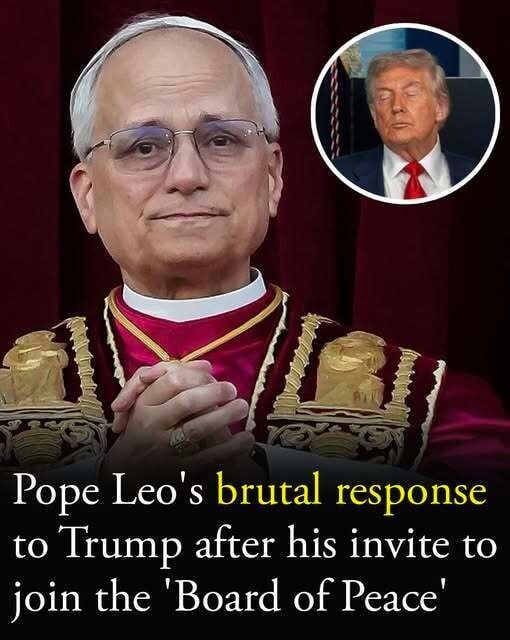
The refusal was quiet, almost understated, yet its impact reverberated like a shockwave across global diplomatic circles. President Trump had unveiled his billion‑dollar “Board of Peace,” a high-profile initiative framed as a bold shortcut around traditional international institutions, and he had publicly extended an invitation to the Pope to join. Many expected a blessing, a nod from one of the world’s most influential moral authorities, a stamp of legitimacy for an ambitious project billed as reshaping peace efforts in some of the world’s most volatile regions. Instead, the Vatican quietly walked away. The decision, while understated in tone, sent a seismic message: moral authority cannot be bought, and diplomacy is not a commodity to be purchased with billions.
Trump’s vision of the “Board of Peace” was audacious. With a $1 billion price tag for permanent membership, it was designed to position Washington at the center of global peace-making, offering governments a chance to join a high-powered consortium with direct influence over conflict resolution. Some nations signed on enthusiastically, swayed by the promise of immediate engagement and proximity to power. Others, however, paused, evaluated the implications, and ultimately declined. Among those who hesitated most carefully was the Vatican. The Holy See, with centuries of diplomatic experience and a global moral footprint, considered not only the initiative itself but also the message that accepting it would send about their own role in the pursuit of peace, particularly in contested regions like Gaza, the West Bank, and other conflict zones.
Behind closed doors, Vatican diplomats and advisers debated the merits and risks of participation. They considered the optics of aligning with a single nation’s unilateral project, the potential for appearing to favor political over ethical priorities, and the implications for the Church’s longstanding role as a neutral moral arbiter. Cardinal Pietro Parolin, Secretary of State for the Vatican, ultimately delivered a firm but measured statement: peace, especially in regions of intense humanitarian and political complexity, must be pursued through inclusive and established institutions, such as the United Nations. True peacemaking, he emphasized, requires multilateral engagement, adherence to international norms, and an unwavering focus on protecting vulnerable populations, rather than advancing the interests of a single state or its financial contributors.
By declining the invitation, Pope Leo and the Holy See preserved something the Vatican has long valued above access, prestige, or political influence: moral and diplomatic independence. In a world where the loudest voices often dominate headlines, the Vatican’s silence spoke volumes. It was a reminder that legitimacy and authority in international affairs are earned not through wealth or spectacle, but through ethical consistency, impartiality, and a commitment to principles that transcend any one nation’s agenda. The refusal underscored that peace is not a commodity to be brokered in private clubs or secured through high-dollar memberships; it is a delicate, collective endeavor requiring inclusivity, patience, and respect for established frameworks that have long been trusted to manage conflict.
Trump’s initiative may still proceed with willing partners, but it now faces a critical limitation: it will operate without the moral cover that Rome could have provided. In diplomacy, this absence is not a minor detail—it shapes perception, credibility, and the willingness of other states to engage seriously. Analysts note that when the Vatican steps back from an initiative, the message is interpreted globally as a call for caution, due diligence, and reflection on ethical responsibilities. For Washington, the move serves as both a rebuke and a subtle lesson in the limits of financial leverage in matters of international peace and humanitarian concern.
Beyond the immediate political and diplomatic consequences, the episode highlights the broader tension between power, wealth, and ethics on the world stage. Initiatives like the “Board of Peace” may generate headlines and media attention, but when moral authority is absent, the true work of conflict resolution—the patient negotiations, consensus-building, and protection of vulnerable communities—cannot be achieved with money alone. The Vatican’s quiet refusal underscores that legitimacy, trust, and ethical influence remain currencies far more valuable than dollars, and that any effort to redefine peace must account for the voices of impartial institutions, not just those with the deepest pockets.
In the end, the refusal sent a message that will echo long after the announcement: in global diplomacy, influence is earned, not purchased. The Vatican’s stance reaffirmed centuries of precedent, demonstrating that moral and ethical integrity cannot be sidelined, even in the face of ambition, spectacle, or billion-dollar incentives. Trump’s “Board of Peace” may move forward, but it now must navigate a world acutely aware that true peacemaking cannot be brokered with money or unilateral authority—it requires legitimacy, inclusion, and the quiet, often invisible endorsement of those whose credibility rests not on headlines, but on enduring principles.