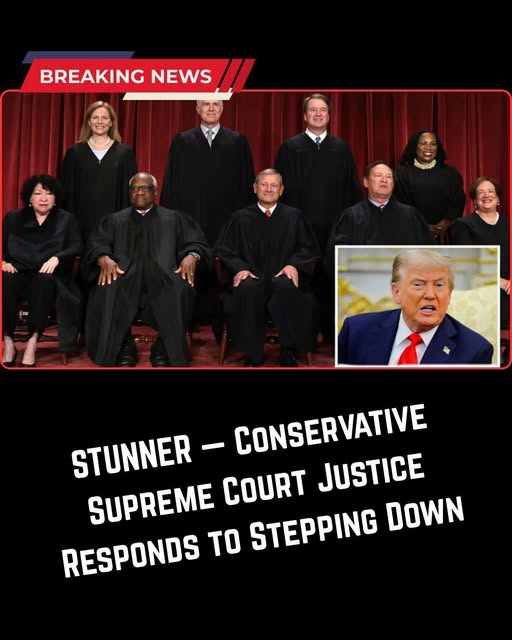
Rumors are exploding in Washington, bouncing from corridor to corridor, from news cycle to news cycle. A 75-year-old Supreme Court justice, a looming presidential election, and a president eager to cement his legacy with one more appointment on the nation’s highest court — the ingredients for speculation are impossible to ignore. Behind the polished public façade, aides, political operatives, legal analysts, and journalists are poring over calendars, book tours, and Senate schedules like generals studying battle maps. Every handshake, every public appearance, every phrase in a prepared statement is dissected for hidden meaning. If Justice Samuel Alito were to step aside now, conservatives could lock in a long-term advantage on the Court, potentially reshaping American law and society for decades to come.
The speculation surrounding Alito’s future is about far more than one man’s retirement. It is about the balance of power for an entire generation of Americans. At 75, with a highly anticipated book scheduled for an October release and a Republican Senate carefully weighing the political risks of an election-year confirmation, every signal he sends is parsed with extreme scrutiny. Legal scholars and political analysts alike see the end of the 2025–26 term as the logical window for a transition if Alito intends to leave while a friendly president and Senate majority are positioned to confirm a like-minded successor. The stakes are enormous: a single vacancy could tilt the Court’s ideological scale for years, potentially influencing rulings on everything from voting rights to federal regulatory authority.
Yet the story is far from straightforward. Some argue that the October book launch points in the opposite direction. Remaining a sitting justice while promoting a high-profile publication offers stature, credibility, and maximum sales impact — advantages that disappear the moment one steps down. Alito may weigh personal legacy alongside political calculus. Retirement isn’t just a matter of age or health; it is also about influence, timing, and legacy in the eyes of history. The justice’s own ambitions, financial considerations, and desire to shape discourse in legal circles all factor into what may appear, on the surface, as purely strategic decisions.
Meanwhile, the Court itself is approaching a series of consequential cases. Challenges on federal power, immigration policy, voting laws, and constitutional interpretation are set to dominate the docket. Many of these cases are likely to split along clear ideological lines, magnifying the impact of any potential vacancy. A single new appointment could sway outcomes in ways that affect millions, and the awareness of that possibility is already shaping strategy in the Senate, among advocacy groups, and across political campaigns. Both parties are revising their playbooks in real time, weighing everything from judicial temperament and past rulings to confirmation likelihood and the optics of election-year battles.
The mere possibility of Alito’s departure has created a ripple effect. Senators who might have taken a measured approach are now reconsidering timelines. Political operatives are adjusting messaging to prepare for potential shifts. Advocacy groups are ramping up campaigns targeting specific voters, aware that public perception may influence not only the Senate vote but broader legislative agendas. Meanwhile, journalists dissect every public appearance, every passing comment, trying to read between the lines — to predict the moment when a decision could alter the nation’s judicial landscape.
Even beyond the political chessboard, this speculation speaks to the human element behind the robe. Justice Alito has served on the Supreme Court for decades, navigating the pressures of landmark cases, public scrutiny, and personal responsibility. Decisions about retirement involve not just timing and politics, but health, stamina, and the weight of decades of service. The intersection of personal choice and national consequence makes this one of the most watched potential transitions in recent Supreme Court history.
Whether Alito retires this year, next, or later, the conversation has already reshaped expectations. The Court, the Senate, and the American public are all engaging in a kind of anticipatory strategy, factoring in what might happen rather than waiting for certainty. Lawyers, judges, and political commentators are analyzing possible successors, ideological outcomes, and the ripple effects for cases already argued but not yet decided. For the broader electorate, the debate underscores the profound importance of Supreme Court appointments — that one seat can influence laws, social policy, and civil rights long after the president who appoints the justice leaves office.
In short, the question of Alito’s retirement is far more than gossip in Washington. It is a study in timing, legacy, strategy, and consequence. Every calendar date, every public engagement, every pending case becomes part of a vast matrix of speculation, because the future of the Court — and with it, significant aspects of American law and life — could hinge on a single decision. And until Alito speaks definitively, Washington will continue to parse, predict, and prepare, fully aware that the implications of his choice will echo far beyond the marble halls of the Supreme Court.