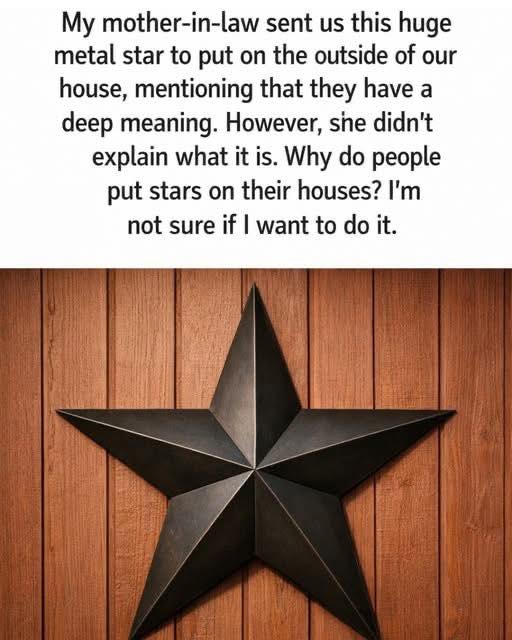
The star on the barn was never just decoration. It was never meant to be a simple flourish of metal nailed onto wood for the sake of appearance. Long before it became a rustic trend or a design choice, it stood as a silent guardian. It watched over families as they slept, over animals sheltered from winter winds, over harvests that determined whether a year would end in comfort or in scarcity. Fixed against weathered beams, it endured heat, frost, wind, and rain without complaint. It was a quiet witness to births, losses, droughts, and abundance. Generations looked to its steady shape and felt reassurance—sometimes more than they felt from spoken prayers whispered into uncertain nights.
Yet somewhere between superstition and style, between lived belief and curated aesthetic, its deeper meaning began to fade. The star became something charming, then fashionable, then commonplace. Its story blurred. What was once chosen with intention started to be chosen for symmetry. What once symbolized hope slowly became categorized as décor. But what if that simple metal star mounted on your wall is not merely an accessory? What if it carries echoes of the hands that first placed it there, trembling slightly with hope?
Nailed high against rough boards, the barn star once bore the weight of a family’s fears and dreams. For the Pennsylvania Dutch farmers who carved out their lives from uncertain soil, survival was never guaranteed. Seasons could betray them. Storms could flatten fields overnight. Illness could sweep through livestock without warning. In a world where control was limited and risk was constant, symbols mattered. The star’s points, often carefully proportioned and intentionally crafted, seemed to stretch outward like quiet prayers made visible—reaching for protection, prosperity, stability, and belonging.
Each star was more than ornamentation; it was a declaration. A statement that this home stood under watch. A reminder that even in isolation—miles from neighboring farms, surrounded by fields that demanded relentless labor—there was connection to something larger. It was a small but powerful act of defiance against hardship. Against the loneliness of rural life. Against the silent fear that a single failed harvest could unravel everything a family had built.
The star did not promise miracles. Crops still failed. Winters still bit hard. But it offered something subtler: comfort. A sense that effort and faith were intertwined. That beauty had a place even on buildings meant for work and survival. That meaning could be hammered into wood just as firmly as iron nails.
Over time, as generations passed and agricultural life changed, the urgency of that symbolism softened. Industrialization reshaped farming. Communities grew less isolated. Superstitions gave way to modern explanations. The star’s protective aura shifted into something more nostalgic than necessary. Yet it never entirely lost its voice.
Today, barn stars often hang on vinyl siding instead of hand-hewn timber. They appear above tidy suburban garages or as accents in carefully landscaped yards, far removed from the creak of haylofts and the earthy scent of livestock. Many who hang them may not know the depth of their origins. They see balance, color, a pleasing geometric shape. And yet, even stripped of explicit belief, the symbol continues to speak.
It speaks of ancestors who refused to separate beauty from hardship. Of people who believed that even the most practical spaces deserved meaning. It whispers of resilience—the kind forged through seasons of uncertainty and sustained by quiet rituals. When someone chooses to hang a barn star today, whether knowingly or not, they participate in that lineage. They borrow a fragment of that old courage.
There is something deeply human about placing symbols on our homes. We mark our spaces to claim them, to protect them, to define them. The barn star, in its simplicity, fulfills that instinct. Its symmetry suggests order in a chaotic world. Its permanence suggests endurance in the face of change.