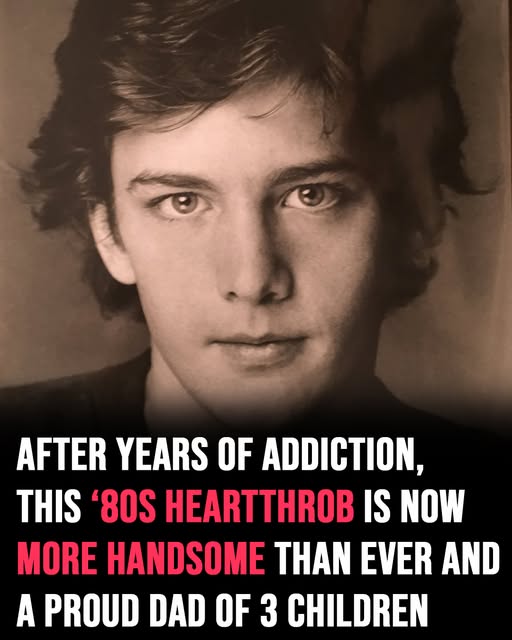
The 1980s were defined by a certain cinematic magic, a decade when coming-of-age films felt like personal invitations into the lives of young, restless dreamers. At the center of this cultural whirlwind was a boy from Westfield, New Jersey—Andrew McCarthy—whose face would come to adorn millions of bedroom walls and magazine covers. With tousled dark hair and a sensitive, introspective gaze, he became the quintessential emblem of understated romance. Yet McCarthy’s story is far more than a highlight reel of teen idol fame; it is a profound tale of resilience, tracing a journey from the heights of Hollywood stardom, through hidden struggles, to a reinvention as a respected director, travel writer, and storyteller.
Roots in New Jersey
Born in 1962 to a hardworking, middle-class family, McCarthy’s upbringing was devoid of the glamour that would later define his career. His father worked in investments, and his mother for a newspaper, providing a stable yet unremarkable childhood. Temperamentally, he was an anomaly in Hollywood—introverted, reflective, and often uncomfortable with attention. This paradox—a man eager to perform yet recoiling from the spotlight—would shape much of his early career.
From NYU Expulsion to Leading Man
McCarthy’s path to fame began with an ironic twist seemingly lifted from a screenplay. In the early 1980s, he enrolled at New York University’s prestigious acting program but was expelled for lack of attendance. Weeks later, he answered an “open call” advertisement for the film Class. After waiting hours alongside 500 hopefuls, he secured the lead role of Jonathan, romancing the mother of his roommate, played by Jacqueline Bisset. Overnight, he transitioned from expelled student to film star. When NYU later offered him a path back through independent study, McCarthy politely declined—Hollywood was already listening.
His rise continued with St. Elmo’s Fire in 1985. Despite critical reviews, the film became a cultural touchstone, cementing his place within the so-called “Brat Pack,” alongside Rob Lowe, Demi Moore, and Emilio Estevez. Yet McCarthy always felt detached from the group’s notorious party lifestyle. He was the sensitive one, a persona fully realized with his role as Blane in 1986’s Pretty in Pink.
The Hidden Struggle: Alcoholism and Dutch Courage
Beneath the charming, sensitive persona adored by fans, McCarthy faced a private battle. In his 2021 memoir, Brat: An 80s Story, he revealed that alcohol had become a coping mechanism—a way to navigate anxiety and the pressures of a career he felt unprepared for. He described it as “Dutch courage,” a temporary armor for social interactions and on-set performances. The glamorous exterior masked a cycle of hangovers, self-doubt, and struggle, punctuated by a particularly painful relapse triggered by a single drink years later, culminating in a dramatic collapse in a bathroom.
Turning Point and Transformation
In 1991, at 29, McCarthy entered rehab, marking the end of his boyish image and the start of a more grounded, self-aware life. He traded Hollywood parties for introspection and rebuilding. As his teen idol status faded, he discovered a new purpose behind the camera, channeling his artistic sensibilities into directing. McCarthy went on to oversee nearly 100 hours of acclaimed television, including Orange Is the New Black, Gossip Girl, and The Blacklist. His early discomfort in front of the camera gave him empathy for actors, while his eye for storytelling allowed him to shape compelling narratives from behind the lens.
The Traveler and Family Man
McCarthy’s reinvention extended beyond Hollywood. He became a celebrated travel writer, earning recognition as Travel Journalist of the Year in 2010 and contributing to National Geographic Traveler and Men’s Journal. Travel became a medium for presence and exploration, a new narrative form mirroring the storytelling of his acting career.
On the personal front, McCarthy married his college sweetheart, Carol Schneider, in 1999; they had one son, Sam, who followed in his father’s acting footsteps. He later married Irish writer and director Dolores Rice, with whom he has two children, Willow and Rowan. Today, he leads a grounded life in New York’s West Village, a stark contrast to the chaotic nights at Chateau Marmont that characterized his early career.
Legacy and Reflection
By 2026, McCarthy stands as a symbol of endurance and reinvention. His eyes no longer hold the wide-eyed wonder of a teen idol but reflect the quiet intensity of a man who has mastered his own narrative. Though modest about the lasting cultural impact of his 80s films, fans continue to celebrate him—not just for the roles that made him famous but for his survival, resilience, and reinvention.
In a year defined by complex global stories and the search for authenticity, McCarthy’s journey resonates powerfully. He proved that fame is fleeting, but character and creativity endure through the choices made away from the cameras. He remains an icon—not for his poster-boy days, but for the honest, rugged, and creatively rich life he built afterward.