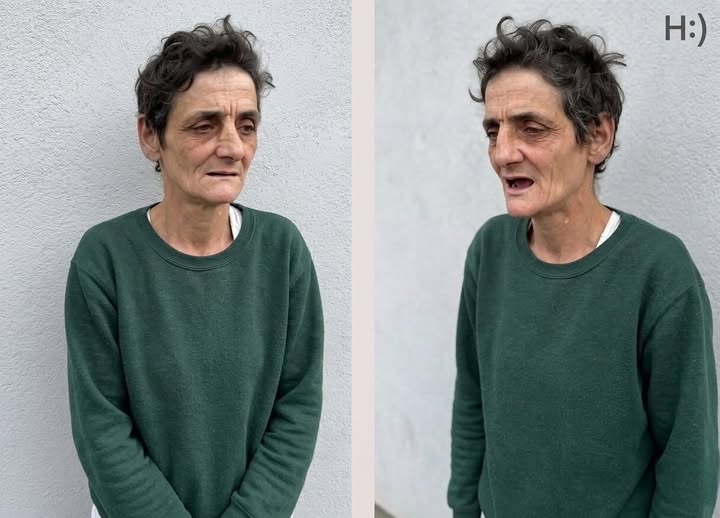
Rita had already been erased from the world as most people measure it. Years on the streets had stripped her of everything except the bare mechanics of survival: the shallow breaths that kept her alive, the instinct to find warmth in a cold city, and the quiet vigilance that came from living in a space where most passersby deliberately looked away. She had become almost invisible, a shadow that moved among shadows, carrying grief and loss like a hidden weight. Then, one stranger stopped. One stranger actually met her gaze, refusing to look away, refusing to reduce her to the hollowed shell that the world had imposed.
What followed was not a sudden makeover or a superficial lift. It was, in every sense, a quiet rebellion against despair—a rebellion paid for with acts of human kindness, the slow shedding of tears, and the terrifying but exhilarating possibility of hope. Rita’s daily life had long been reduced to survival: searching for bottles to trade, enduring freezing nights under thin layers of clothing, and trying not to feel the hollow ache left by the son she had lost years before. The grief had driven her to the margins of society, where human eyes slide past without acknowledgment, and where every interaction seemed measured by suspicion or pity. Job applications went unanswered, not because she lacked the determination, but because her appearance told a story that no one wanted to hear—a story of struggle, loss, and the city’s harshest truths. She was judged long before she had a chance to speak, and the weight of that judgment was invisible yet suffocating.
Meeting makeup artist Shafag Novruz cracked the walls around that silence. But Shafag did not begin with lipstick or foundation. She began with dignity, restoring it gently, almost reverently. Dental care, clean nails, a careful combing of tangled hair, each small gesture whispered, “You are worth this. You are worth being seen.” As Rita’s hair was lightened and styled, as layers of dirt and neglect were replaced with gentle grooming, something inside her began to loosen. The invisible armor she had carried for years—of shame, sorrow, and self-preservation—started to fall away. Her shoulders lifted; her gaze sharpened. For the first time in a long while, Rita did not see herself as a cautionary tale or a city statistic. She saw herself as a person who could still step into the world and be recognized, not just survived.
The transformation was not magical. It did not erase her pain, her memories, or the scars left by a life lived on the streets. But it offered her something equally powerful: a tangible sense of future, a vision of herself that could exist beyond mere survival. The act of being tended to, of being valued, of being restored bit by bit, was radical in its simplicity. In the mirror, she did not see someone else; she saw herself returned, reclaimed from the shadows of loss and neglect. And in that reflection, she glimpsed a life she could still reach for, one that included hope, dignity, and the quiet courage to believe she deserved to be seen, known, and loved.