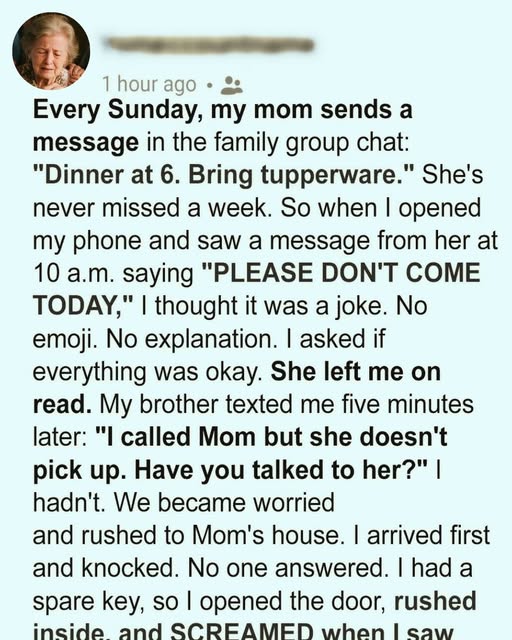
The text shattered everything we thought we knew about our family. There was no warning, no softening of the blow—just a single message that obliterated the only tradition still holding us together. By the time we pulled into Mom’s driveway, the silence in the car was deafening, heavier than any argument we had ever had. Every glance, every hesitation felt charged with tension. Inside the house, the air seemed staged, as if the room itself were waiting for a revelation, a confession we had never expected. And there, at the dining table, sat a stranger occupying the chair that once belonged only to our father.
We stepped into a version of our family we had never been allowed to see before. The man in Dad’s chair wasn’t merely an accidental resemblance; he was living evidence of a life our mother had carefully hidden to preserve the family she chose. As she spoke, the neat story we had been told about love, loyalty, and tradition began to unravel. What emerged instead was raw and messy: survival, regret, and the echoes of a decision that had shaped decades of our lives. Each revelation was a reminder that history isn’t always tidy, that love often intersects with pain, and that the choices of those we trust can leave scars that ripple across generations.
Anger would have been the easier path. It would have justified our hurt and allowed us to retreat back into the safety of resentment. But we stayed. In that cramped kitchen, passing paper plates around, we traded hard truths alongside the food, letting the initial shock settle just enough for us to see her not as a figure in a story, but as a human being—flawed, fearful, and yet deeply familiar. Forgiveness didn’t arrive in a moment of dramatic reconciliation; it seeped in slowly, quietly, in the conscious decision to show up again despite the risk of pain.
When her next message arrived—“Sunday dinner is on”—we didn’t hesitate. We answered, understanding that the tradition was no longer the perfect ritual we had imagined, but it had become something more authentic, more alive. Imperfections had replaced illusion, and in that honesty, we found a renewed connection, fragile but real. The table, once a symbol of routine and comfort, had transformed into a place where truth and acceptance could coexist. And in choosing to return, to engage despite disappointment, we discovered that family isn’t about flawless histories—it’s about presence, perseverance, and the courage to rebuild what has been broken.