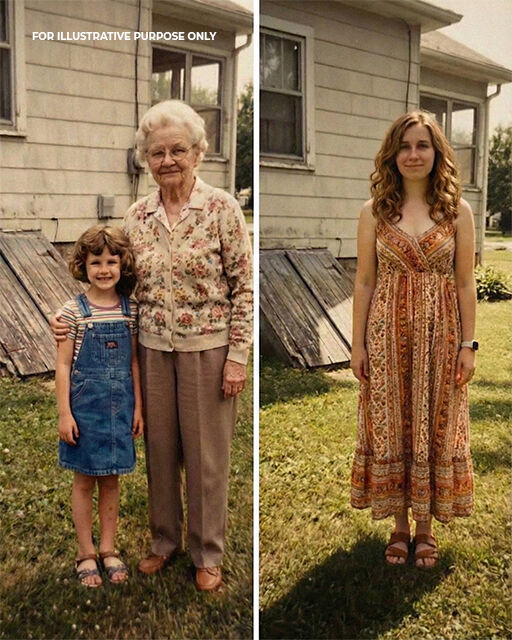
If someone had told me a year ago that my life would unravel into something resembling a multi-generational mystery novel, I would have laughed and gone back to whatever mundane task I was doing—probably folding laundry or answering emails. My grandmother had always been the most reliable, predictable presence in my life. There were no secrets about her.
Or so I thought.
My name is Hannah. When I was twelve, my mother died in a car accident on a rain-slick highway just outside our town. I never knew my father. By the time I could ask about him, the answers had already faded into silence.
After the funeral, when the casseroles stopped arriving and the house felt empty, my grandmother Margaret packed a suitcase, drove three hours, and brought me to her home. She never framed it as charity or duty. She simply said, “You’re coming with me, sweetheart.” That was that.
Her small white house at the edge of town became my refuge. The porch sagged slightly in the middle. The kitchen cabinets were older than both of us combined, but it was safe. She filled the house with structure and warmth. She taught me to make pie crust from scratch, balance a checkbook, and look someone in the eye when I meant what I said. She was firm, sometimes stubborn, but she loved with quiet, unwavering loyalty.
There was one rule that never bent.
“Stay away from the basement,” she would say.
Behind the house, near the back steps, a pair of heavy metal doors pressed against the concrete foundation. They were always locked. I never once saw them open.
Naturally, I asked.
“What’s down there?” I’d say, hovering while she watered plants. “Is it creepy? Full of spiders?”
She’d give me a look that ended the conversation immediately. “It’s full of old things you could hurt yourself on. That’s all you need to know.”
Her tone made it clear that pressing further was a bad idea, so I stopped asking. Over time, the doors became part of the scenery—like the cracked birdbath or the off-key wind chimes.
Life moved on, as it does.
I left for college but returned most weekends. Her house remained my anchor while I tried on adulthood like an oversized coat. During my senior year, I met Caleb. Patient, thoughtful, steady—he reminded me of her in some ways.
After graduation, staying at his apartment gradually became living there. My grandmother pretended not to notice how rarely I slept in my childhood room. She would press leftovers into my hands when I visited and say, “Make sure you’re eating properly.”
She began to slow in her late seventies, though she never admitted it. Small things at first: forgetting her glasses, pausing halfway through sweeping the porch. When I asked if she felt alright, she waved me off.
“I’m old, Hannah. That’s not a disease.”
But I could see it. She stopped humming while cooking. She no longer lingered on the porch at sunset. Her world seemed to shrink inch by inch.
The phone call came on a Tuesday while I sorted bills at the kitchen table.
“I’m so sorry,” the nurse said gently. “She passed peacefully this morning.”
The words felt unreal, as if they belonged to someone else.
Caleb found me on the floor, back against the cabinets, phone still in hand. He held me while reality settled like dust.
We buried her on a cold, windy Saturday. The service was small. My mother had been an only child; my grandmother’s siblings were long gone. A few distant cousins attended, offering polite condolences.
“Do whatever you think is best with the house,” one said. “We trust you.”
A week later, Caleb and I began the slow, painful process of sorting her life.
The house felt frozen in time. Her slippers still beside the couch. A half-finished crossword on the table. Her faint lavender scent lingered.
We moved methodically through the rooms. Each drawer contained pieces of my childhood: school drawings, birthday cards, photos of my mother as a toddler. I cried more than once, sometimes without warning.
When the main rooms were done, I stepped outside.
And there they were.
The basement doors.
For the first time, no one could tell me no.
“Caleb,” I whispered, “I think we need to open it.”
He followed my gaze. “Are you sure?”
I nodded. My heart raced.
We had never seen a key. The lock was old, rusted, untouched for decades. It took effort to break it. When it finally gave way, a stale breath of cold air drifted upward.
Caleb went down first with a flashlight. I followed, gripping the railing.
The basement was not chaotic. It was orderly.
Along one wall, neatly stacked boxes labeled in my grandmother’s handwriting.
Caleb opened a box. At the top lay a yellowed baby blanket. Beneath it, a pair of knitted booties, impossibly small. Then a black-and-white photograph.
He handed it to me.
My grandmother stared back, impossibly young—no older than sixteen. Sitting upright in a hospital bed, hair pulled back, face a mix of fear and exhaustion.
In her arms was a newborn baby wrapped in that blanket.
It wasn’t my mother.
I felt the air leave my lungs.
“What is this?” My voice cracked.
I opened more boxes: photographs, letters, official documents stamped CONFIDENTIAL and SEALED, rejection letters, notes in her handwriting.
At the bottom, a thick notebook.
I opened it.
Dates, agency names, phone numbers. Each entry brief and restrained:
“Called again. No information released.”
“They said records are sealed.”
“Told me to stop contacting them.”
The last entry, just two years prior:
“Spoke to someone new. Still nothing. I hope she’s safe.”
My grandmother had had a child before my mother. A daughter she was forced to give up at sixteen. She spent forty years searching for her.
I sank to the concrete floor, notebook trembling. Caleb knelt beside me.
“She never told anyone,” I whispered. “Not my mom. Not me.”
He looked around the carefully preserved boxes. “She didn’t forget,” he said quietly. “She couldn’t.”
The basement was not neglect; it was a vault—a sanctuary for grief she never shared.
We brought everything upstairs and spread it across the living room. I read the notebook from start to finish. In the margin of one page, a single name was written more boldly than the rest:
Violet.
“She named her,” I said softly.
Caleb met my eyes. “Then let’s find her.”
The search consumed me.
I contacted agencies, requested records, and ran into walls of bureaucracy. Most documents were permanently sealed.
Every time frustration threatened, I thought of the last notebook entry:
“I hope she’s safe.”
Finally, DNA testing. Desperate, but necessary. I mailed the sample and waited.
Three weeks later:
Close family match identified.
Her name: Violet Mercer. Fifty-six years old, less than two hours away.
Hands shaking, I wrote:
Hello. My name is Hannah Whitmore. According to the results, we are closely related. I believe my grandmother may have been your biological mother. If you’re open to talking, I would be grateful.
She replied the next evening:
I’ve known I was adopted since I was young. I never had information about my birth mother. Yes, I would like to meet.
We chose a quiet café halfway between our towns.
I arrived early, unable to sit still. When she walked in, I knew instantly. She had my grandmother’s eyes—deep-set, observant, quietly resilient.
“Hannah?” she asked carefully.
“Yes,” I said.
I slid the black-and-white photo across the table.
“That’s her?” she asked.
“Yes. She was sixteen.”
Violet’s eyes filled with tears. “She looks scared.”
“She was,” I said. “But she never stopped looking for you.”
I showed her the notebook, decades of persistence.
“She searched?” Violet whispered. “All those years?”
“She never stopped,” I said. “She just ran out of time.”
We talked for hours about her childhood, my grandmother, and the invisible thread connecting us.
When we left the café and embraced, it felt unfamiliar but right. Not dramatic—just real.
In the months since, Violet and I have built something steady. We talk regularly and share stories. She laughs in that unique way my grandmother used to.
I sometimes think of the locked basement. For forty years, it held a story too painful to tell. Opening it changed everything I thought I knew about my grandmother, making her more human, vulnerable, extraordinary.
Somewhere, I like to think she knows what happened next. That her first daughter is safe. That we found each other.
The basement is empty now. The boxes sorted, the house sold.
But the silence she carried for decades has finally been broken.
By telling her story and finding Violet, I finished what she could not. I answered the question she had been asking for forty years.
And I discovered that even the most steadfast love can hide decades of quiet heartbreak.