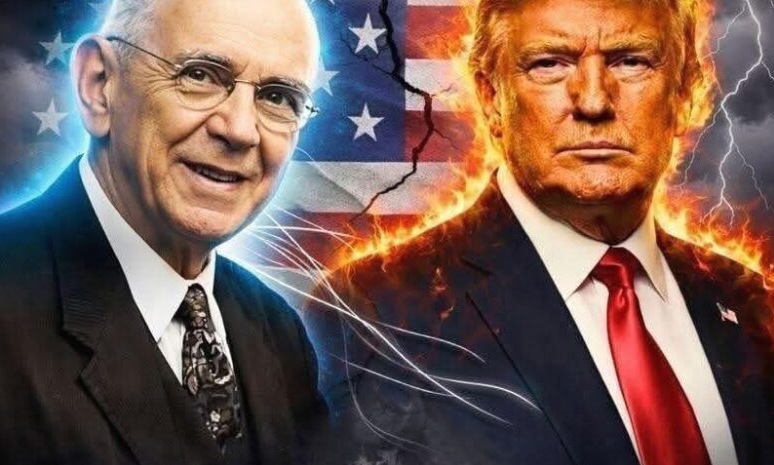
In the vast expanse of human history, there are moments of deep systemic disruption—times marked by an unmistakable sense of unease, where the old order collapses before the new one has fully emerged. During such periods of acute distress, humanity instinctively reaches back to the wisdom of the past, seeking a lens through which to interpret the chaos of the present. As we navigate the complex and often unsettling landscape of 2026, one figure from American mysticism has once again come to the forefront: Edgar Cayce. Known globally as the “Sleeping Prophet,” Cayce’s enigmatic legacy is experiencing a resurgence as scholars, political analysts, and spiritual seekers look to reconcile his century-old prophecies with the tumultuous realities of today’s political and social upheavals.
Born in Kentucky in 1877 and passing in 1945, Edgar Cayce remains one of the most prolific and documented clairvoyants in history. Through a unique method of self-induced sleep, Cayce delivered over 14,000 recorded “readings,” covering a wide range of topics. While most of these sessions focused on medical diagnoses and holistic health, a significant portion also addressed global events, the rise and fall of nations, and a fundamental shift in the spiritual consciousness of humanity. Today, in a world marked by political polarization, a fragile global economy, and a crisis of trust in democratic institutions, the relevance of Cayce’s readings seems increasingly pertinent. The question is no longer just what he predicted, but how his insights are being interpreted in light of our current circumstances.
One of Cayce’s most frequently discussed prophecies centers on a “great leveling” or “period of transition” that would herald a new age of human consciousness. In readings from the 1930s and 40s, he spoke of a time when the “strife of the world” would intensify, particularly within the systems of governance and finance. He envisioned a future where the divide between “the haves and the have-nots” would evolve from a localized economic issue into a global spiritual crisis. Looking at the state of the world in 2026, where wealth inequality is at historic levels and populist movements have upended traditional political structures, Cayce’s warnings about a “breakdown of the old order” seem less like mysticism and more like a prescient analysis of the current moment.
A key aspect of Cayce’s political predictions involved his views on the leadership and internal health of nations. He often emphasized that a nation’s “spirit” is directly tied to its commitment to universal laws of brotherhood and selfless service. He warned that when a nation prioritizes self-interest and material gain over the welfare of its citizens and the world, it invites a period of corrective turmoil. In the context of 2026, many contemporary interpreters point to the rise of hyper-nationalism and the erosion of civil discourse as the manifestation of the “internal rot” Cayce foresaw. His teachings suggested that political systems are not merely administrative tools, but reflections of the collective consciousness of the people. Thus, a fractured political landscape mirrors a fractured national spirit.
Cayce’s readings also addressed specific geopolitical shifts that have gained renewed attention in modern analysis. He spoke of a time when the “earth would be changed in many places,” a phrase often debated as referring to physical cataclysms or metaphorical shifts in global power centers. In 2026, as traditional Western alliances are challenged by emerging powers and the global energy market experiences upheaval, Cayce’s vision of a “rearranged map” seems increasingly plausible. One of his most controversial predictions—that “Russia would become the hope of the world” through spiritual purification—remains particularly provocative in light of current geopolitical tensions in Eastern Europe and the West.
The renewed interest in Cayce can also be attributed to the “crisis of trust” that dominates 2026. In an age where citizens are bombarded with an overwhelming amount of information—much of it contradictory or intentionally misleading—Cayce’s call to “know the truth within” offers a compelling alternative. He advocated for radical personal responsibility, suggesting that the solutions to global crises don’t lie solely in political institutions, but in the integrity and compassion of individuals. This “bottom-up” approach resonates with a generation that feels alienated by centralized authority and disillusioned by institutional failures.
Scholars within the Association for Research and Enlightenment (A.R.E.), the organization dedicated to preserving Cayce’s work, have noted that his readings often align with historical cycles of around eighty to ninety years. If we calculate from the Great Depression and the global conflicts of the 1930s and 40s, the mid-2020s align almost perfectly with a predicted “return to the crossroads.” Cayce’s cyclical view of history suggests that we are currently facing the same challenges our ancestors did, though with the added complexities of modern technology and global interconnectedness. His “Sleeping Prophet” persona wasn’t merely about predicting the future; it was about warning the present. He believed that the trajectory of the future was not fixed, but rather shaped by the choices humanity makes in the here and now.
As we observe the unfolding events of our time—technological breakthroughs, social unrest, shifts in constitutional law—it becomes clear that we are undergoing a period of deep, structural transformation. Cayce’s interpretations suggest that this “labor” is necessary for the “birth” of a more unified human experience. He spoke of a time when the “laws of the soul” would surpass the “laws of the state,” a vision that remains a central goal for many of his followers. While critics argue that his prophecies are vague or open to confirmation bias, the volume of his accurate medical and historical insights lends weight to his more abstract political visions.
Ultimately, the resurgence of Edgar Cayce’s work in 2026 represents a search for spiritual guidance amid a storm of systemic uncertainty. His teachings offer a narrative framework that elevates our political struggles from partisan conflict to a necessary phase in human evolution. Whether seen as a genuine prophet or a fascinating psychological phenomenon, his message centers on the idea that external peace is a reflection of internal alignment. As Cayce once suggested, the ultimate “reading” of our political landscape is not found in the headlines, but in humanity’s collective ability to choose unity over division. In a world marked by its fractured nature, his legacy offers a reminder that the path to stability is paved with timeless virtues—faith, compassion, and a steadfast commitment to truth. As we move further into 2026, the teachings of the Sleeping Prophet will likely remain a vital, if mysterious, guide.