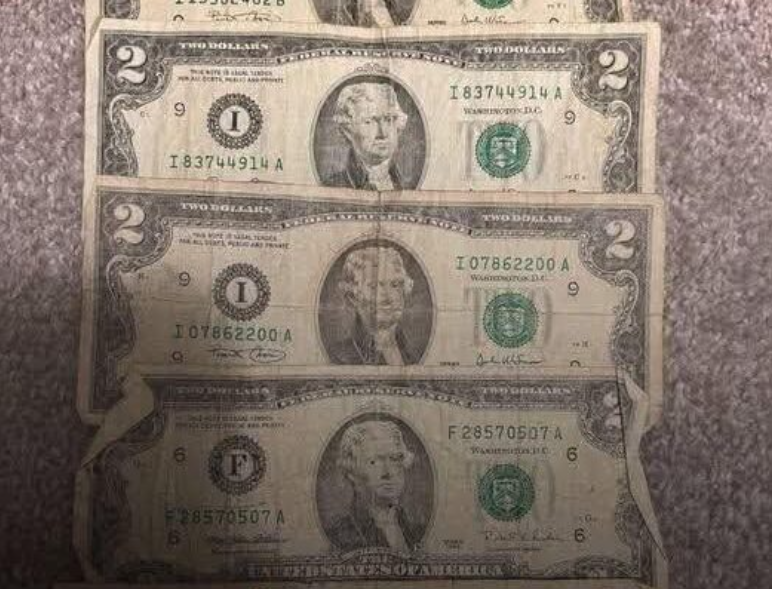
The American $2 bill occupies a unique and somewhat surreal position within U.S. currency. While most denominations serve solely as practical means of exchange, the $2 bill exists at the intersection of everyday money, urban legend, and significant numismatic value. Over the years, myths have suggested that the bill was “cursed,” brought bad luck to its holder, or was simply a relic of the past, no longer in circulation. In reality, the $2 bill has never been discontinued or banned; its perceived rarity is largely due to public habits and the logistical preferences of retail environments.
The Decline of the $2 Bill
The $2 bill’s decline in circulation wasn’t due to a federal mandate but instead resulted from its gradual shift into novelty status. Most cash registers weren’t designed with a slot specifically for this denomination, making them cumbersome for merchants to store. This created a logistical challenge that led to fewer $2 bills being handed out as change, further reinforcing the public’s belief that they were rare. As people saw them less frequently, they began to hoard them as keepsakes, removing them from the market and solidifying their status as collector’s items.
Determining Value: Beyond Face Value
For those wondering if a $2 bill is worth more than its face value, it’s important to look for specific historical and technical details. While most modern $2 bills, particularly those printed after 1976, are worth exactly $2, certain factors can significantly increase their market value. Collectors and currency enthusiasts focus on several criteria: age, seal color, printing errors, and the serial number.
The Serial Number: Hidden Value
The serial number is often where the most significant value lies. On modern, crisp, uncirculated bills, certain numerical patterns can command impressive premiums. Collectors seek “fancy” serial numbers, which include:
Low Serial Numbers: Bills with numbers like 00000001 or 00000010 are highly prized.
Ladder Patterns: Numbers that ascend or descend sequentially, like 12345678.
Solid or Repeating Digits: Numbers where every digit is the same (e.g., 77777777) or patterns that repeat, known as “repeating serials.”
Radar or Symmetrical Numbers: Numbers that read the same forward and backward, much like a palindrome.
Age, Seal Color, and Historical Context
Age and historical context also play a significant role in determining a $2 bill’s value. Bills from the early 20th century are particularly coveted. One quick way to identify a vintage note is by the color of its seal. While modern $2 bills feature the standard green seal, older versions may display red or brown seals, indicating a different era of U.S. currency. Vintage notes, especially those in “uncirculated” condition—meaning they show no signs of folds or wear—can fetch far more at auction than their original value.
Error Notes: The Holy Grail for Collectors
“Error notes” are the most sought-after items in the currency world. These are bills that contain printing mistakes, such as ink smears, misaligned cuts, or “double denominations” where different values are printed on the front and back. Since the Bureau of Engraving and Printing has strict quality control, the few errors that slip through are considered highly valuable by collectors.
The Psychological Economics of the $2 Bill
The $2 bill is also an example of a self-fulfilling prophecy in economics. Because people believe the bill is rare, they save it, which in turn makes it rare in circulation. This cycle has transformed the $2 bill into a “novelty” currency, often used for special occasions like tips, gifts from the tooth fairy, or good luck charms. In some communities, it’s even a tradition to carry a $2 bill in one’s wallet to avoid an “empty” wallet, further contributing to the bill’s scarcity in circulation.
How to Identify a Valuable $2 Bill
If you find a $2 bill in a drawer or receive one as change, it’s worth taking a moment to inspect its characteristics. Look for the date to see if it predates the 1976 series. Check the seal color for anything other than the standard green. Hold the bill up to the light to assess the crispness of the paper, and examine the serial number for unusual patterns. While it’s unlikely to find a multi-thousand-dollar rarity, there’s a real chance that the bill could be worth more than its face value—perhaps fifty, one hundred, or even five hundred dollars.
A Piece of American History in a Digital Age
As we move toward an increasingly digital economy, physical currency like the $2 bill is becoming more than just money—it’s a tangible piece of American history. What was once seen as “unlucky” has evolved into a symbol of uniqueness and a quirky collector’s item. Whether it serves as a lucky charm or a serious investment, the $2 bill remains a reminder that sometimes the most valuable things in our wallets are the ones we least expect to find.