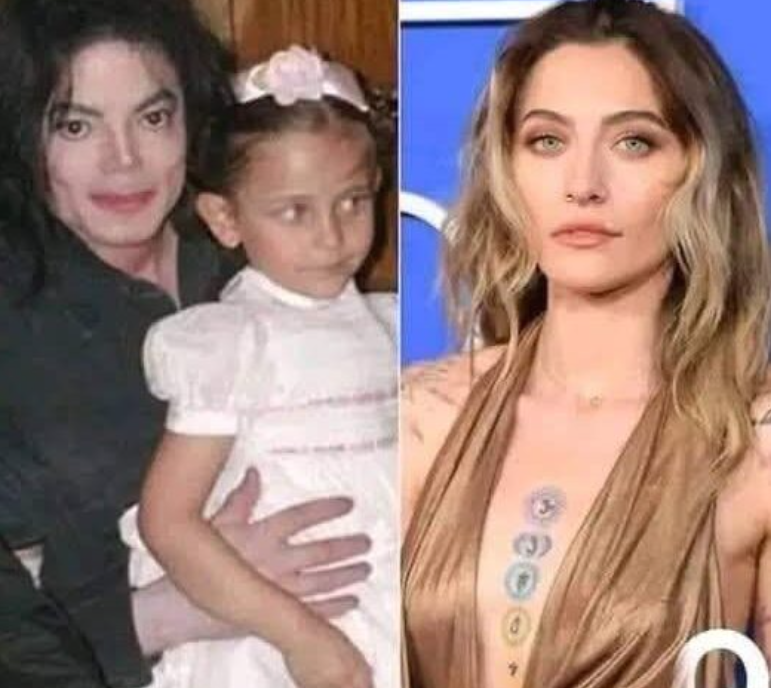
The image of an eleven-year-old girl standing before millions of viewers, her voice trembling yet determined, remains one of the most touching moments in modern celebrity culture. When Paris Jackson spoke at her father’s 2009 memorial and said that Michael Jackson was “the best father you could ever imagine,” she did more than deliver a tribute. She cut through the complicated public image surrounding him and revealed a deeply personal truth: to the world he was an icon and a mystery, but to her he was the foundation of her life. That raw moment of grief marked the beginning of her transformation from a protected child into a strong, self-defined woman navigating an extraordinary legacy.
Losing a parent is devastating for any child, but for Paris the pain was intensified by constant global media attention. During his lifetime, Michael Jackson had gone to great lengths to shield his children from paparazzi and public scrutiny, trying to give them as normal a childhood as possible. After his passing, that protection disappeared. Paris suddenly found herself at the center of international headlines, forced to process her private grief while the world speculated about her life and future.
Stability came through her family, particularly under the guardianship of her grandmother, Katherine Jackson. There, she spent her teenage years surrounded by family support but also under the weight of the Jackson name. It was a period of emotional growth while public discussions about her father’s legacy continued outside those walls.
A symbolic turning point came on her nineteenth birthday when she moved into her father’s former private studio on the family estate. By transforming that creative space into her own personal sanctuary, she began blending his memory with her adult identity. It was a step toward independence — honoring the past while building her own future.
Now 27, Paris Jackson has become a multifaceted presence in both art and fashion. A significant milestone in her public journey was an open conversation with supermodel Naomi Campbell, where she discussed how she has handled fame and expectations. She spoke not as a victim of circumstance, but as someone intentionally shaping her own life.
Modeling was one of her first steps toward independence. By walking international runways and appearing in major fashion magazines, she carved out a space where she was recognized for her individuality rather than simply her last name. Fashion became a means of self-expression and identity exploration.
At the same time, she developed her music career. Her debut album introduced an indie-folk and alternative sound, far removed from the pop style that defined her father’s career. Through music, she expressed personal experiences with honesty and vulnerability, showing that she is not trying to replicate his legacy but to create her own.
In public reflections, Paris speaks about her father with love and gratitude, crediting him for teaching her resilience and compassion. At the same time, she openly acknowledges the heavy weight of her family name and the challenge of ensuring her own voice is heard. She has found a balance — neither running from her heritage nor allowing it to completely define her.
Paris Jackson’s story is ultimately one of healing and self-creation. While her father’s influence is clearly woven into her passion and values, it does not limit her identity. She has managed to preserve his memory privately while establishing her own presence publicly.
Through music, fashion, and activism, Paris continues to write her own chapter — one defined by strength, individuality, and a quiet grace that belongs entirely to her.