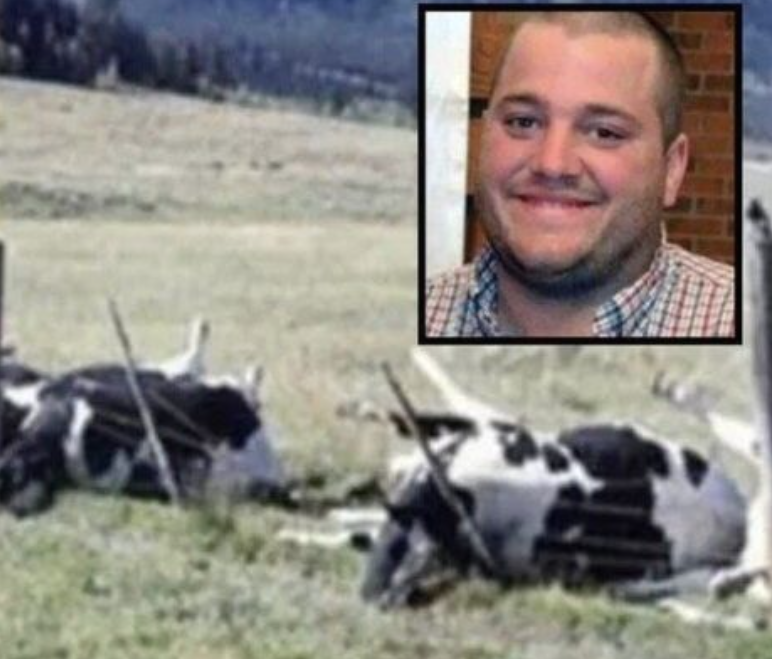
The story of Mike Biadasz is a poignant testament to the hidden hazards of everyday farm life, and a somber reminder of how quickly routine labor can turn fatal when nature, chemistry, and circumstance collide. On a seemingly ordinary summer morning in August 2016, Mike, a 29-year-old fourth-generation beef farmer, set out on his family’s farm in Amherst, Wisconsin, to perform a task he had done countless times before: preparing the manure pit for spreading. Mike’s life was inseparable from the land and livestock he tended. Known for a tireless work ethic, a gregarious personality, and a natural ability to connect with people across generations, he was not only a cornerstone of his local community but also a living embodiment of the American farming tradition. Yet, in an instant, an extraordinarily rare combination of environmental factors turned this familiar morning into a tragedy that would claim Mike’s life and sixteen of his cattle, leaving behind grief, reflection, and a renewed commitment to farm safety.
The day began as most mornings did, imbued with Mike’s characteristic optimism. Around 6:00 a.m., he arrived at the edge of the manure storage pit, preparing to stir and homogenize the “liquid gold,” the nutrient-rich fertilizer that fuels both crops and the local ecosystem. In a final moment of lighthearted connection with the world beyond the farm, Mike snapped a photo and shared it on Snapchat, jokingly acknowledging the work ahead. To anyone viewing it, the image portrayed nothing more than a dedicated farmer beginning his day. But as Mike engaged the pit’s machinery—a routine process intended to make the slurry pumpable and evenly spreadable—he unknowingly triggered a lethal chemical hazard.
Manure pits are notorious for producing dangerous gases, including methane, ammonia, and hydrogen sulfide, the last of which is colorless, odorless, and highly toxic. Under normal circumstances, these gases disperse harmlessly into the atmosphere. On that fateful morning, however, Portage County was experiencing a rare meteorological phenomenon known as an air temperature inversion. This occurs when a layer of warm air settles above cooler ground-level air, effectively trapping it—and any gases it contains—close to the surface. Combined with dense morning fog, the resulting “atmospheric dome” created a lethal environment. The gases released from the agitated manure accumulated invisibly, forming a concentrated cloud that would prove fatal within moments.
At approximately 6:30 a.m., Mike’s friend and farm colleague, Steve Burclaw, arrived to assist with the hauling. To Steve, the scene appeared calm; the fog hung low over the fields in a way that was entirely ordinary for Wisconsin summer mornings. It was only when they neared the manure pit that the horror became unmistakable. Mike lay unmoving at the edge, overcome so swiftly by hydrogen sulfide that he likely never recognized the danger. Nearby, sixteen cattle—vital members of the farm’s livelihood—had also succumbed. The accident was the result of a rare and almost unimaginable convergence of chemistry and weather, turning a routine task into a lethal event.
The news of Mike’s death reverberated through Amherst and the agricultural world at large. His father, Bob Biadasz, was in his kitchen with a cup of coffee when the phone call came, delivering the devastating confirmation that his son—the future of the family farm and a man who had inspired so many—was gone. The visitation that followed was an extraordinary testament to the young farmer’s life. Over 1,200 people attended to pay their respects, surpassing the population of the village itself and reflecting the deep bonds Mike had forged across the community. As his father noted, Mike had a rare talent for connecting with people, no matter their age, background, or life experience.
Amid their grief, the Biadasz family made a courageous decision: Mike’s death would not be in vain. They recognized that if an experienced, fourth-generation farmer could fall victim to such a hidden danger, countless others were potentially at risk. From this realization arose the Mike Biadasz Farm Safety and Education Memorial Fund, dedicated to revealing the “invisible dangers” of agriculture, particularly manure gas exposure, and preventing similar tragedies.
The memorial fund has since become a vital resource for farmers across the Midwest and beyond. Central to its mission is the promotion of wearable gas monitors—small, inexpensive devices that alert the wearer to hazardous hydrogen sulfide or methane levels. These monitors, costing far less than a single head of cattle, have the power to save lives and could have dramatically altered the outcome that August morning. Beyond technology, the fund emphasizes education, teaching farmers to recognize weather patterns—such as temperature inversions, high humidity, and stagnant air—that elevate risk. They advocate for enhanced manure pit ventilation, strict adherence to safety protocols, and a “buddy system” for high-risk tasks, ensuring no one faces potential exposure alone.
The local community honored Mike in ways that remain etched in memory. In the days following his passing, a line of tractors and farm machinery, painted in the regional hues of red and blue, stretched down the road to Biadasz Farms. Mike’s black pickup truck led the procession, a silent sentinel for a life cut tragically short. The display was more than ceremonial—it was an affirmation of solidarity in a profession ranked among the most dangerous in the United States, where even routine tasks can carry life-threatening risk.
Nearly a decade later, Mike’s influence endures. Farmers who once approached manure pits casually now check weather reports meticulously, attach gas monitors to their belts, and implement the precautions promoted by the memorial fund. The Biadasz family’s journey from personal tragedy to public advocacy has become a blueprint for community resilience: transforming grief into actionable education and ensuring that future generations of farmers are equipped with the tools and knowledge to safely return home after every day in the field.
Mike Biadasz’s story is a reminder of how quickly life can change on the farm, but also a testament to human adaptability and legacy. He is remembered not only for his untimely passing, but for the vitality, humor, and devotion to the land that defined his life. Through the memorial fund, his spirit continues to watch over the farming community, fostering awareness, saving lives, and inspiring a culture of safety that may well prevent future tragedies. In every sense, Mike Biadasz’s legacy is a life lived in service—to his family, his community, and the essential work of feeding the world.