The wrench slid from my grease-slick fingers and struck the concrete floor of Peterson’s Auto Shop with a sharp metallic crack that echoed through the empty service bay. I straightened slowly, pressing a hand against the dull, persistent ache in my lower back—the predictable consequence of two decades spent hunched over engines and transmissions. Outside the open garage door, Redwood Glen rested beneath the warm glow of late afternoon. Pine-covered hills rolled peacefully toward the horizon, and the faint shimmer of Lake Thornton caught the fading sunlight. From a distance, it looked like the kind of town people moved to for safety and simplicity. Up close, I knew better.
I wiped my hands on a rag that had long ago surrendered its original color to oil and grime and glanced at the clock. 4:30 p.m. Nancy would be home from school any minute. The thought of my daughter brought a rare softness to my face, the only real brightness in an otherwise heavy day. That feeling lasted only seconds before my phone buzzed in my pocket. A message from Riley.
Mom’s staying for dinner. Please don’t start anything.
My jaw tightened. Donna Wells had been “staying for dinner” nearly every night for months. What was once occasional help had turned into a permanent presence. Our home no longer felt like a refuge—it felt like neutral territory in a quiet war.
When I pulled into the driveway, Donna’s spotless silver sedan was already there, parked with deliberate precision. Nancy was waiting for me on the ramp I’d built beside the front steps. She rang the small bell attached to her wheelchair handlebar—bright and cheerful.
“Daddy! We learned about the water cycle today!” she said, her eyes shining. Then her smile faltered. “Grandma said it’s boring. She said I should learn things I’ll actually need.”
The comment hit harder than it should have. Nancy was only seven, but she’d already learned how to shrink herself around her grandmother’s judgment. Before I could reassure her, Donna stepped out onto the porch.
“Riley’s finishing dinner,” she said sharply. “Nancy, move along. You’re in the way.”
“She’s not in the way,” I replied evenly.
Donna’s gaze flicked toward me, cold and dismissive. “I wasn’t speaking to you.”
Once Nancy rolled inside, Donna leaned closer. “You indulge her too much, Roy. Riley’s exhausted. That child drains her. You wouldn’t understand—you hide in that garage all day.”
“That child is my daughter,” I said quietly but firmly. “You will not speak about her like that.”
Donna gave a dry laugh and walked past me. Dinner that night was suffocating. Riley looked worn down, caught between loyalty and denial, while Donna criticized everything—the seasoning, the neighbors, even Nancy’s posture at the table. When I tried to talk to Riley afterward, she defended her mother. She said Donna was only being practical. That she was helping. But the cost of that help was carved straight into Nancy’s confidence.
Two weeks later, everything shattered.
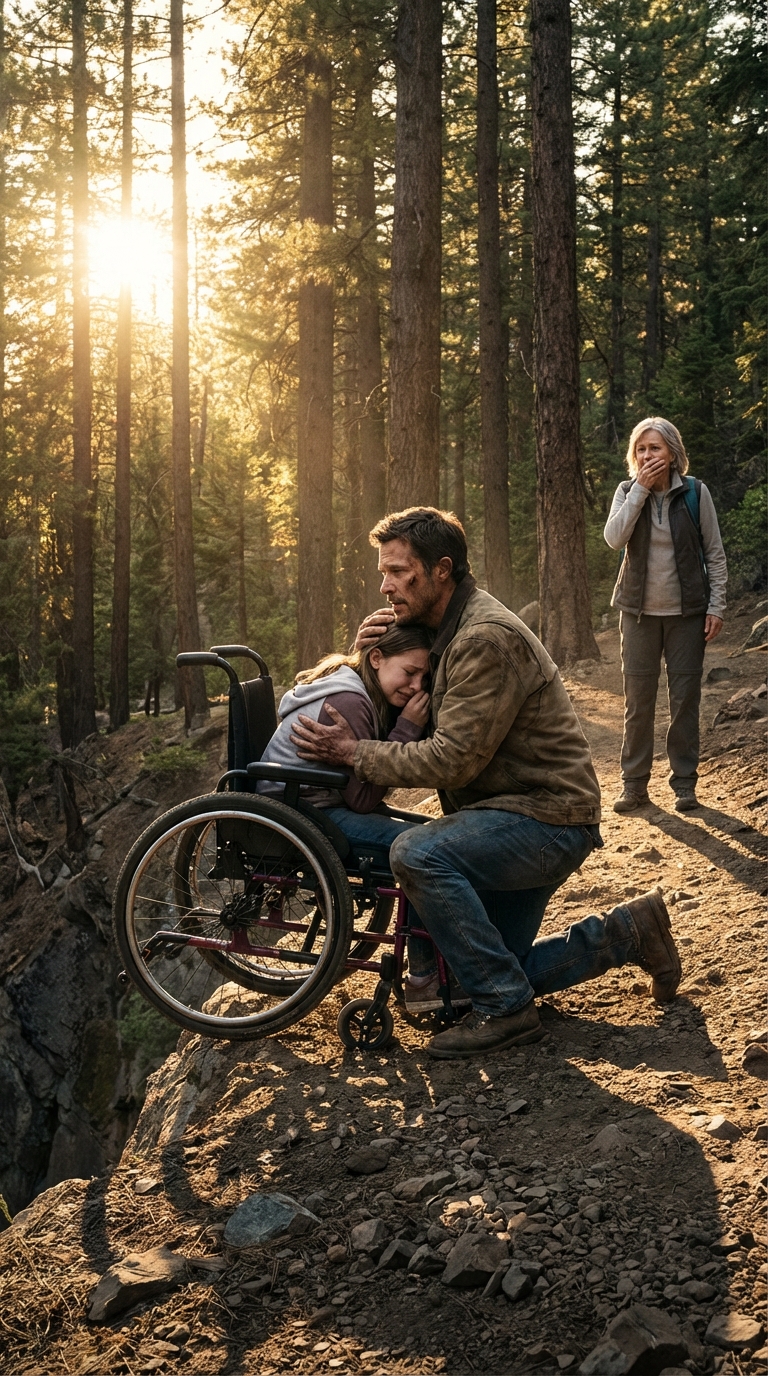
We were on the Ridge Trail overlooking Lake Thornton. The path ran dangerously close to a steep gravel slope. I had locked Nancy’s wheelchair securely near the railing while Riley stepped away briefly. I bent down to tie my boot—and heard Donna’s voice behind Nancy.
“She holds everyone back,” Donna muttered. “Riley deserved more.”
I looked up just as Donna shoved the wheelchair. The locked wheels skidded on loose gravel and slipped through a gap in the railing. Nancy screamed as the chair tipped forward and began hurtling down the slope.
There was no time to think. I threw myself after her, sliding, clawing at the earth. The chair gathered speed toward jagged rocks below. At the last possible second, I grabbed the metal frame. The force dragged me through dirt and stone, tearing my skin, but I dug in until we slammed to a stop inches from a tree.
When I carried Nancy back up the slope, trembling and sobbing, Donna was already shouting.
“The brakes failed!” she cried. “It was an accident!”
“You pushed her,” I said.
Riley arrived, shaken and confused. She looked from me to her mother. “Maybe… maybe the chair malfunctioned,” she said uncertainly.
In that moment, I understood that I was fighting this alone.
The following week, I installed security cameras around the house—porch, living room, backyard pool. Riley accused me of paranoia. I ignored her. I needed proof.
It came on a Friday evening.
An emergency job kept me late at the shop. At 6:15 p.m., I checked the camera feed on my phone. The backyard view froze my blood. Nancy sat in her spare wheelchair near the pool’s edge. Riley was inside. Donna stood behind her.
I activated the audio.
“Everyone’s tired of you,” Donna whispered.
“I’ll be better,” Nancy said softly.
“It’s too late.”
Donna glanced toward the house—then shoved her.
The splash echoed through my mind as I sped home. On the screen, the pool surface churned. Donna didn’t move to help. She simply watched.
I barely stopped the truck before racing to the backyard. I dove fully clothed into the deep end. Nancy was strapped in at the bottom. I tore at the buckle, braced my feet, and pulled her free. When we broke the surface, she was limp. I dragged her onto the concrete and started CPR.
“Breathe, baby. Come on.”
She coughed—weak, watery—and burst into tears.
Donna hovered nearby. “I tried to save her—”
I stood, soaked and shaking. “Riley!”
Riley ran outside, horrified. Donna began her act again, but I shoved my phone into Riley’s hands.
“Watch.”
Riley watched the footage. She heard the words. Saw the shove. Saw her mother stand still while her daughter sank.
The sound Riley made wasn’t anger. It was devastation.
Donna finally dropped the pretense. “I did it for you!” she shouted. “You were miserable!”
“Get out,” Riley whispered. Then louder. “GET OUT!”
The police arrested Donna that night. The footage erased any doubt. At trial, the audio alone was enough. She was sentenced to fifteen years for attempted murder and child endangerment.
In the months that followed, everything changed. I kept the house and full custody. Riley moved out, needing space to untangle years of manipulation.
A year later, Nancy and I returned to Ridge Trail. She sat in a new red sports wheelchair, confident and steady. We stood overlooking Lake Thornton.
“She can’t hurt me anymore,” Nancy said, ringing her bell softly.
“No,” I told her. “She can’t.”
“I learned about gravity,” she added thoughtfully. “It pulls things down. But if you push hard enough, you can keep moving forward.”
I swallowed the lump in my throat and smiled.
We turned away from the edge and headed back down the trail—leaving behind the shadows, walking toward something that finally felt steady and real.