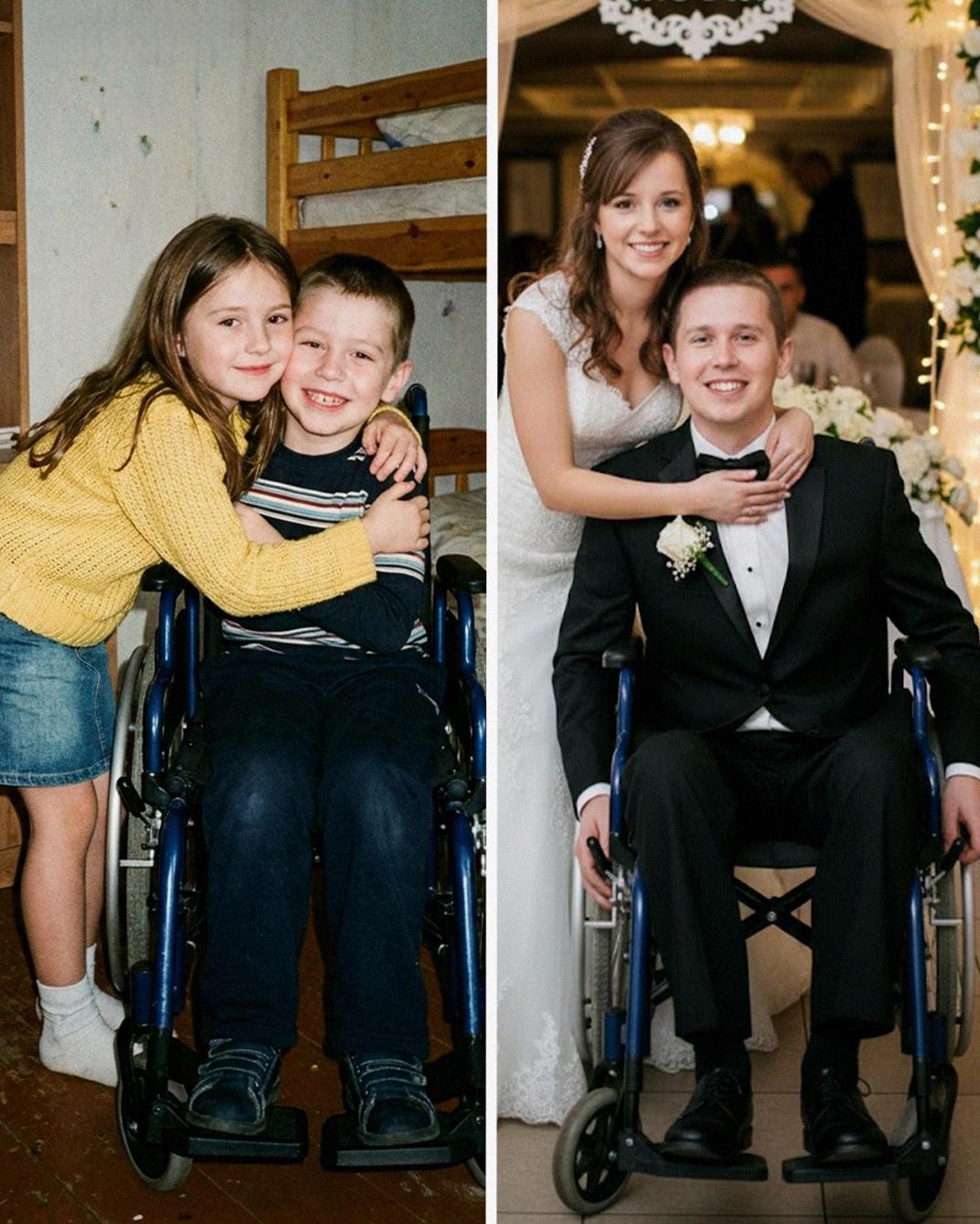
The world of foster care and orphanages teaches a child one harsh truth: everything is temporary. By the time I turned eight, I had been moved through more foster homes than I had birthdays. I became an expert at packing my life into a single trash bag in less than ten minutes. My survival strategy was simple: never get attached. Resilience, I learned, meant no longer asking questions or expecting anything permanent, especially not love. Everyone I met was bound to leave eventually. But when they placed me in my last group home, I met a boy named Noah who would shatter every wall I’d spent years building.
Noah was nine, thin, and carried a gravity beyond his years. He navigated the world in a wheelchair, a detail that made the adults uncomfortable and caused the other children to keep their distance. They treated him like a prop—something to be moved around, a chore to be dealt with. One afternoon, tired of the cold indifference, I sat beside him by the big window in the common room. I didn’t offer pity or pretend to help him; instead, I simply told him that if he wanted to guard the view, he had to share it. He raised an eyebrow and gave me a look of silent acknowledgment. In that instant, something shifted between us, and we became a part of each other’s story.
Living in the system together meant we witnessed each other’s pain, growth, and inevitable heartbreak. We saw the angry versions of ourselves, the quiet ones, and the moments we stopped hoping when we saw the “nice couples” touring the facility. We both knew they were looking for babies or “easy” kids, not a girl with a history of failed placements or a boy who needed a ramp. So, we created our own coping ritual. Every time a child was adopted, we would joke, “If you get adopted, I get your hoodie.” He’d reply, “And I’ll take your headphones.” We said it in jest, but it was a pact. We both knew no one was coming for us, so we decided to be there for each other.
The day we turned eighteen, the transition from “ward” to “adult” was cold and transactional. We signed papers, were handed a folder and a bus pass, and walked out of the only home we’d ever known with our lives packed in plastic bags. On that windy sidewalk, Noah spun his wheelchair slowly and said, “At least now no one can tell us where to go.” And so, we began the long, exhausting process of surviving. We shared a tiny apartment above a laundromat where the smell of hot soap lingered in the air, and every day was a struggle for Noah to navigate the stairs. We worked back-to-back shifts—him in IT support and tutoring, me at a coffee shop and stocking shelves. But despite everything, we built a life together from second-hand furniture and raw determination.
Our friendship never erupted into romance. It grew quietly, almost imperceptibly, like tectonic plates shifting underfoot. I realized it had changed when I noticed my breathing would only settle when I heard the sound of his wheelchair in the hallway. Our big “confession” came one late night while we were studying: we were already a family; we were just waiting for the paperwork to catch up. A year after we graduated, Noah proposed in our cramped kitchen while I was making pasta. He didn’t get down on one knee—he didn’t need to. He simply asked if I wanted to keep doing life with him legally, and I said yes before he could finish his sentence.
Our wedding was small but full of defiance. College friends, cheap cupcakes, and a few staff members from the group home who had seen us as real people, not just cases. We returned to our little apartment as husband and wife, finally feeling that we had a foundation beneath us that wouldn’t disappear. But the morning after our wedding, a knock at the door would change everything.
A man named Thomas, dressed in a sharp coat and exuding the quiet authority of an attorney, stood at our doorstep. Instantly, my foster-care instincts kicked in—any time someone in a suit arrived, it usually meant something was being taken away. He explained he had been looking for Noah on behalf of a man named Harold Peters. Noah was confused—he didn’t know anyone by that name. We let Thomas inside, and he placed a thick envelope on our coffee table.
Inside, there was a letter from Harold Peters, revealing a moment of humanity Noah had long forgotten. Harold had spent his life working maintenance at various group homes, never having a family of his own. Years ago, Harold had fallen outside a grocery store, and while many people walked around him, ignoring his struggle, Noah—a young boy in a wheelchair—had stopped to help him. Harold had never forgotten that act of kindness, though Noah didn’t recognize him.
Thomas explained that Harold had recently passed away and had left his entire estate to Noah. It wasn’t just a small inheritance; it was enough to guarantee we’d never again worry about rent or broken appliances. But more than the money, Harold had left us something more profound—a home. A single-story house with a ramp and a sturdy, ancient tree in the yard. A real home, designed for roots, not transit.
We visited the house a few weeks later. The air inside smelled of old coffee and nostalgia. Noah slowly rolled through the living room, his face a mixture of awe and disbelief. For twenty-eight years, we had lived defined by what we didn’t have and the people who didn’t choose us. Now, we stood in a kitchen that couldn’t be taken away, looking out at a yard that belonged to us.
Noah admitted he didn’t know how to live in a place that wouldn’t vanish. I put my hand on his shoulder, feeling the solid, undeniable reality of the walls surrounding us. No one had ever chosen us. But a man we barely remembered had seen Noah’s kindness and left us a legacy. We had spent our lives protecting ourselves from the world, only to find that one person had been watching and waiting to give us what we thought we’d never have: a place to call home. We were no longer two orphans with paperwork. We were two people with a future, finally grounded in a place where we could finally grow.