My name is Johnny. I’m 38, and for the past six years I’ve worked security at a modest grocery store where the doors slide open all day like a heartbeat and the world moves past in every mood imaginable.
It’s not glamorous. Most of my job is about preventing small problems from turning into big ones. I settle arguments over expired coupons, break up parking-lot shouting matches, and watch teenagers slip beer into their hoodies like it’s a secret rite of passage. Some days I feel less like a guard and more like a referee for the worst impulses people carry around.
But it pays the bills.
My wife works from home, tapping away at deadlines on our kitchen table, surrounded by stacks of papers and half-drunk mugs of coffee. Our son, Stewart, is eleven, sharp as a tack, and completely relentless when it comes to books. He reads by the hallway light at night because he can’t stand leaving a chapter unfinished. I want him to have a life full of choices, wider than the narrow path I sometimes feel trapped on.
I’ve told him the same lesson a thousand times: hard work matters, but character matters more. You can lose money and earn it back. You can lose pride and rebuild it. But if you lose your integrity, there’s no replacement, no way to undo it.
Still, I’d be lying if I said I never worried whether he believed me. Kids notice everything—the old car, the small house, the way I count receipts before tossing them. Sometimes I fear he thinks the world rewards the wrong things.
Then came Tuesday.
It was a slow shift, the kind where the clock mocks you and every minute feels like an hour. The store was busy enough to keep the registers moving, but quiet enough that I could hear the hum of the air conditioning and the occasional beep of a scanner echo through the aisles. I was stationed near the front doors when I noticed a man at the checkout who didn’t fit the usual blur of shoppers.
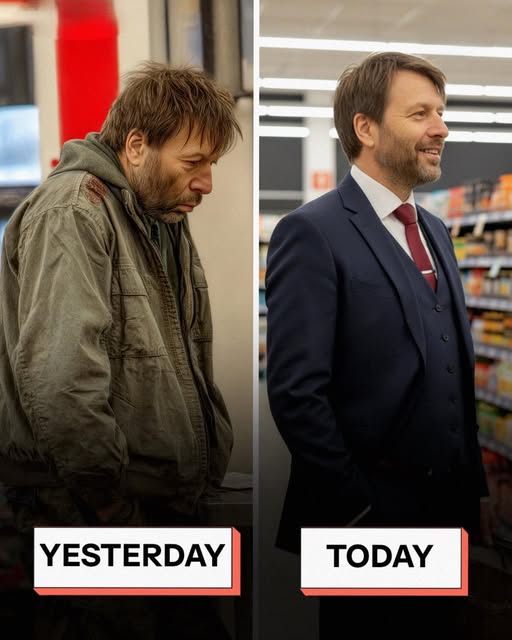
He looked to be in his forties or fifties. A faded military jacket clung to his frame, a stitched name patch on the chest, a unit insignia on the shoulder. His boots were worn and scuffed, each mark a story, each crease a mile traveled. He carried a single item: a carton of milk.
At the register, he counted out coins slowly, deliberately. Not for attention. Not dramatically. Just carefully, like arithmetic running through his mind. Behind him, impatience built. A man held the hand of a small boy—five or six, wide-eyed and fidgety.
“What a poor loser,” the father muttered, sharp and dismissive.
The man’s ears reddened. His fingers trembled. A few coins slipped to the floor. He crouched, picking them up carefully, shoulders hunched, humiliation radiating from him.
Then the boy asked, loud and innocent, “Dad, why is that man so poor?”
The father sneered, not lowering his voice, “Not everyone is smart, buddy. Watch people like this deadbeat so you know how not to end up like them.”
The word “deadbeat” hung in the air like smoke.
The man didn’t respond. He just kept picking up coins, slow, careful, shoulders slumping further.
Something inside me snapped—not into rage, exactly, but into clarity. I thought about Stewart, about the lessons I’d tried to teach him, about the example I’d set. Silence teaches too. Silence says: this is normal. This is acceptable.
I walked over.
“I’ve got it,” I said to the cashier.
The man looked up, eyes tired but dignified. “You don’t have to,” he said, strained.
“I want to,” I replied. “Please.”
I paid for the milk, then quietly added a few essentials—coffee, macaroni and cheese, chicken tenders. The cashier rang them up without comment.
The veteran stared at the bags, disbelief written on his face. His eyes glistened, and he reached out, gripping my hands tightly.
“Thank you,” he whispered. “You have no idea what this means.”
“It means you’re going to eat,” I said softly. “That’s it.”
I crouched to the boy’s level. “Listen,” I said. “There’s no shame in struggling. Honest work is nothing to mock. Shame is mocking someone doing their best.”
The father avoided my eyes.
The man collected his bags and left, quickening his pace like he wanted to disappear before anyone could question it.
I returned to my post, heart pounding—not from fear, but from the strange relief of doing what felt right.
Until closing.
My manager called me into his office, that tight expression people wear when the word “policy” is coming.
“We got a complaint,” he said.
I didn’t need to ask who.
“He says you embarrassed him in front of his son,” my manager continued. “You interfered with a paying customer and created a hostile environment.”
I blinked. “I paid for his groceries.”
“Corporate doesn’t care about context. They care about complaints. Fifty dollars will be deducted from your next paycheck for professional misconduct.”
Fifty dollars. Enough to sting. Enough to cover groceries for a week or a utility bill. But still… I couldn’t regret what I did. Not for a second.
That night, I sat in the car before going inside. I rehearsed how I’d tell my wife. I hated the lost money. But I couldn’t regret doing the right thing.
The next day, halfway through my shift, a man walked in who looked like he belonged in a boardroom, not aisle seven. Expensive suit, polished shoes, a presence that made people instinctively step aside.
“Johnny?” he asked.
“Yes,” I said cautiously.
“We need to talk about what you did yesterday.”
My stomach tightened. “Am I in more trouble?”
“No. But you need to come with me. Your manager’s aware.”
We drove through neighborhoods I rarely see: gated houses, manicured lawns, fountains, marble accents. We stopped at a mansion with a long driveway.
Inside, it was silent, gleaming. Marble floors, high ceilings, chandeliers. Then I saw him: the veteran from the store, but transformed—clean-shaven, hair styled, a tailored suit that made him look untouchable.
“I’m Simon,” he said, extending his hand.
I shook it, confused.
“Sit,” he said gently.
He explained he was a veteran, two tours overseas, now running a logistics company he built from scratch.
“So… yesterday?” I asked.
“Every year on my birthday,” he said, “I dress down, go out into the world, and see how people treat someone they assume is struggling. I struggled when I came home—not financially, but emotionally. And I saw how quickly people disappear when they think you have nothing.”
His brother, Timothy, helped run the foundation Simon built.
“You didn’t know who I was,” Simon said. “You acted without expectation. You were the only one who stepped forward.”
He handed me an envelope—a reward. I thought of Stewart, the programs we couldn’t afford, the fifty-dollar fine. But I refused it.
“Decency isn’t transactional,” I said.
Simon nodded. “Fair.”
A week later, Stewart came home with a letter: a full scholarship to a private academic program. Timothy and Simon’s foundation had recognized the lesson I had tried to teach: that character matters more than money, and doing the right thing can echo farther than you ever see.
The fifty-dollar fine had been taken from my paycheck. Life returned to its rhythm. But something had shifted.
Because for once, I knew, with certainty, that the lesson I’d spent years trying to teach Stewart wasn’t wasted.
Doing the right thing matters. Even when it costs you.
And sometimes, that cost carries farther than anyone can imagine.