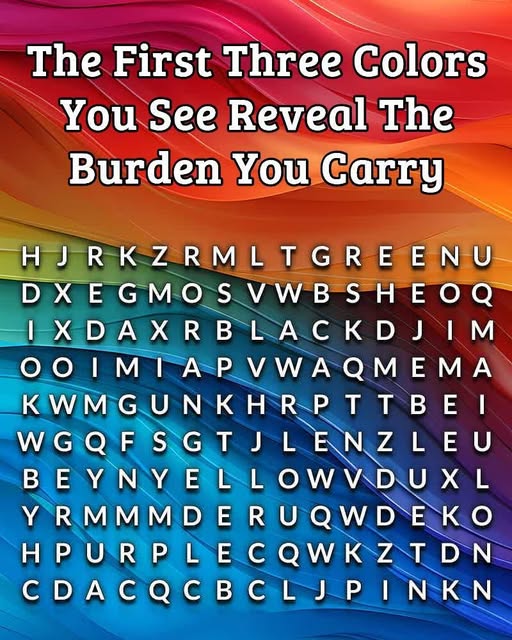
Our eyes are not the only organs that perceive color. We are where they land. A shade may strike like a memory, a mood, or a warning before we’ve given the emotion a name. For this reason, the phrase “The first three colors you see reveal the burden you carry” keeps coming up on the internet. As a symbolic exercise, it can be surprisingly effective at one thing: forcing you to stop long enough to notice what’s happening inside of you. It’s not a clinical test, and it won’t replace actual mental health therapy.
The concept is straightforward. Your brain does not make a random selection whether you are presented with a colorful visual or asked to quickly name the first three colors you see in your environment. Selective attention is used. We are attracted to things that are noticeable, familiar, secure, or urgent. In an instant, you are filtering the world in addition to viewing it. This is where the idea of “burden” enters the picture.
In this sense, “burden” does not necessarily imply tragedy or trauma. You may have normalized stress. You’re carrying pressure in silence. You’ve suppressed your anger for years. This small color game isn’t meant to diagnose you. It’s to reflect you. You might notice trends you’ve been ignoring if you give it enough thought and don’t use it as a horoscope.
The way the brain functions explains why colors may feel so intimate. Perception of color is interpretative as well as visual. The brain associates color with emotion, memory, and acquired meaning. Consider how a warm golden light may ease your shoulders or how a hospital-white hallway can quickly make you feel uptight. Your body responds even if you aren’t aware of it. That’s a combination of experience and biology.
It’s cultural as well. In some contexts, a color that conveys comfort might also convey grief. In many Western cultures, white is linked to “clean,” purity, and weddings. White is closely associated with funerals and sadness in some parts of Asia. In Chinese culture, red is associated with luck, celebration, and prosperity, but in other contexts, it can also indicate danger, stop, and warning. Therefore, when someone says, “Black means grief” or “red means passion,” they are providing a common abbreviation rather than a universal truth.
But there’s a reason those shorthands are used. Humans have given color emotional value over time because it facilitates our ability to quickly understand the outside environment. Every time we decide what to wear on a day when we want to feel invisible or confident, we use it, just like designers, filmmakers, and advertisers do. Color is a language that speaks directly to the neural system without using reasoning.
What is the purpose of this “first three colors” exercise, then? It challenges you to pay attention to your gut. The point at which you persuade yourself to give a more “reasonable” response. It’s a tiny method of recognizing when you’re reacting. And the truth frequently resides there.
These are some typical symbolic interpretations of these readings. As prompts, not as regulations.
Intensity is represented by red. It could be boldness, ambition, love, or passion. Moreover, it may manifest as rage, impatience, conflict, or a persistent sense of urgency. If you experience red first, the “burden” may be emotional heat—the sense that everything is important at the moment and that everything may shatter if you slow down. It can occasionally indicate that a person has been attempting to maintain their strength for too long.
Depth is represented by blue. It can convey emotional intelligence, loyalty, stability, and serenity. It may also convey melancholy, accountability, and the strain of maintaining order. If you feel blue right away, you can be under silent pressure to maintain the peace, carry the mood of others, and remain calm when you need help too.
Yellow has a hint of brightness. It’s optimism, playfulness, inventiveness, and hope. But it’s also overthinking, worry, and the need to maintain a positive outlook. The performance of happiness—the idea that you should be cheerful even when you’re exhausted or in pain—may be your burden if yellow appears first.
Protection is symbolized by black. It can stand for strength, self-control, sophistication, and boundaries. It may also indicate emotional armor, dread, grief, or concealment. You may be carrying a burden you don’t discuss if black is one of the first colors you see. Or you’ve gotten so proficient at protecting yourself that it feels dangerous to let others in.
White is clarity and control. It might represent simplicity, calm, and new beginnings. Additionally, it may imply avoidance, perfectionism, and an emotional drive to maintain order. Maintaining an image—remaining calm, doing things “right,” and feeling insecure when life gets messy—may be the burden if white comes up easily for you.
Green symbolizes survival, growth, and healing. It may convey resilience, equilibrium, and rejuvenation. Envy, comparison, and the strain of change can all be linked to it. Green may be your burden if it sticks out—whether you’re trying to grow, rebuild, or recover from anything while your surroundings keep pushing you back.
Transformation is frequently associated with purple. It can stand for profundity, creativity, wisdom, and insight. It may also allude to feelings of isolation, misunderstanding, or unanswerable questions. If purple appeals to you, it could be a sign of emotional complexity—having strong emotions, living in your thoughts, and lacking a straightforward outlet for them.
Stimulating is orange. It’s vigor, bravery, excitement, and ambition. However, it can also indicate confusion, burnout, and the desire to “bring it” at all times. Constant output—always performing, always producing, always being “on”—could be the hardship if Orange arrives early.
Gray falls somewhere in the middle. It can stand for stability, neutrality, and maturity. Additionally, it may indicate weariness, numbness, and doubt. Going through the motions, finding it difficult to feel passionately, or feeling torn between options could be your emotional load if gray shows up early.
None of these interpretations constitute a judgment. They serve as a gateway. Your response—does the interpretation make you uncomfortable in any way—is what matters. Is it familiar? Does the fact that it’s near something you don’t want to acknowledge make you angry?
Keep this practice grounded if you want to use it in a way that truly benefits you. Don’t think of it as fate. Think of it as a mirror.
Don’t overthink it; choose your three colors quickly. Then, for each color, write a sincere statement that explains what it means to you, what it makes you feel, and what it might mean in your life at the moment. “What am I carrying that I’m pretending is normal?” is a deeper question to ask if you enjoy journaling. Bring it up as a topic of discussion if you’re receiving therapy. Paint it if you’re an artist. You can still utilize it to give names to what your body already knows if you’re not.
Your troubles won’t be solved by colors. However, they can assist you in recognizing them. And sometimes the first step to actually lowering the weight is just realizing it.