The bookstore had always been my quiet escape from the outside world—a sanctuary where the sunlight streamed lazily through the tall, arched windows, painting the worn wooden floors with golden patterns, and the scent of old paper, ink, and faint vanilla lingered like a comforter around my shoulders. The soft hush that hung in the air made every day feel safe, like the outside chaos couldn’t touch me here. I was shelving classics, arranging the faded spines just as I’d done a hundred times before, letting my hands brush over the familiar titles with a kind of meditative rhythm. Everything felt steady, predictable, warm. Until the doorbell rang, a sharp tinkle that sliced through the calm, and the ordinary rhythm of the afternoon suddenly fractured.
A teenage girl stepped inside, moving like she wanted to melt into the shadows. Her oversized hoodie swallowed her completely, the hood pulled low over her face, and her backpack hung heavy and lopsided on her shoulders, making her look smaller than she really was. There was something about the way she carried herself—tense, hesitant, like she was holding her breath—that made the room feel suddenly charged, as if the silence itself was taut with expectation. And even before I understood why, a strange intuition swept over me: whatever was about to happen wasn’t going to be just another routine shift.
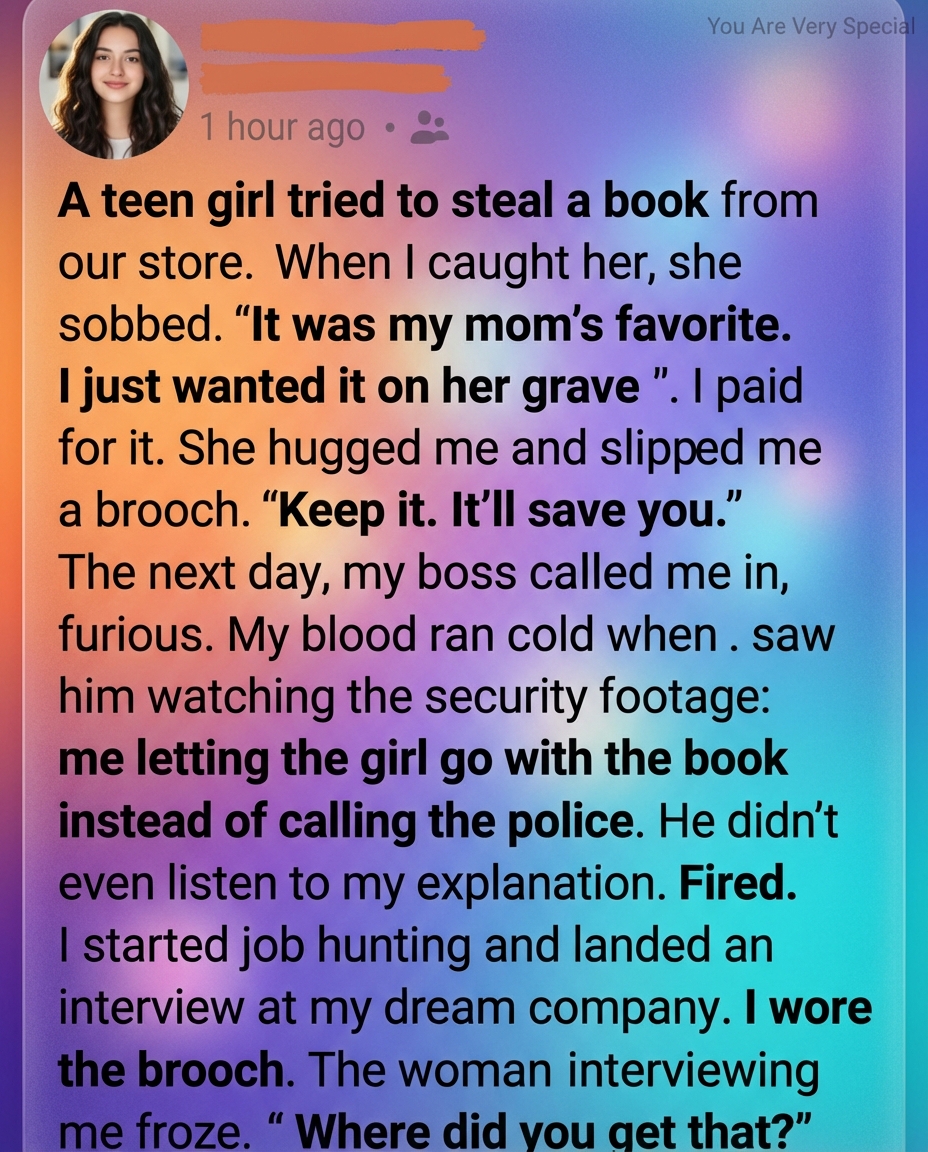
She lingered in the paperback aisle, fingers trembling as they hovered over the books, scanning titles again and again, as if she was searching for something that went far beyond words on a page. Then, with a sudden, almost imperceptible movement, she slid a worn book into the open pocket of her backpack. My stomach knotted immediately. I knew the protocol—I was supposed to intervene, call security, enforce policy. That was the rule. That was the world. But as I stepped toward her, something in the way she looked up at me—wide, wet eyes, the faintest quiver in her lips—made my sense of right and wrong shift. She didn’t bolt. She didn’t fight. She simply froze, and then broke down completely.
Tears spilled down her cheeks as she whispered, voice shaking and barely audible: this book had been her mother’s favorite. Her mother had read it to her every night before illness took over, before it stole her away last year. She wasn’t trying to steal for fun. She just wanted this one story, a fragment of memory, something to leave on her mother’s grave—a final gift, a tangible piece of love to place beside goodbye. She spoke in fragments, stammering through grief and desperation, and every word made the bookstore feel smaller, as if the walls themselves were holding their breath with us.
In that instant, the rules felt irrelevant, cold, cruel. I didn’t hesitate. I took the book from her bag, walked to the register, and paid for it with my own card, my hands steady even as my heart thumped. The girl stared at me, a mix of disbelief, relief, and awe flooding her expression. Then, before she could even find her voice, she threw herself into a shaking, desperate hug that felt both fragile and monumental. She pressed something small into my palm—a delicate silver flower brooch with a bright blue stone nestled in its center. “It was my mom’s,” she whispered. “She said it was lucky. She wanted it to be with someone good now. Someone who would understand.” I tried to refuse, but she was already pulling away, offering a sad, fleeting smile before slipping out the door and disappearing as suddenly as she had arrived, leaving behind only the scent of her hoodie and the lingering echo of her presence.
The next morning, the weight of consequence caught up with me. My manager called me into the back office, and the security footage was played like evidence in a trial. He didn’t pause, didn’t consider grief, memory, or heartbreak—policy was law in his eyes. I was fired on the spot, handed a cardboard box of my personal belongings, and escorted out into the cold morning air. I wandered the city streets in a daze, questioning every choice I’d made, thinking I had ruined my life for a moment of compassion.
But life has a way of weaving the threads of kindness into unexpected tapestries. A week later, I wore the silver brooch to an interview at a major architectural firm I’d never dared hope would consider me. Midway through the conversation, the hiring manager’s eyes widened, and he leaned forward, voice sharp with recognition: “Where did you get that?” I told him the story—the bookstore, the girl, her mother, the grief and the gift. He nodded, expression unreadable, then led me into the office of the firm’s owner. When the owner saw the silver flower, his face went pale, and his hands trembled slightly. He whispered, almost reverently, that it had belonged to his late wife, and that his daughter had vanished with it years ago after a tragedy tore their family apart.
The story didn’t just secure me a job. It restored a broken connection, mending a gap left by loss, grief, and misunderstanding. Somehow, in that brief, unexpected exchange, one act of simple kindness had bridged a gap between sorrow and reconciliation, despair and hope. The bookstore aisle, the trembling girl, the silver flower—each had been a portal to a life rebuilt, a future reshaped by empathy and courage.
From that day on, I understood the quiet power of small choices, the profound ripple effects of compassion. A single, uncalculated act—the decision to pay for a book, to accept a gift, to see a person instead of a policy—had altered more than just my life. It had mended a fractured family, restored a sense of faith in humanity, and reminded me that sometimes, the most extraordinary moments arise not in grand gestures or monumental events, but in the hushed, fragile spaces where grief and love intersect, and kindness finds its way into the world like sunlight spilling through tall, dusty windows.