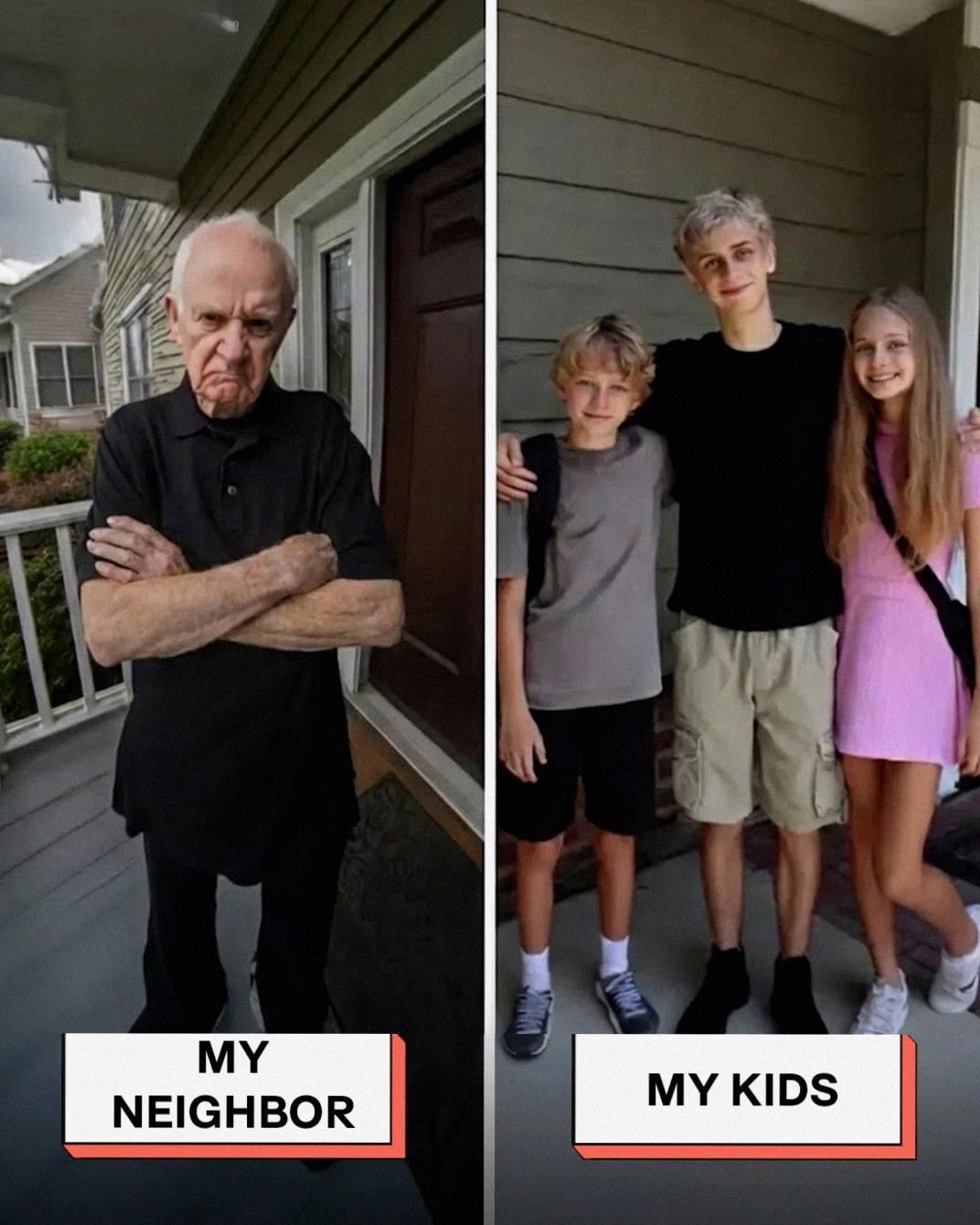
For ten years, Mr. Henderson had been the looming shadow over our driveway, a man whose sole mission seemed to be regulating the joy of my three children. He was every suburban nightmare personified—a figure gripping his porch railing like a judge’s gavel, launching verbal tirades over sidewalk chalk, stray basketballs, and the high-pitched symphony of childhood laughter. Our lives were structured around his anger. My daughter, Mia, learned to dribble her basketball in tentative, muted rhythms. Sam, my eldest, pedaled his bike in tight, anxious circles to avoid the invisible boundary of the Henderson property. Only Leo, the youngest, seemed immune. Every morning, he offered a bright, unwavering wave to the stone-faced man next door, receiving nothing but a door slam or a low, guttural growl in response.
When the news arrived that Mr. Henderson had passed away, the street was engulfed in an eerie, unnatural quiet. It felt as if a structural hum we’d grown accustomed to had been suddenly cut, leaving us deafened by the absence of sound. Neighbors, led by the ever-curious Mrs. Callahan from the HOA, expressed relief. She stood on the sidewalk, arms folded, and spoke the thought everyone secretly harbored: “So, he finally died.” She cautioned me, predicting that his family would arrive soon to settle decades of grievances and HOA complaints he had filed against our “situation.”
Her prediction came true when a black sedan pulled into the driveway. A woman emerged, her posture sharp and her gaze calculating—the same meticulous intensity as her late father. This was Andrea, Mr. Henderson’s daughter. But she didn’t head to the front door of her father’s house; she walked straight to ours. I instinctively pulled Leo close, bracing for a lecture on noise ordinances or property lines. But Andrea came with neither accusation nor anger. She brought a delivery: a locked metal box addressed to Leo. Her face carried exhaustion and the faintest crack in a lifetime of defenses. Without another word, she left, murmuring that her father had requested it in writing and that she was too weary to carry the burden of his secrets any longer.
Inside the box lay a single USB drive—no note, no map, no apology. When I plugged it into my laptop, the screen flickered to life, revealing a side of Mr. Henderson we had never seen. He wasn’t shouting. He sat in a dimly lit living room, eyes red-rimmed, voice heavy with a vulnerability that felt almost invasive. “I made myself unbearable on purpose,” he confessed to the camera. “I needed to know if anyone could be kind to someone who didn’t deserve it.”
The video transitioned into a compilation of porch security footage spanning years. We watched ourselves through his eyes. I saw a younger me, wild-haired and frustrated, herding the children inside after one of his tirades. I saw Mia and Sam flinch at his shadow. But then, the footage shifted to a rainy afternoon three months prior. Mr. Henderson was struggling on his porch, cursing the storm as he reached for a dropped cane. And there was Leo, small and steadfast in a yellow raincoat. Despite the man’s snapping command to “get away,” Leo calmly picked up the cane, leaned it against the railing, and produced a crumpled, rain-soaked dandelion from his pocket.
“It’s for you,” Leo whispered, voice echoing through the laptop speakers. “To make you feel better.”
The footage froze on Mr. Henderson’s face—stunned, silent, unblinking. His voice returned, quieter now, stripped of the authority it usually carried. “I spent eighty years proving people are only good when it’s easy,” he whispered. “But he… he chose it. Every day.” The screen went black, leaving us in a dim kitchen, grappling with the realization that the neighborhood villain had been conducting a lonely experiment on the limits of human mercy.
Andrea returned shortly after, letting herself in with the ease of familiarity. She sat at the kitchen table, noting the shards of a mug I had dropped in shock. She spoke of a childhood under the thumb of a man who equated softness with weakness, kindness with manipulability. She had spent her life trying to earn a version of her father that Leo had been freely given. “He didn’t want a connection,” she said. “He wanted control. If you didn’t follow the rules, you weren’t just wrong; you were a disappointment.”
But the box held one final revelation. Andrea pulled out a manila envelope containing her father’s will and a personal letter addressed to me. Mr. Henderson had left most of his estate to charities, but the house next door was now Leo’s, accompanied by a substantial trust to secure his future. In his letter, he wrote: “You kept your children kind in a world that tried to harden them. That’s not weakness. That’s brilliance. Thank you for letting Leo wave.”
The anger I had carried for ten years didn’t vanish, but it evolved into something more complex—a somber empathy for a man so afraid of being hurt that he chose to be hated. Andrea stayed for the first time without carrying the weight of her father’s expectations alone. She sat with us, and when Leo offered her hot chocolate, she exhaled a breath she had held since childhood.
Around the mismatched kitchen mugs, we weren’t enemies or survivors. We were people acknowledging that sometimes, the hardest hearts are waiting for a dandelion they believe they don’t deserve. The grumpy neighbor was gone, but his legacy of unlikely kindness remained—a reminder that bitterness can be chosen, but grace is the only force strong enough to outlive it.