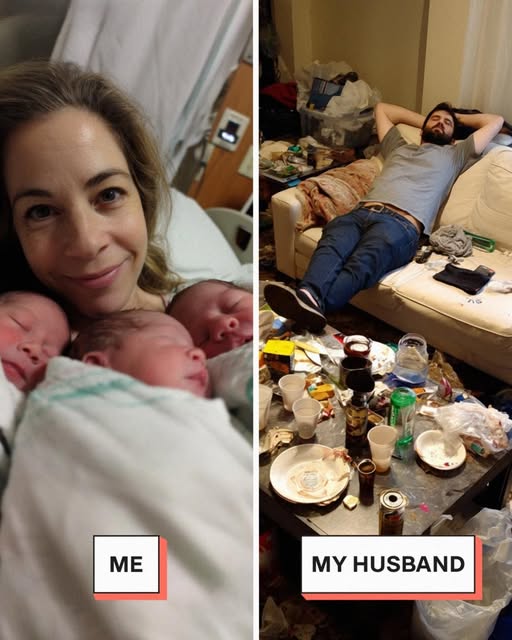
The homecoming Nicola had imagined during those long hours in her hospital bed was filled with soft light, the calming scent of lavender, and the steady presence of a partner who understood the enormity of what she had just endured. Instead, after surviving a traumatic emergency C-section and bringing three fragile premature babies into the world, she stepped back into a reality that felt like a calculated blow to her dignity.
The apartment didn’t simply feel cold—it felt openly hostile.
Her abdomen throbbed with every movement as she carried two infant car seats, her core muscles burning from surgery, while balancing a third baby against her hip. She stood in the doorway of what had once felt like home. Sam, her husband, didn’t step forward. He didn’t relieve her of the weight in her arms. He didn’t kiss her forehead or ask how she felt. He stood there with his arms folded, irritation etched across his face.
“Finally,” he muttered. “You could’ve given birth faster. The apartment’s filthy.”
The words landed harder than the pain in her stitches.
The smell hit her next—a sour, rotting stench that clung to the air and coated the back of her throat. As she moved further inside, the scene was worse than she could have imagined. The living room had become a landscape of neglect. Towers of takeout containers leaned against the television stand. Plates crusted with dried food attracted flies. Crumbs were ground so deeply into the carpet that its original texture was lost. And in an act so careless it felt deliberate, used toilet paper sat piled on the coffee table.
When Nicola called out in disbelief, Sam barely glanced up from his phone. He shrugged and claimed the mess was simply “what she left” before her month-long hospital stay. He expected her—fresh from major abdominal surgery—to start scrubbing immediately, as though the last month of his own inactivity had been invisible.
But the true betrayal wasn’t the garbage. It was what came next.
While Nicola struggled in the nursery, wincing through postpartum pain as she tried to soothe three crying newborns, her phone buzzed. Sam had posted a photo on Instagram—a wide-angle shot of the trashed apartment. The caption read: “MY SLOBBY WIFE HASN’T CLEANED THE APARTMENT IN A MONTH. DOES ANYONE KNOW WHEN THIS IS GOING TO STOP?”
The comment section exploded. Strangers called her “lazy,” “useless,” a “terrible wife.”
In that moment, something inside Nicola shifted. The tears that threatened to rise dissolved into something colder—clearer. This wasn’t stress. This wasn’t exhaustion. It was cruelty. Sam wasn’t overwhelmed; he was publicly humiliating her to mask his own incompetence.
Instead of confronting him in anger, Nicola chose strategy.
She returned to the living room, smiled sweetly, and apologized. She thanked him for his “patience” and suggested they celebrate with a special surprise dinner the next evening. Flattered and unaware of what was unfolding beneath her calm exterior, Sam agreed eagerly.
The next day, Nicola moved with quiet precision. She made calls. She gathered screenshots. She secured her sister to watch the babies. She organized everything.
When evening came, she handed Sam a silk blindfold and told him the surprise required mystery. She drove through the city before stopping at his sister’s home. Inside, she removed the blindfold.
Sam stood frozen.
The room was filled with the people whose opinions mattered most to him—his parents, her parents, close friends. The atmosphere felt heavy, like the beginning of an intervention.
“I’m worried about Sam,” Nicola said gently. “We’re all here because he needs support.”
She guided him to a chair in the center of the room, facing a large television. With steady hands, she pressed play.
First came the screenshot of his Instagram post. The caption. The comments. The insults.
Then came photos of the apartment as she had found it—rotting food, piles of trash, the coffee table.
Nicola spoke calmly, almost clinically, explaining what a C-section entails. The layers of muscle cut. The weeks of restricted movement. The physical strain of caring for premature infants in the NICU.
“I’ve realized what the real issue is,” she told the room. “Sam lacks basic life skills. He exposed me publicly, but the truth is he cannot function as an adult without someone serving him.”
The tension in the room thickened.
Sam tried to protest, claiming he knew how to clean. Nicola calmly asked simple questions—Who does the laundry? Who cooks? Who vacuums? Who schedules appointments?
His answers were silence.
Frustrated, he finally snapped: “It’s her job.”
The mask fell.
His father stood up, face flushed with embarrassment. His mother looked stricken. The narrative Sam had crafted online collapsed under the weight of reality.
Nicola didn’t ask permission for what came next.
“I’m taking the girls to my parents’ house,” she said. “Indefinitely.”
She told Sam that if he wanted his family back, he would clean the apartment completely and post a public apology as visible as his insult.
There were no excuses left. No audience to impress.
Late that night, sitting in the quiet of her childhood bedroom while nursing her daughters, Nicola checked her phone.
A new post appeared.
It wasn’t glamorous. It wasn’t humorous. It was a video of Sam on his hands and knees scrubbing the kitchen floor. The caption admitted his disrespect and acknowledged that the mess had been his.
Nicola didn’t feel victorious. She felt steady.
She had learned something powerful: if someone tries to shame you in public, sometimes the only answer is to turn on brighter lights.
One night wouldn’t repair everything. But it changed the balance. It restored her voice.
Nicola knew she would be many things to her daughters—a protector, a provider, a teacher of strength.
But she would never again allow herself to be the villain in someone else’s story.