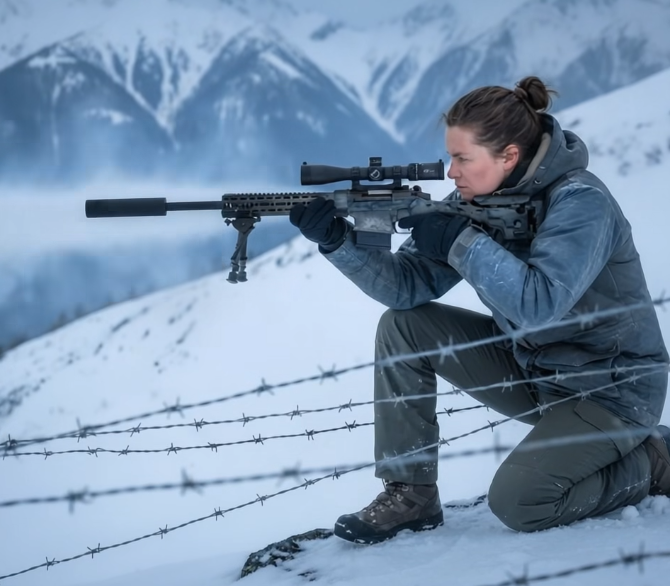
The northern Rockies do not offer forgiveness to the unprepared; they offer only an austere, indifferent silence that presses against the lungs like a tangible weight. Mara Holt discovered this truth the moment she set foot on her newly purchased eight hundred acres of timber, jagged rock, and relentless elevation. To the local land registry, she was a private citizen seeking solitude. To the classified archives of the U.S. Navy, she was a former elite sniper—medically retired, honorably discharged, and irrevocably finished with the politics of war. Yet the mountains did not know her past; they only knew preparedness and the consequences of failing to respect the land.
Mara did not relocate to the Rockies to construct a retreat; she moved to erect a fortress for the mind and body. Every boundary was deliberate, a chessboard of defensive layers: steel-reinforced fencing hugged the primary ridgelines, motion sensors buried beneath frost and snow tracked every subtle shift of heat, and thermal cameras surveyed the silent valleys where sound traveled for miles like a predator. Her cabin, minimalist and unassuming to the untrained eye, was in truth the central nerve hub of a meticulously maintained stronghold. For Mara, peace was never the absence of conflict—it was the unshakable dominance of environment over chaos.
Her control faced the first true test on a frigid Christmas Eve. At 22:47, while the world lit its holiday candles and the smell of pine and roasted chestnuts filled distant homes, Mara’s alert system pulsed a single, silent notification. Three heat signatures traced the eastern boundary of her property. They moved with the precision of trained tacticians, deliberate and low-slung, as if choreographed to study her defenses. Mara’s feet touched the cold concrete floor. She didn’t reach for a phone to call a distant, underfunded sheriff; she laced her boots, her movements smooth and patient, a shadow merging with shadows.
The first man approached her steel-reinforced fence with a specialized cutter. The wire bent under professional pressure, a sound subtle yet unmistakable. Mara activated the tree-mounted speaker. Her voice, calm and absolute, carried through the frozen pines: “You’re trespassing on private land. Turn around.” A laughter rippled through the intruders—a sound too casual, too arrogant. One man shifted, rifle raised, signaling defiance. Mara’s pulse didn’t quicken. The terrain, the silence, and her knowledge of both were weapons far sharper than any firearm.
She did not fire. Instead, she let the mountain fight with her. The first man stumbled into a hidden, ice-slick depression, sliding twenty feet into a deadfall. His weapon clattered into the snow like discarded metal. Mara moved silently behind the second, neutralizing his balance and disarming him in one seamless motion. The third, seeing his allies fall to the terrain and shadows, fled into the whiteness of the snowline. Mara did not pursue; nature had done its work. By dawn, the remaining two were left tied with zip-ties at the legal boundary, a satellite phone and a message waiting for their employers: “This land isn’t for sale.”
Weeks later, the incursions evolved. Drones—commercial models modified for surveillance—buzzed the ridges. Mara downed the first with a signal jammer, the second falling into a dead zone she had intentionally created. An old teammate, Evan Brooks, confirmed via a burner line that the threat had escalated: black-market wildlife traffickers and private contractors were eyeing her mountain as an unmonitored corridor for illegal trade. Mara was no longer a private landowner; she was a target. Her forest, her home, and her solitude were now strategic assets in a shadow war she had never asked to fight.
The second major intrusion involved six men, heavily armed, moving with coordination and professional intent. Mara observed their thermal silhouettes splitting into teams, a textbook pincer formation. She waited until they reached a clearing near her cabin. Then she unleashed the environment she had mastered: blinding high-intensity lights and disorienting acoustic frequencies. Chaos erupted in the snow-laden trees. They tripped over hidden deadfalls, collided with each other, and vanished into the mountain as if the terrain itself rejected them. By the time the sun rose, her ridge had expelled them.
Months passed. The mountain settled into a wary equilibrium. The legend of the “vanishing poachers” circulated in local towns, whispered in taverns and general stores. Yet Mara knew the reality was far simpler: predators understood the cost of intrusion, the risk far exceeding any reward. Federal land management agents arrived not to arrest her, but to negotiate. Mara had inadvertently sealed a critical corridor used by traffickers, and her defenses had preserved an ecological lifeline. They proposed a permanent conservation easement—federal protection, restricted access, and the unbreakable guarantee that her timber, her cliffs, and her solitude would remain untouchable. Mara signed the deed. She did not own the mountain; she belonged to it.
Evan Brooks visited once more in July. He marveled at her restraint, noting that she had broken the intruders’ confidence without ever breaking bones. “That’s harder to rebuild,” he said. Mara nodded. The mountain, like her, demanded respect before fear.
The final test arrived from a single, unarmed man, a former member of the previous failed teams. He approached her gate late one night, seeking answers. He asked how one woman had rendered six trained men impotent against her defenses. Mara’s eyes, cold and clear as the winter air, met his. “I didn’t do anything,” she said. “You came thinking no one would stop you. You were wrong. That was the lesson.”
She opened the gate and let him walk into the night. The summer deepened, and Mara hiked without her rifle, planted trees in the scars left by drones and boots, and sat by the stream without expectation of alarm. The fences and cameras remained, silent witnesses to a world she had mastered. Power, she realized, was not in destruction but in the quiet certainty of being understood without words.
The legend of the vanishing poachers endured, whispered in towns below, ensuring her eight hundred acres remained blank on every map. Mara Holt had finally found her peace—not through flags, confrontation, or violence—but in the enduring, absolute silence of a mountain that had accepted her terms. The line had been drawn, and for the first time, the world listened.