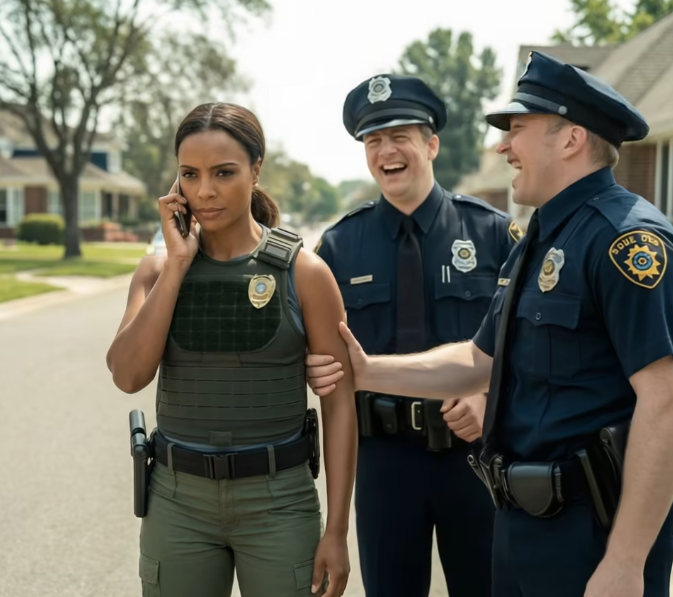
Lieutenant Jasmine Carter had learned the value of silence and the power of composure in environments where hesitation could cost lives. With two combat deployments under her belt, a Purple Heart, and a Bronze Star earned in the shadows of overseas conflict, she had endured situations where a single misstep meant the difference between life and death. On a humid Friday night on the outskirts of Charleston, South Carolina, Jasmine faced a very different kind of danger—a threat dictated not by an enemy combatant, but by authority wielded carelessly, amplified by bias she had encountered far too often.
She was dressed in her formal Army blues, freshly returned from a memorial service honoring a fallen comrade. The weight of the uniform, both literal and symbolic, reminded her of her years of discipline and sacrifice. When red and blue lights exploded in her rearview mirror, she followed every protocol she had drilled into muscle memory: pull over immediately, hazards on, engine off, hands on the wheel at ten and two. Compliance, she knew, could mean survival.
The two officers who approached her sedan did not exhibit the cautious respect typical of a traffic stop. Officer Grant Malloy, tall and exuding a sense of unyielding authority, thrust a flashlight into her eyes. The sudden glare seared across her vision. His partner, Officer Dane Rucker, circled the vehicle, sneering as he muttered about “stolen valor.” Jasmine handed over her driver’s license and military ID. Malloy tossed the ID back onto her lap as if it were refuse.
“What’s this costume supposed to do?” he barked.
“It’s not a costume,” Jasmine replied, her voice calm, measured. “I am active-duty Army. I am requesting that you contact my command.”
Her words, however, did nothing to diffuse the aggression. Malloy ordered her out of the vehicle. As she stepped onto the scorching asphalt with palms open, Rucker seized her elbow, twisting her shoulder far beyond what was necessary. In moments, Jasmine was pressed against the hood of the car, cheek on the hot metal. The handcuffs snapped onto her wrists too tightly, a sharp, biting reminder of the vulnerability she now faced. Malloy yanked her hair, forcing her head toward his body camera. “Smile,” he mocked, as though her pain was entertainment.
Jasmine’s training kicked in. With cuffed hands, she reached into her inner jacket pocket and activated her encrypted device. “I’m invoking Contingency Seven,” she whispered, barely audible over the sweat and chaos.
Malloy laughed, oblivious. But Contingency Seven was not a request—it was a signal to high-ranking service members that triggered an immediate, multi-agency response. The air shifted as a low thrum grew beneath the humidity—a sound Jasmine recognized as the herald of accountability.
The hum escalated into the deafening roar of Blackhawk rotors slicing through the night. Searchlights pinned the patrol car in a blinding glare. Unmarked SUVs converged from all directions, blocking the road. Men in tactical gear with “FBI” and “Military Police” emblazoned on their vests moved with surgical precision.
Malloy’s arrogance vanished under the wind of the rotors. His radio erupted with frantic voice traffic. Special Agent Lyle Bennett of the FBI stepped forward, badge in hand, and delivered a command that allowed no negotiation: “Remove her cuffs. Now.”
A medical team immediately documented the injuries—bruising on her wrists, abrasions along her neck. The rescue was both clinical and symbolic, a statement that the hunters had become the hunted. Malloy and Rucker were stripped of their weapons and cameras; for once, the power dynamic was reversed.
But Jasmine’s ordeal extended beyond personal vindication. Her stop intersected with a federal investigation into a deeply entrenched pattern of corruption within the department. For months, investigators had suspected the existence of a hidden database used to target minority drivers, but no one had the proof or the leverage to expose it—until Jasmine became the catalyst.
Weeks later, the incident reverberated across the nation. Footage of a Black lieutenant in full dress blues being mocked and assaulted by local officers went viral, igniting public outrage that could not be silenced. A whistleblower, Officer Caleb Price, came forward, handing Jasmine the “Black Book”—a digital ledger cataloging hundreds of citizens who had been systematically harassed.
The ensuing trial exposed the rot at the department’s core. Malloy’s defense attempted to frame Jasmine as the aggressor, but the Blackhawk footage, combined with her encrypted device recordings, left no room for deception. When the audio of Malloy deriding her uniform as a “costume” played in the courtroom, the jury’s silence spoke louder than words.
Malloy was sentenced to federal prison for civil rights violations and assault. Rucker, in exchange for his testimony, took a plea deal, implicating the commanders who had fostered the culture of fear. The department was placed under federal oversight. Sweeping reforms followed, including the establishment of a civilian review board empowered to terminate officers for misconduct.
Jasmine Carter didn’t step back from public life; she doubled down. She trained military-police liaisons, ensuring that no service member—or civilian—would be left powerless against abuse of authority. She held evening seminars at community centers, teaching recruits the weight of authority and the need for accountability. “Authority without accountability,” she would say, “is just fear with a badge.”
A year later, standing on the same bridge where she had met the whistleblower, Jasmine looked out over the dark, still waters. The city had been forced to confront its reflection, ugly but truthful. She had not sought fame, but she had harnessed its power to forge justice. One calm decision, made in the shadow of arrogance and fear, had moved mountains. And as she gazed across the river, she knew the record she had helped create would endure long after the rotors had faded from memory.