I’ve worked at the same neighborhood pharmacy for years. You learn to see people—not just their prescriptions, but the small, silent stories they carry across the counter. There are the obvious ones, like the trembling hands of someone with arthritis or the quiet sighs of someone exhausted by illness. And then there are the hidden ones: the furtive counting of coins, the small hesitation before someone asks to remove an item, the way someone’s eyes flicker to the floor when they realize they can’t quite cover the cost. Over time, you start to notice these tiny signs, these little human hesitations that reveal more than words ever could.
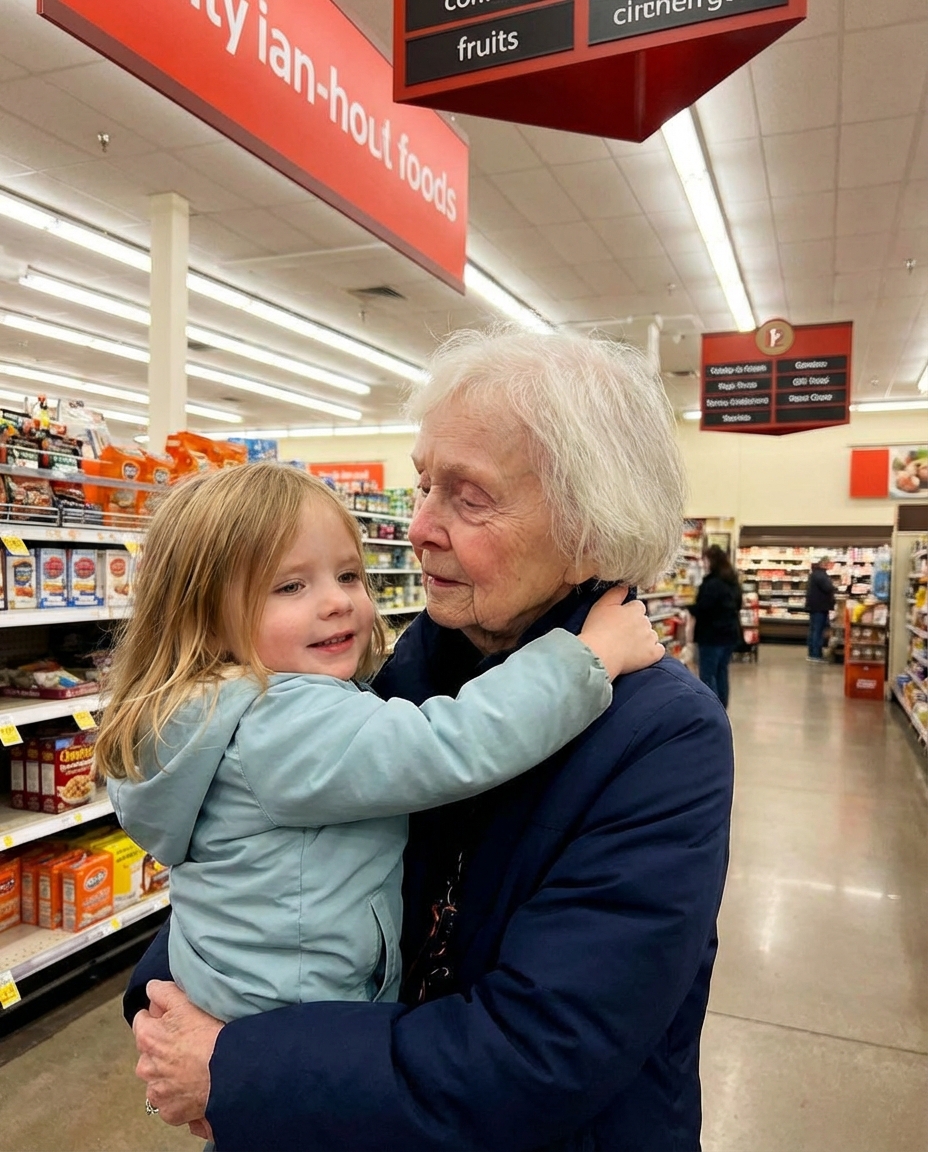
One evening, toward the end of my shift, an elderly woman came to my register. She was accompanied by her little granddaughter, who clung to her side with wide, earnest eyes. They carried only a few essentials—a loaf of bread, some milk, and, tucked between the groceries, a small bottle of children’s cough syrup. It wasn’t a large order, but every item mattered. When I scanned the groceries and told the woman the total, she counted her money carefully, only to realize she was a few dollars short. Her shoulders sagged, a subtle but unmistakable gesture of embarrassment, and she began to apologize in hushed tones. “I’m so sorry… I don’t know how this happened,” she said, her voice trembling slightly. She reached for the bottle of syrup to put it aside, as if removing it could somehow make the world right again.
The little girl watched silently, eyes fixed on that tiny bottle like it was the only thing in the world that mattered. She didn’t fidget or whine; she just stared, hope and fear mixing in her wide eyes. Something in that moment—seeing the desperation in a grandmother trying not to feel shame and the innocence in a child clinging to a small piece of hope—made my hands move before my brain fully caught up. I reached into my pocket and pulled out a crumpled bill, not thinking about store policy or rules. I covered the difference. I didn’t make a show of it. I simply smiled and said, “Take the syrup. Get your granddaughter home safely.”
The woman’s eyes welled immediately—not the dramatic tears of a staged moment, but the quiet, exhausted relief that comes from years of invisible struggle. She grasped my hand, whispered a blessing, and hurried out with the child. They disappeared down the street, small and fragile, but carrying with them something I hoped I had helped preserve: dignity. I finished my shift in a sort of quiet haze, assuming this moment would fade into the countless other small, unnoticed instances that define life behind a register.
The next morning, I barely had time to clock in and log into the system when a uniformed police officer walked straight toward me. There was no casual greeting, no small talk, no browsing around. Purpose radiated from him, sharp and immediate. My stomach sank. The questions started before I even recognized the voice: “Are you the employee who paid for an older woman’s medicine last night?” My brain spun through every worst-case scenario. Had I broken a rule? Was I going to be reprimanded? Had the woman complained? Was I in trouble?
My manager arrived moments later, and the officer’s expression softened. He explained, slowly and carefully, that the woman I had helped was his mother—and that the little girl with her was his daughter. He told us their story: his wife had been seriously ill, the family stretched to the breaking point, and his mother was quietly doing everything she could on a fixed income. Every small action, every few dollars she could spare, mattered immensely. “It may have been just a few dollars to you,” he said, “but to them, it meant my child got exactly what she needed last night.”
He handed my manager a short note his mother had written—a few heartfelt lines thanking me for treating her with dignity in a moment that could have been humiliating. Then, before leaving, he told my manager she should know what kind of employee she had—someone capable of seeing a human need and acting without hesitation, someone whose kindness could ripple far beyond a simple transaction.
Days later, I was called into the office again. Corporate had received a formal commendation on my behalf, and a promotion had been approved. It wasn’t about the money I had given. It was about recognizing a moment of quiet humanity—a decision to treat someone with respect, to give someone a little dignity when the world had already demanded so much from them. In that ordinary moment, I realized that the act of kindness had far-reaching consequences, touching lives in ways I could never have predicted.
As I reflect on that night, I remember the small details that made it unforgettable: the way the little girl’s eyes never left the syrup bottle, the exhaustion and shame in her grandmother’s voice, the tiny sigh of relief when I handed over the crumpled bill, and the quiet blessing whispered in gratitude. I remember feeling a deep, almost physical weight lift from the woman’s shoulders in a way that had nothing to do with money and everything to do with being seen and respected. I remember leaving the store that night with a sense of purpose, even in the smallness of a single act, that would stay with me long after the shift ended.
That experience taught me that ordinary moments often hold extraordinary power. Kindness isn’t always loud. Compassion doesn’t always require grand gestures or recognition. Sometimes, it’s about noticing the invisible struggles, acknowledging someone’s dignity, and acting without expectation. That evening, behind a simple pharmacy counter, I saw firsthand how small acts of humanity can ripple through lives, shaping outcomes, preserving hope, and sometimes even creating paths we never anticipated.
I didn’t just cover a few dollars; I participated in something far larger. I helped someone keep their child healthy. I reminded a grandmother that she was not powerless. I reminded myself why humanity matters. And in the end, it wasn’t the money, the commendation, or the promotion that counted. It was the understanding that in a world where everyone is struggling in ways we might never see, a single decision to act with kindness can change everything.