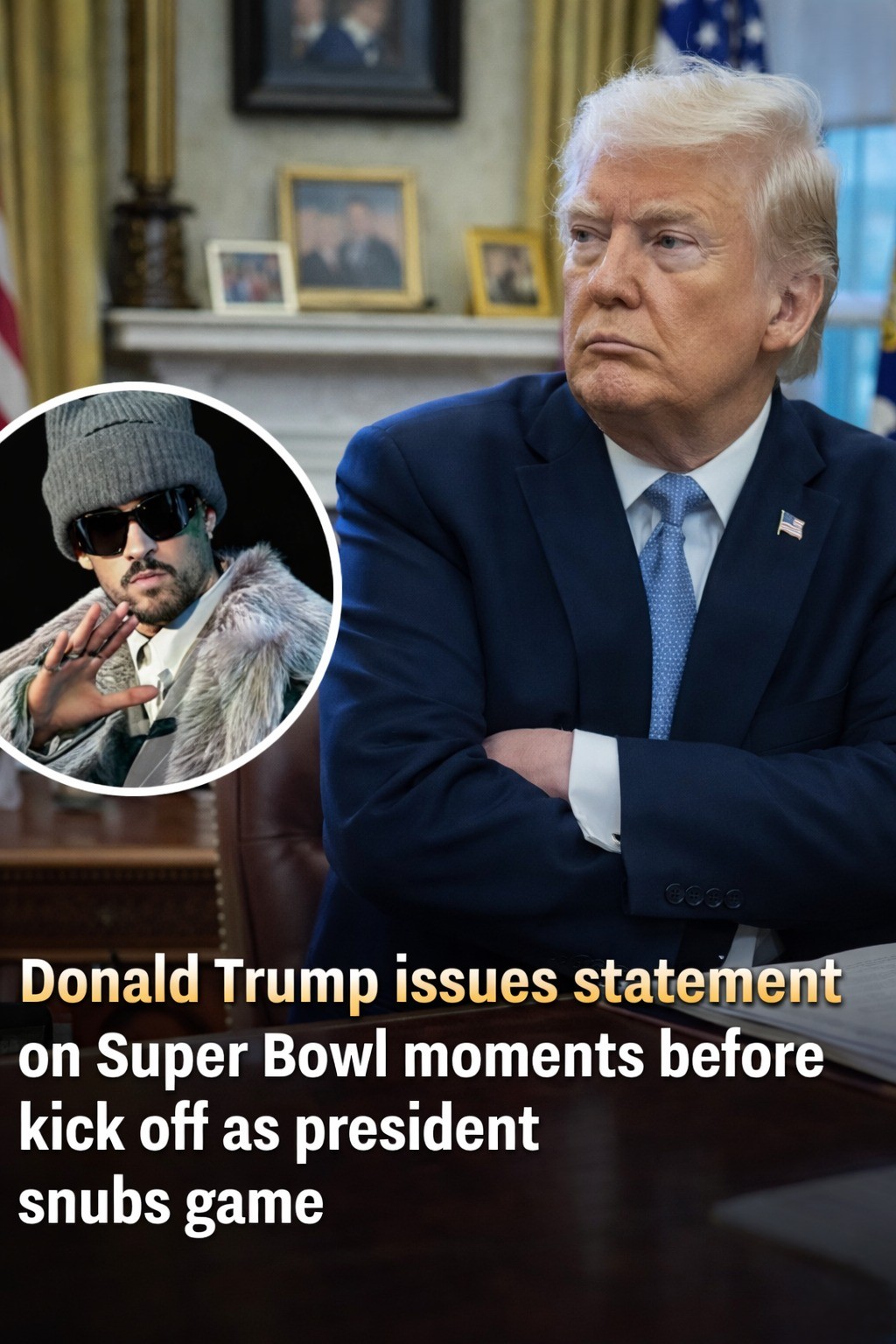
At Super Bowl LX on February 8, 2026, the true competition didn’t unfold on Levi’s Stadium turf—it played out across social media. Just moments before the Seattle Seahawks faced the New England Patriots, Donald Trump released a statement that, on the surface, appeared to celebrate a quintessentially American tradition. He praised the Super Bowl as a national institution, offered good wishes to both teams, and highlighted the unity and dedication shared by players and fans. But beneath this patriotic veneer lay a masterclass in attention—the subtle art of influencing the public through calculated presence and deliberate absence.
In today’s media landscape, physical attendance at a national event is no longer the mark of relevance. Leaders once used the Super Bowl to show their connection to the people, occupying prominent booths as symbols of belonging. Trump’s choice to skip California while dominating the conversation digitally signals a fundamental shift: influence is now measured not in proximity, but in the moments captured online. By staying away, yet flooding the digital space, he became simultaneously outside the ritual and central to its narrative—a symbolic presence without physically being there.
This “Presence of Absence” extended to his critiques of the halftime shows. As Bad Bunny prepared to take center stage and Kid Rock headlined a rival “All-American” show for Turning Point USA, Trump’s commentary framed cultural debate. The discussions surrounding his remarks revealed deeper tensions over language, representation, and national identity. Rather than policy or ideology, the focus shifted to culture, and journalists amplified social media outrage to shape moral judgment. In this environment, cultural differences become weapons, and audiences increasingly seek tribal loyalty signals in every post.
A prime example of this attention strategy was a teaser video Trump released hinting at his game-winner pick—only for the clip to cut off in suspense. To casual viewers, it may have seemed like a joke or glitch; in reality, it was a masterful use of uncertainty. Ambiguity becomes branding, suspense becomes messaging. Leaders now compete less on ideas and more on narrative control. By withholding the prediction, Trump ensured conversation remained fixated on him, turning politics into high-stakes entertainment—a society increasingly rewarding intrigue over substance.
This shift from substance to spectacle exposes a troubling reality about democracy today. Major events like the Super Bowl are no longer about the contest itself, but the online discourse it generates. Leadership is reframed as content; citizens analyze gestures, posts, and tones instead of values and policies. The result is a “distraction economy,” where meaning is drowned in noise. Even neutral reporting, aggregating reactions, leaves the public to navigate chaos without clear moral guidance.
Traditionally, national rituals served a unifying purpose: they affirmed collective identity. Leaders’ presence reinforced belonging. Rejecting the ritual for digital dominance fragments that cohesion. Populism thrives on authenticity over ceremony, yet without ritual, the public square becomes performative rather than responsible. The danger lies not in skillful performance, but in mistaking visibility for purpose. True leadership is measured not by trending topics, but by consistency, moral clarity, and service.
In truth, Trump’s online statements did not affect the game’s outcome. The Seahawks won, the Patriots lost, and history moved on. The digital frenzy is often ephemeral; urgency is illusory. Who posted, who remained silent, or who teased a video becomes a stand-in for real engagement with the nation’s challenges.
Super Bowl LX highlights a society addicted to signals. Every absence, every cliffhanger is read as political intent, and obsession with performance distracts from civic responsibility. Trump mastered this attention economy, knowing when to provoke and when to withhold—but the broader lesson falls on the audience. When politics is consumed as spectacle, society becomes vulnerable. The challenge ahead is reclaiming leadership defined by accountability and vision, not by the ability to dominate the digital stage. When the 2026 NFL championship ended, the online noise faded, leaving a stark truth: performances capture eyes, but only purpose builds a nation.